Oracle’s AI Buildout Faces Funding TestOracle’s AI Buildout Faces Funding TestCoverage from The New York Times, CNBC, and others
00/00/0000
DailyWeekly
Oracle is expanding data center capacity to serve growing AI cloud commitments, reporting a large contracted backlog and plans to bring substantial new computing capacity online.
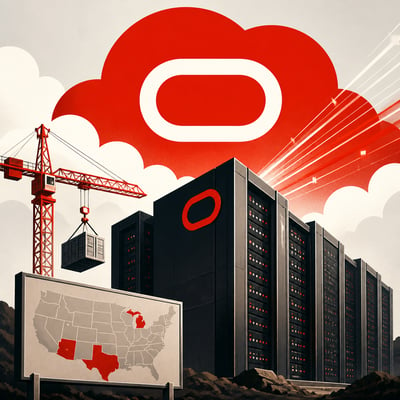
The expansion requires exceptionally high capital spending and further financing, while negative free cash flow and rising borrowing costs highlight the challenge of converting contracted demand into operating capacity and revenue. Construction of the Oracle-OpenAI Stargate campus in Michigan provides a concrete example of this buildout.
Oracle’s reported contract bookings and infrastructure-revenue growth provide a concrete view of demand outpacing available capacity.
AOL / Kara Greenberg
Key Issues
01
AI demand continues to exceed available capacity
Oracle says AI cloud demand is growing faster than supply, with new contracts and sharply higher infrastructure revenue. AWS reporting likewise describes constrained capacity and customer reservations, keeping pressure on providers to bring additional facilities and power online.
Stable
Drawn from 3 articles
02
Buildout is imposing heavy financing and cash-flow pressure
Oracle’s capacity expansion is consuming cash and requiring substantial new financing, while customer-supplied hardware and prepayments offset only part of the burden. Broader hyperscaler investment is also leaning more heavily on debt as capex weighs on free cash flow and credit metrics.
Stable
Drawn from 4 articles
03
Power, infrastructure and execution constrain delivery
Turning contracted demand into usable capacity depends on construction and timely access to power and grid infrastructure. Reported utility collateral requirements and supply, power and water risks could add cost or delay delivery.
Stable
Drawn from 3 articles
04
Backlog conversion and returns remain unproven
Oracle’s large contracted backlog provides demand visibility, but much of it is scheduled to convert beyond the next three years and does not guarantee free cash flow or attractive margins. The economics depend on bringing facilities online and serving contracts at returns sufficient to cover infrastructure costs.
Stable
Drawn from 3 articles
Key Numbers
$23.7 billion USD
negative free cash flow
after data-center spending · fiscal 2026
“Oracle generated a record $32 billion of operating cash flow in fiscal 2026 but spent more than that on data centers, producing negative free cash flow of $23.7 billion.”
Nasdaq and 1 other article
$32 billion USD
operating cash flow
record level · fiscal 2026
“Oracle generated a record $32 billion of operating cash flow in fiscal 2026 but spent more than that on data centers, producing negative free cash flow of $23.7 billion.”
Nasdaq and 1 other article
$43 billion USD
debt raised
fiscal 2026
“The company raised $43 billion in debt and $5 billion in equity during the year and expects to raise approximately $40 billion more in fiscal 2027, including through a previously announced $20 billion at-the-market stock program.”
Nasdaq and 1 other article
$5 billion USD
equity raised
fiscal 2026
“The company raised $43 billion in debt and $5 billion in equity during the year and expects to raise approximately $40 billion more in fiscal 2027, including through a previously announced $20 billion at-the-market stock program.”
Nasdaq and 1 other article
$638 billion USD
remaining performance obligations
contracted work not yet recognized as revenue · end of fiscal 2026
“Oracle ended fiscal 2026 with $638 billion of remaining performance obligations, representing contracted work customers have signed up for that has not yet become revenue.”
The Motley Fool and 1 other article
Looking Back
141 Day Timeline
Articles published over time. Hover any bar for the period and its article count.
May 11
Jun 4
Jun 25
Jul 19
Aug 12
Sep 2
Sep 26
The Story So Far
No material change
New reports add comparisons of other hyperscalers’ AI spending, demand, and cash flow, but do not materially change the picture of Oracle’s buildout or its financing test.
Previously
Oracle is expanding data center capacity for AI cloud services while reporting a record backlog of contracted work. That growth requires sharply higher capital spending: Oracle reported negative free cash flow and plans further funding, while customer prepayments and supplied hardware offset some costs. The central test is whether facilities can come online and turn booked commitments into revenue at a pace that supports the investment.
History
09/29/2026
The update quantifies Oracle’s fiscal 2026 investment burden and adds rising borrowing costs and widening credit spreads as a sharper financing risk. The Michigan construction example and broader capacity buildout were already established.
09/28/2026
Oracle’s backlog grew from $638 billion to $664 billion in its fiscal first-quarter update, while construction began on the Stargate campus. The campus has moved from plans into execution, though the pace of converting commitments into revenue remains uncertain.
Oracle and OpenAI advanced Project Stargate in 2025 through massive data-center construction across the United States and overseas, while debt, grid costs, and uncertain customer payments increased financial risk.
Alphabet, Amazon, Meta and Microsoft are increasing debt, leases and partnerships worldwide to finance AI data center expansion as projected 2027 capital expenditures exceed operating cash flow.
8/28/2026 • Project Finance & Incentives • General
In July 2026, Microsoft and Alphabet reported rapid cloud growth and large AI data center investment in their quarterly earnings disclosures, with cash generation and backlog conversion emerging as key differences.
On September 27, 2026, Oracle's data center expansion and financing exposure drew attention amid a New Mexico Project Jupiter payment delay and rising debt costs.
Oracle forecast fiscal 2027 revenue of $90 billion and planned nearly a gigawatt of new AI capacity in the current quarter after reporting record $638 billion contracted backlog.
Amazon expanded AWS global AI data-center plans in 2026 by committing to deploy two million additional Nvidia GPUs during 2027 and 2028, increasing capital demands.
Oracle reported a $638 billion AI infrastructure backlog in fiscal 2026, but heavy data-center spending and financing needs continue to pressure cash flow.
Oracle reported a $638 billion contracted backlog at the end of fiscal 2026 as AI data-center expansion drove negative free cash flow and new financing.
Oracle and OpenAI-backed leadership attended a Saline Township, Michigan groundbreaking in response to resident concerns about water use and traffic for a $16 billion data center campus.
Amazon and Microsoft expanded global AWS and Azure data-center capacity during the latest reported periods as AI customers awaited additional computing infrastructure worldwide.
Amazon Web Services reported accelerating second-quarter growth as cloud and AI inference demand exceeded data center capacity, with supply constraints expected through 2027.
Oracle shares declined as investors weighed cash flow risk from AI infrastructure capital spending tied to a multicloud hyperscale data-center footprint, with New Mexico permitting denial and energy-use protests increasing execution uncertainty.
Oracle warned in annual filings that AI data center investment and OCI capital plans could be undermined by construction delays, permitting issues, grid strain, and water limits.
Amazon expects to double AWS data-center and power capacity by the end of 2027, with most planned capacity already reserved by customers; specific locations were not identified.
Oracle is financing AI data-center construction during fiscal 2026 and 2027 through debt, equity, customer hardware, and project loans in Texas and Wisconsin.
Amazon raised its 2026 capital expenditure forecast to approximately $220 billion during its second-quarter earnings call as AWS faces AI capacity constraints through 2027.
Oracle disclosed large AI infrastructure spending plans and embedded 72 multicloud datacenters in hyperscaler facilities while facing BBB- credit-rating pressure and a New Mexico pipeline permit denial.
Emerald Wealth Partners forecasts continued hyperscaler demand for Oracle’s AI data center capacity after a sharp rise in Remaining Performance Obligation tied to AI training contracts.
Oracle reported fiscal fourth-quarter 2026 results and expects to fund AI data center buildout with additional borrowing as it targets nearly a gigawatt capacity ramp.
Mark Morgan at Kinaxis says AI data center scaling faces a decision-making bottleneck as North America requires 92 GW of additional power capacity over five years.
Oracle and OpenAI launched construction on the The Barn Stargate campus in Saline Township, Michigan, on June 1, 2026, planning three buildings and more than one gigawatt of capacity.
6/15/2026 • Infrastructure & Site Development • General
Oracle projected about $70 billion in net capital expenditure for AI data-center expansion and planned about $40 billion in new debt and equity after a major investor selloff.
6/11/2026 • Project Finance & Incentives • General
Oracle reported record AI-related cloud commitments in fiscal 2026 and outlined approximately $40 billion of fiscal 2027 financing for expanding data-center capacity.
8/19/2026 • Project Finance & Incentives • General
S&P Global downgraded Oracle debt on July 9 as bond-financed AI data center spending increased leverage and strained free cash flow for hyperscale investors.
7/17/2026 • Project Finance & Incentives • General
Amazon CEO Andy Jassy said Friday in investor commentary that Amazon plans approximately $200 billion of 2026 capital spending, mainly for AI data centers, servers, and networking equipment.
Amazon reported second-quarter AWS growth and a $496 billion backlog as constrained compute capacity drove plans for approximately $220 billion in 2026 capital spending.
Amazon said during its second-quarter earnings report that higher 2026 capital spending will accelerate AWS data-center capacity expansion while temporarily reducing free cash flow.
Amazon reported stronger second-quarter AWS growth and raised annual capital expenditure guidance to $220 billion across its global cloud and data-center operations.
Alphabet raised AI infrastructure capex guidance in response to faster cloud capacity delivery, but investors worried hyperscaler buildouts could weaken returns.
Bitdeer Technologies Group announced Q1 2026 results May 14 and described ongoing development and tenant negotiations for its Tydal AI data center in Norway.
Amazon, Alphabet, and Microsoft increased or maintained major 2026 infrastructure commitments in response to AI-driven cloud demand and supply constraints.
Oracle reported in its fiscal 2026 results that AI demand is driving global cloud infrastructure and datacenter expansion supported by customer-funded GPUs and new financing.
6/10/2026 • Project Finance & Incentives • General
Alphabet raised its 2026 capex forecast in July 2026 earnings, and investors shifted focus to Amazon, Microsoft, and Meta on cash, debt, and AI infrastructure spending returns.
Amazon said July 30 during its quarterly earnings call that approximately $220 billion in annual capital spending will support AI data-center expansion before servers are deployed.

 AI Governance
 Data Centers
 Drones
 Climate
 Privacy
 2026 Maine Senate
 Bob Dylan