
 AI Governance
 Data Centers
 Drones
 Climate
 Privacy
 2026 Maine Senate
 Bob Dylan
Marine Data Centers Test New Siting
Coverage from The Register, WebProNews, and others
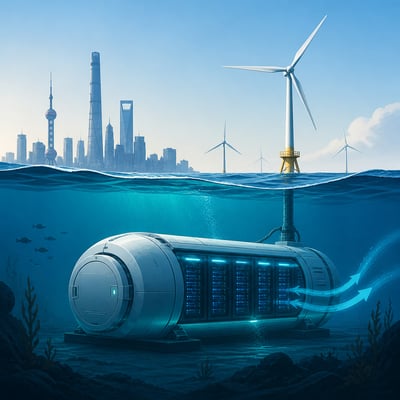
Developers in China and elsewhere are testing underwater and floating data centers as alternatives to land-based facilities constrained by electricity, water, land, and permitting requirements.
A Shanghai facility is reported to be operating at pilot scale with a planned capacity of 24 MW, while Samsung Heavy Industries and Mousterian are developing a 50 MW floating pilot near Houston and Samsung is targeting broader commercialization by 2028. The designs may reduce freshwater use and land requirements, but marine construction, power and fiber connections, corrosion, maintenance, environmental effects, storm resilience, and regulatory approvals remain unresolved.
The story now includes a substantially larger floating-data-center project near Houston and a concrete 2028 commercialization target, making the path beyond Shanghai more tangible. Texas grid-connection scrutiny also adds a specific regulatory constraint to the broader permitting concerns.
The story shifts from a largely experimental niche to one showing limited commercial deployment, led by the Shanghai underwater facility now described as operating commercially. It also broadens to include more marine-based designs, but the core uncertainties around servicing, cables, and scaling remain unresolved.
The story has shifted from a mostly China-led underwater-data-center buildout to a more explicit operational assessment: the Shanghai facility is now described as live, wind-powered, and commercially structured, but its broader scalability looks more constrained than before. The new version also adds sharper emphasis on unresolved subsea infrastructure, maintenance, and environmental hurdles, alongside clearer context that competing ocean-based approaches remain niche.
- Shanghai facility reported operational in 2026.
- Smaller pilot phase reported at about 2.3 megawatts.
- Nearby offshore wind farm connected by subsea cable.
- Panthalassa targeting commercial deployment from 2027.
- Microsoft Project Natick did not lead to commercialization.
The story has sharpened from a general China-led underwater/floating data center trend into a more specific commercial buildout centered on Shanghai’s 24 MW wind-powered underwater facility. It also now includes named ship-based floating concepts, but they remain secondary to China’s operational deployment.
- Shanghai Lingang site is a 24 MW project submerged about 10 meters offshore.
- Shanghai’s facility is tied to offshore wind power.
- Hainan now has an operating commercial underwater data center.
- Samsung Heavy Industries is developing ship-based floating data center concepts.
- AI-driven power demand is a central driver of the buildout.
The story has shifted from a broad focus on experimental ocean-based data centers to a more concrete commercial deployment picture in China, while U.S. efforts remain earlier-stage pilots. The new version also adds environmental and operational constraints as central unresolved issues, not just engineering tradeoffs.
The story has broadened from a single Shanghai underwater data center into a wider set of ocean-based compute experiments. A new U.S. floating, wave-powered approach has emerged, shifting the frame from one commercial deployment to an early-stage, multi-architecture race to solve land, power, and cooling constraints.
- Panthalassa is advancing a U.S. floating, wave-powered offshore model.
- Ocean-based compute now spans Shanghai, Washington state, Scotland, and Oregon references.
- The story now includes Microsoft Project Natick and SpaceX as related concepts.
- Current activity is driven mainly by new deployments, funding, and pilot planning.
The story has shifted from describing a commercial underwater data center near Shanghai to emphasizing that it has now moved through pilot and trial phases into commercial operation. The new version also adds more explicit institutional participation and frames the project more clearly as a phased buildout for AI infrastructure.
China has brought a commercial underwater data center near Shanghai into full operation, pairing subsea server modules with offshore wind power and seawater cooling. The project is being framed as a test case for reducing land use, cooling demand, and electricity intensity as AI-driven compute loads grow. It also raises unresolved questions about durability, maintenance, and marine environmental impact at commercial scale.