
 AI Governance
 Data Centers
 Drones
 Climate
 Privacy
 2026 Maine Senate
 Bob Dylan
Oakland AI Data Center Dispute
Coverage from The Oaklandside, KQED, and others
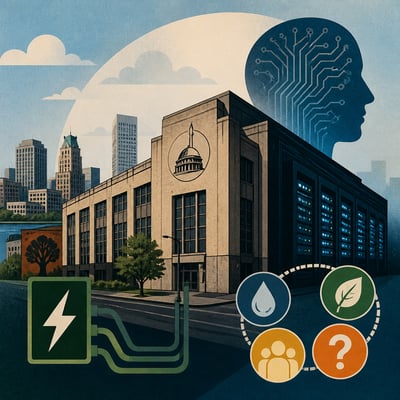
Oakland is evaluating Behring Companies' proposed AI data center in a former Berkeley Lab building as residents and officials contest its power, water, noise, land-use, employment, and transparency impacts.
A proposed moratorium could pause approvals while the city develops data center standards.
If you read one thing
It provides the clearest broad introduction to the proposal, its adaptive-reuse rationale, and the opposition it has generated.
Best explainer
It explains why the facility’s zoning, operating scope, power needs, and potential impacts remain unresolved.
The evidence
It documents how resident opposition has broadened into a conflict over resources, equity, disclosure, and governance.
Latest development
It captures the latest significant policy development: a proposed moratorium while Oakland considers data-center standards.
Regulatory approval is becoming an active policy test
Oakland has not resolved whether the proposed facility is an allowable use or completed its approval path. A proposed 45-day moratorium and possible standards for power, water, noise, safety, environmental review, and land use are shifting the issue toward formal citywide regulation.
Existing infrastructure is the project’s central feasibility advantage
The proposal is being presented as a relatively small urban AI facility that reuses a former Berkeley Lab supercomputing site, existing electrical infrastructure, and a specialized building. That distinguishes it from greenfield or hyperscale development, but does not resolve approvals or operating details.
Opposition has become a resource and governance conflict
Residents and organizers are contesting the proposal over electricity, water, cooling, noise, pollution, disclosure, displacement, employment, equity, and community benefits. The dispute now extends beyond the facility’s scale to questions about who controls Oakland’s infrastructure and development choices.
The facility’s actual operating scope remains unsettled
Reported capacity ranges from an active 4.5-megawatt allocation to possible expansion near 20 megawatts, while the tenant, final use, cooling and mechanical systems, water needs, and operating plan remain incomplete. This prevents a firm assessment of the project’s eventual infrastructure and environmental impacts.
The new material does not change the Oakland project’s status or the existing dispute over its infrastructure, environmental, and regulatory impacts; the newly added San Francisco moratorium coverage is a separate jurisdiction.
Previously
Behring Companies is proposing to convert part of a former Lawrence Berkeley National Laboratory supercomputing facility at 415 20th Street in downtown Oakland into an approximately 20,000-square-foot AI and data center facility. The site has existing electrical infrastructure, with reports describing an active 4.5-megawatt allocation and possible expansion to as much as 20 megawatts, which could reduce interconnection work and support the nearby 1900 Broadway innovation campus. The proposal remains early-stage and has drawn questions about zoning, continuous operations, electricity, water, noise, pollution, employment, and community benefits.
The story has shifted from an early-stage facility proposal to an active Oakland policy dispute, with Councilmember Carroll Fife proposing a 45-day moratorium while standards are developed. The project is increasingly framed as a test case for regulating AI infrastructure and environmental equity, not merely a redevelopment effort.
The proposal is now more concretely defined in size and operating concept, while remaining preliminary and lacking a selected tenant or finalized review path. New named political and community actors have sharpened scrutiny over zoning and operational impacts.