
 AI Governance
 Data Centers
 Drones
 Climate
 Privacy
 2026 Maine Senate
 Bob Dylan
AI Data Centers Face Power-Cooling Constraints
Coverage from Data Center Dynamics, Texas Instruments, and others
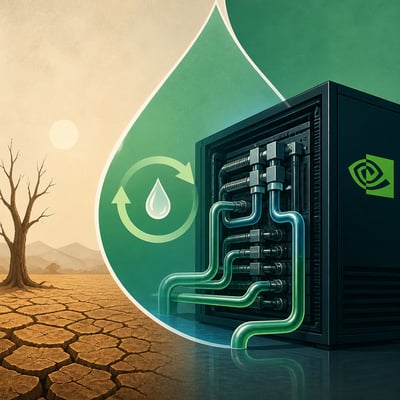
AI workloads are raising rack density and thermal variability, making liquid cooling, integrated power design, grid access, water accounting, and climate resilience the main infrastructure constraints.
The story shifts from primarily a cooling-and-water challenge to an integrated infrastructure constraint involving grid access, electrical design, climate resilience, and operational controls. It also adds evidence that digital twins, submeters, and automated systems are moving into active deployment for validation and resource accounting.
The story becomes more technically specific, quantifying rack-density thresholds and potential water savings while emphasizing monitoring, leak controls, and integrated electrical-cooling design. New companies and research institutions provide concrete engineering and climate examples, but no major regulatory or deployment milestone is added.
The story has broadened from cooling technology and water constraints to integrated data-center siting, encompassing grid access, permitting, community impacts, and climate-related operational risks. A proposed Utah project combining advanced nuclear power with water-efficient cooling adds a concrete but still early-stage alternative.
The story has become more specific and operational: it now centers on direct-to-chip, hybrid, and immersion cooling as the practical response to AI rack densities, while emphasizing tighter engineering constraints and infrastructure timing. It also adds clearer geographic and research detail, especially around drought-prone U.S. siting and climate limits on free cooling.
The story has broadened from a narrower focus on NVIDIA’s liquid-cooling water savings to a wider infrastructure question about how AI data centers can be built and powered at scale. Cooling is now framed alongside grid capacity, climate resilience, permitting, and local infrastructure constraints, not just onsite water use.
- AI rack densities are exceeding conventional air-cooling ranges.
- Utilities and regulators are linking cooling choice to permitting and infrastructure needs.
- Extreme weather is degrading free-cooling reliability.
- Reporting requirements and possible moratoria are being discussed in some jurisdictions.
- Advanced nuclear power is being proposed for AI facilities.
The story has narrowed from a broad industry shift in AI cooling to a specific NVIDIA-led push for higher-temperature, fully liquid-cooled systems that may cut onsite water use. The main new wrinkle is that the water question is now framed more explicitly as a total-footprint issue, because power generation can shift consumption upstream and facility-level data remain sparse.
The story has broadened from a general shift toward liquid cooling into a more specific policy-and-operations issue: water, wastewater, and permitting constraints are now central alongside heat and power. It also adds a sharper contrast between optimistic vendor claims of waterless designs and the continued dependence of existing facilities on conventional cooling.
- Wastewater discharge and permitting are now highlighted as active constraints.
- Planned U.S. projects are being discussed alongside drought and cooling-reporting rules.
- Vendor messaging now emphasizes waterless or near-zero-water designs.
- Existing facilities are still relying on older cooling systems.
- Wastewater handling is now part of the AI water-footprint discussion.
The story has broadened from cooling and water-efficiency design into climate-resilience and siting risk. New material ties AI data center planning to heat, flooding, insurance exposure, and utility curtailment, making location and weather stress a more central part of infrastructure strategy.
- Climate exposure is now tied to outage risk and insurance losses.
- PJM curtailment during heat stress is newly part of the story.
- Siting decisions now factor drought and weather hazards more directly.
- University and insurance actors are newly cited in the debate.
The story has broadened from Nvidia-led liquid cooling claims into a wider industry and infrastructure planning theme: higher rack densities are driving adoption of multiple liquid-cooling approaches, while vendors, engineers, and operators are now focused on whole-system thermal modeling and long-range power-cooling coordination. The emphasis has also shifted toward operational constraints such as permitting, discharge, reuse, and code compliance rather than just water savings claims.
- Higher rack densities are making air cooling less sufficient.
- Liquid cooling is becoming the dominant technical response.
- Engineering is shifting toward whole-loop and digital-twin thermal modeling.
- Planning now links power expansion with cooling uncertainty.
- Permitting constraints around reuse and discharge are more central.
Nvidia is promoting a new liquid-cooling architecture for AI infrastructure that it says could sharply reduce or nearly eliminate water use in next-generation data centers. The discussion has broadened beyond cooling systems to include drought-sited data centers, water use in chip fabrication and power generation, and emerging regulation around reporting and closed-loop cooling. The topic is coherent around AI infrastructure water demand, but there is still uncertainty about real-world costs, rollout speed, and how much of the broader water footprint cooling can actually remove.