
 AI Governance
 Data Centers
 Drones
 Climate
 Privacy
 2026 Maine Senate
 Bob Dylan
North Dakota’s Data Center Transparency Test
Coverage from KELOLAND, NDSU News, and others
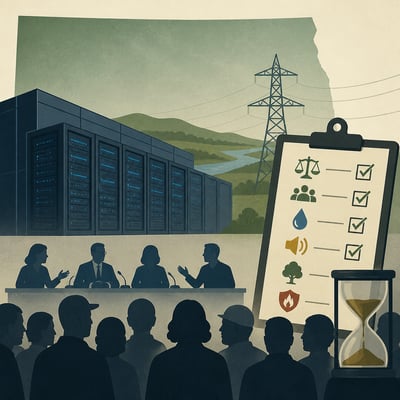
North Dakota is reassessing how data centers are proposed, approved, and connected to local infrastructure as communities respond to rapid project growth.
Lawmakers and counties are weighing disclosure requirements, public notification, moratoria, siting standards, and rules to ensure developers cover grid upgrades, while residents raise concerns about electricity bills, noise, water use, and limited information about projects. The debate could shape whether the state’s development incentives remain compatible with local oversight and utility capacity.
The disclosure debate moved from a pending proposal to a concrete legislative rejection: lawmakers voted down a government NDA ban, while leaving broader transparency rules open for future review. The story also clarifies that existing cost-causation rules already assign dedicated grid infrastructure costs to large-load customers.
The story now includes a concrete measure of project-related utility spending and more explicit state-level involvement, particularly the governor’s support for reviewing developer confidentiality agreements.
The story has broadened from a primarily North Dakota debate into a regional response to AI-driven hyperscale development, with South Dakota now involved and project outcomes becoming more consequential. Oversight is also moving toward concrete cost-allocation, water, cooling, siting, and disclosure requirements rather than remaining primarily deliberative.
- North Dakota tracks 26 facilities totaling 3,927 megawatts, with nearly three-quarters not operating.
- South Dakota enacted SB135 requiring large data centers to cover associated electric-service costs.
- Applied Digital withdrew a proposed South Dakota campus amid infrastructure and regulatory considerations.
- Closed-loop cooling and wastewater-return review are emerging as explicit permitting requirements.
- North Dakota requires large-load customers to fund dedicated grid infrastructure.
The story has shifted from mostly county-level moratoriums and local siting disputes to a broader state-level push for tighter oversight, with legislative scrutiny now centering on transparency and whether the public should bear infrastructure costs. The model ordinance also appears more institutionalized, reflecting a more coordinated local-government response.
The story has shifted from a broad debate over data-center scrutiny to a more concrete local-regulatory showdown, with new county moratoriums, model ordinance work, and high-profile project disputes driving the conversation. Disclosure and infrastructure-cost allocation now appear more central than before, alongside growing pressure on local governments to keep pace with development.
- Barnes County adopted a six-month moratorium.
- Morton County continues revising data center standards.
- Harwood negotiations were reportedly conducted under a nondisclosure agreement.
- Ellendale is now cited as a consultative siting example.
- Officials are weighing how developers should pay infrastructure costs.
The story has shifted from general local pushback and rulemaking into a more formal state-local policy process, with a new interim committee and clearer focus on infrastructure cost allocation and water impacts. Local jurisdictions are also moving from broad moratorium talk to specific siting standards and disclosure demands.
- Public interim committee formed to study data-center impacts before 2027 session.
- Morton County has used moratoria or revised standards on data-center siting.
- Mandan is weighing a half-mile residential setback for proposed facilities.
- Confidential negotiations are driving demands for public hearings and disclosure.
- Policy debate now emphasizes assigning dedicated infrastructure costs to new facilities.
North Dakota officials, local governments, and industry groups are developing new rules for evaluating large data center projects as AI-related electricity demand accelerates. The debate focuses on whether projects can secure power without shifting costs to residents, while addressing noise, water, environmental effects, emergency response, and community input. Moratoriums, legislative hearings, and a coalition-backed model ordinance show that local governments are seeking more time and authority before approving projects.