
 AI Governance
 Data Centers
 Drones
 Climate
 Privacy
 2026 Maine Senate
 Bob Dylan
Counties Draw Lines Around Data Centers
Coverage from CalMatters, WBFF, and others
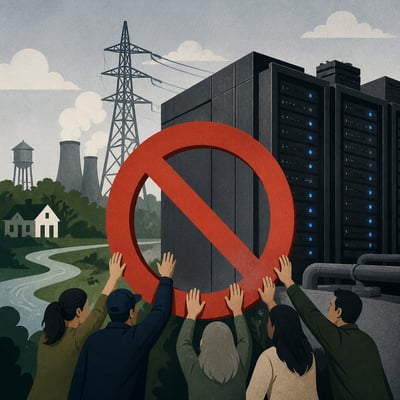
Maryland counties and cities are using moratoriums, zoning changes, conditional approvals, and proposed bans to slow or reshape data center development.
Officials are seeking more information on electricity capacity, utility costs, water withdrawals, noise, environmental effects, and community impacts before allowing large facilities to proceed. The direction is toward discretionary review, stronger siting limits, public input, and developer-funded mitigation, although several measures remain proposals and jurisdictions are taking different approaches.
The story is shifting from broad moratoriums and proposed bans toward more detailed, discretionary permitting frameworks, including industrial-zone limits, conditional approvals, and developer-funded mitigation. Prolonged reviews extending into 2027 are also increasing uncertainty over which projects can proceed.
Maryland’s response has progressed from temporary pauses and general concern toward concrete moratoria, permanent-ban proposals, zoning restrictions, and more specific public-health review requirements. The story also expands beyond Maryland through Imperial County’s moratorium, litigation, and proposed state safeguards over a hyperscale project.
The story has broadened from a handful of county-level restrictions into a wider Maryland siting slowdown involving Baltimore City, Prince George’s County, state impact analysis, and regional grid constraints. Developer withdrawal in Calvert County and extended pauses indicate that permitting risk is now affecting project viability, not just local rules.
- Prince George’s County adopted a two-year moratorium on hyperscale data centers.
- Baltimore City approved a one-year pause for facilities using at least 10 megawatts.
- A statewide impact report is due September 1, with some local pauses extending into 2027.
- Amazon Web Services withdrew from a proposed Calvert Cliffs project after local opposition.
- Quantum Frederick’s proposed campus covers 2,100 acres and 17.4 million square feet.
Frederick County has newly joined Maryland’s restrictive response by halting data center approvals amid the Quantum Frederick dispute, broadening the issue beyond the previously highlighted counties.
The story is mostly unchanged, but the latest version adds that Baltimore County’s approach is shifting toward conditional approvals and stricter utility/community requirements, while Johns Hopkins’ research center is more clearly framed as a smaller, supported exception to the broader commercial restrictions.
Harford County has now moved from considering restrictions to enacting the region’s first countywide data-center ban, while Baltimore and Montgomery counties are still advancing tighter moratoria and zoning limits. The story also gains a clearer split between large commercial facilities targeted by counties and a smaller Johns Hopkins research computing project that remains funded.
- Harford County enacted the first Maryland countywide data center ban.
- Baltimore County is considering extending its approval pause.
- Montgomery County advanced an 18-month moratorium and 25-megawatt zoning cap.
- Industry and opponents raised lost-investment and legal-risk concerns.
- Johns Hopkins won a $9 million state grant for a research computing center.
The story has broadened and intensified: Maryland has moved from mostly temporary pauses to a mix of outright bans, longer moratoria, and more detailed siting rules, while opposition is now shaping elections, litigation, and executive decisions outside the state. At the same time, the issue has expanded beyond North Carolina and Maryland to include Delaware and California.
- Harford County enacted Maryland’s first county-level data-center ban.
- Prince George’s County adopted a two-year hyperscale moratorium.
- Baltimore City approved a one-year pause on 10-megawatt-plus facilities.
- Imperial County reversed an approval and imposed a temporary moratorium.
- The story now includes Delaware and California.
The story is mostly unchanged, but the framing has broadened slightly from approvals and moratoriums to include operating requirements and the fact that several major projects are already approved or underway, which limits how far new local restrictions can reach.
The story has shifted from a general wave of local scrutiny into a more concrete set of county-level policy actions, with Prince George’s County’s moratorium and Harford County’s emergency ban proposal showing the regulatory response is deepening. The updated version also emphasizes that opposition is now affecting local politics and that larger named projects are sharpening infrastructure and neighborhood conflicts.
- Prince George’s County enacted a two-year moratorium.
- Harford County advanced an emergency ban proposal.
- Frederick County incumbents lost primary contests.
- Projects in Woodlawn, Landover, and near Calvert Cliffs are now highlighted.
- The debate now centers more on local rules and development cost allocation.
The story has broadened from a mostly Maryland-local backlash against data centers into a wider regional policy fight that now includes Charlotte, North Carolina, and more explicit debate over enforceable operating standards and community benefits. The emphasis has also shifted toward concrete governance tools—moratoriums, zoning limits, reporting rules, and election pressure—rather than just proposed bans.
- Charlotte is considering a 150-day moratorium on new data center applications.
- Several Maryland jurisdictions have enacted or pursued pauses and emergency bans.
- Data center opposition influenced primary elections in Frederick and Calvert counties.
- Residents are demanding public reporting of water and electricity use.
- Community benefits agreements are being discussed as enforceable project conditions.
The story now extends beyond Maryland’s county-level pushback to include Baltimore City, Imperial County, and a selective carve-out for a Johns Hopkins research facility. It also shifts from a general fight over restrictions to a more time-sensitive race to act before projects clear zoning or approvals.
- Baltimore City is considering a one-year moratorium on larger data centers.
- Imperial County faces moratorium and countywide ban efforts against a proposed campus.
- Johns Hopkins won approval and grant funding for a smaller Baltimore research facility.
- Harford County is weighing emergency action to speed a permanent ban.
- Local advocates say action is needed before zoning changes allow approvals.
Local governments are responding to rapid data center proposals with moratoriums, tighter zoning rules, and, in Harford County, an outright ban. The debate centers on power demand, water use, noise, environmental effects, and whether local rules can withstand state-law and legal challenges. Public hearings show broad resident mobilization, but there is still disagreement over whether to pause, regulate, or prohibit development.