
 AI Governance
 Data Centers
 Drones
 Climate
 Privacy
 2026 Maine Senate
 Bob Dylan
Iowa Data Centers Test Power Choices
Coverage from KCRG, Iowa Public Radio, and others
Going On
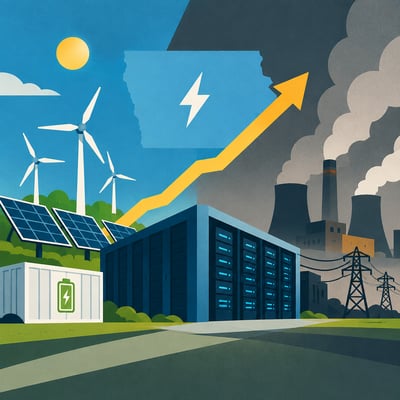
Researchers say data centers account for most of Iowa’s projected electricity-demand growth.
A few articles that between them cover the whole topic, picked by the role each one plays.
If you read one thing
Iowa Data Centers Drive Debate Over Future Power GenerationIt provides the broadest overview of Iowa’s data-center-driven load growth and the resulting renewable-versus-fossil generation choice.
Best explainer
Iowa Data Center Growth Raises Electric Bill ConcernsIt adds a concrete explanation of how grid expansion and large-load cost allocation could affect household electric bills.
The forces this coverage keeps returning to, and which way each has moved.
Data centers are driving major load growth
Iowa's planned data-center expansion is emerging as the main source of projected electricity-demand growth, with peak load potentially increasing by more than 30% over the next decade. The scale of proposed development is creating substantial requirements for new generation and grid capacity.
New demand is forcing a generation-pathway choice
Iowa's response to data-center demand is centered on whether utilities and policymakers rely on wind, solar, storage, and brownfield projects or add fossil-fuel capacity. That choice will shape future emissions, public-health impacts, reliability, and the timing and cost of data-center expansion.
Cost allocation is a central regulatory risk
Meeting large new loads will require grid and generation investment, but the allocation of those costs remains consequential for households. Residents and experts are concerned that billing rules could shift infrastructure expenses from data-center developers to residential customers.
No new member articles were supplied, so there is no evidence of a material change in Iowa’s data center-driven electricity demand and power-supply debate.
Previously
Iowa’s data center growth is emerging as a major driver of projected electricity-demand increases, with researchers warning that peak load could rise by more than 30% over the next decade. The central debate is whether utilities and developers should meet that demand with wind, solar, storage, and brownfield projects or with new natural-gas and coal generation. The outcome could affect grid expansion, household electricity bills, public health, emissions, and the timeline and cost of new facilities.
Every article behind this topic, ranked by CI Score.