Illinois Puts Data Center Incentives on…Illinois Puts Data Center Incentives on HoldCoverage from Block Club Chicago, Inside Climate News, and others
00/00/0000
DailyWeekly
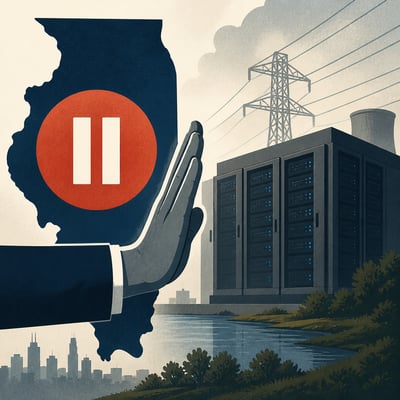
Illinois has paused new state tax incentives for data centers while lawmakers and stakeholders debate rules governing energy supply, water use, and benefits for host communities.
The POWER Act did not pass during the spring session, and negotiations continue amid concerns about rising electricity demand and local impacts. The eventual framework could affect project costs and timelines as well as what developers must provide or report to qualify for state support.
Its estimates of jobs, property-tax revenue, and electricity use provide a distinct account of the potential economic benefits and tradeoffs.
Illinois Economic Policy Institute
Key Issues
01
Statewide rules remain unsettled as incentives are paused
Illinois has paused new data-center incentive agreements, but the POWER Act did not pass and no replacement statewide framework is in place. Negotiations and proposals continue around energy responsibility, water reporting, renewable power, and community requirements.
Stable
Drawn from 4 articles
02
Local oversight is becoming more concrete
Chicago and other Illinois municipalities are advancing project review, reporting, zoning, and environmental controls while state rules remain unsettled. Chicago has adopted an energy-benchmarking change, while broader moratorium and land-use proposals remain unresolved.
Stable
Drawn from 3 articles
03
Grid demand and cost allocation are central constraints
Large proposed loads and forecasts of substantial added data-center demand heighten concerns about grid capacity and electricity costs. The policy question is who pays for new power and infrastructure, and how ratepayers are protected.
Stable
Drawn from 4 articles
04
Projected economic gains remain a counterweight to tighter rules
Studies project substantial investment, jobs, and property-tax revenue from Illinois data centers, giving localities a reason to weigh benefits against impacts. The projected employment totals include many temporary and indirect roles, with fewer permanent facility jobs.
Stable
Drawn from 3 articles
Key Numbers
1,000 square feet
minimum facility size covered by the proposed moratorium
data centers larger than this size
“The moratorium introduced Wednesday would apply to data centers larger than 1,000 square feet, with more than 20% of their floor space dedicated to servers.”
WTTW News
20%
share of floor space dedicated to servers
more than this share
“The moratorium introduced Wednesday would apply to data centers larger than 1,000 square feet, with more than 20% of their floor space dedicated to servers.”
WTTW News
7% percent
data centers' share of Illinois electricity demand
statewide
“Data centers account for 7% of the state’s electricity demand.”
Illinois Economic Policy Institute
3,000 positions per year
permanent jobs once facilities are operational
per year
“They estimate the buildout will create 39,000 skilled construction jobs, 3,000 permanent positions per year once facilities are operational, and more than 41,000 induced jobs in supply chains and local businesses. At least a third of new employment opportunities connected to the facilities are expected to pay six-figure incomes.”
Illinois Economic Policy Institute
39,000 jobs
skilled construction jobs from the buildout
“They estimate the buildout will create 39,000 skilled construction jobs, 3,000 permanent positions per year once facilities are operational, and more than 41,000 induced jobs in supply chains and local businesses. At least a third of new employment opportunities connected to the facilities are expected to pay six-figure incomes.”
Illinois Economic Policy Institute
Looking Back
146 Day Timeline
Articles published over time. Hover any bar for the period and its article count.
May 9
Jun 2
Jun 26
Jul 20
Aug 13
Sep 6
Sep 30
The Story So Far
No material change
There was no material change: the new article reiterates the existing tradeoff between data-center investment and jobs, limited permanent employment, and electricity costs.
Previously
Illinois has paused new state tax incentives for data centers while lawmakers and stakeholders debate rules governing energy supply, water use, and benefits for host communities. The POWER Act did not pass during the spring session, and negotiations continue amid concerns about rising electricity demand and local impacts. The eventual framework could affect project costs and timelines as well as what developers must provide or report to qualify for state support.
History
10/02/2026
The update mainly clarifies that the incentive pause took effect July 1, 2026; the legislative deadlock and ongoing negotiations were already established.
Chicago officials, utilities and developers are managing rapid 2025 data-center expansion amid projected power, water, infrastructure and neighborhood impacts across Chicago and surrounding Cook County.
Chicago City Council staff recommended in 2026 that Chicago adopt dedicated data center permits and zoning reviews to address environmental, water, energy, and neighborhood impacts.
Chicago Mayor Brandon Johnson ordered a city task force in Chicago to develop stricter data center regulations and urged a temporary moratorium on new and expanded facilities.
Chicago Mayor Brandon Johnson ordered a pause on new data center construction Tuesday as city officials develop stronger environmental and permitting rules in Chicago.
Chicago Mayor Brandon Johnson signed a 2026 executive order creating data center safeguards and proposed a moratorium on new facilities and major expansions in Chicago, Illinois.
Chicago Mayor Brandon Johnson signed an executive order Tuesday creating a data center task force and urged a temporary moratorium as Chicago develops permanent regulations.
Chicago alderpeople voted last Wednesday to remove data centers' exemption from the Energy Benchmarking Ordinance, increasing energy and water-use disclosure requirements in Chicago.
Missouri, Iowa, and Illinois policymakers address data center siting and incentives, as Illinois halts tax incentives and the Illinois POWER Act fails to advance.
Illinois lawmakers began summer negotiations on POWER Act-style data center rules after Gov. JB Pritzker paused tax benefits and House Bill 5513 advanced in committee.
Champaign County Board in Illinois approved a one-year moratorium on large-scale data centers after residents raised water, energy, and noise concerns and requested zoning reforms.
Illinois lawmakers said the POWER Act for data center water, community benefits, and renewable-energy rules will not pass this spring, and tax-credit pause talks continue into summer.
Environmental advocates in Illinois seek passage of the POWER Act before session end, proposing mandatory data-center water and energy disclosure, community benefits agreements, and public environmental assessments.
Aurora, Illinois adopted new data center moratorium follow-on rules in 2024-2025, joining other Illinois counties citing noise, water, and utility-cost concerns.
6/29/2026 • Permitting & Regulation • General
Greenberg Traurig / Shawn K. Ronda; Joshua B. Forman; Kostas Poulakidas; Nicholas (Nick) P. Hyde67
Chicago Mayor Brandon Johnson signed Executive Order No. 2026-5 on August 11, 2026, directing city departments to strengthen data center oversight and urging the City Council to consider a temporary moratorium.
Chicago Mayor Brandon Johnson signed an executive order Tuesday creating a data-center task force and advancing a temporary moratorium proposal in Chicago.
Illinois lawmakers and local officials debate new data center obligations as the Illinois POWER Act and Aurora ordinances respond to AI-driven demand and noise and water concerns.
5/11/2026 • Community & Local Opposition • General
Environmental advocates in Illinois pressed lawmakers in May to advance the POWER Act, which would require data-center water-use reporting, public benefits agreements, and renewable power generation.
Illinois mayors and the Illinois General Assembly weigh the POWER Act and local ordinances as AI data-center growth raises grid, noise, and water concerns.
5/11/2026 • Community & Local Opposition • General
Illinois lawmakers consider the proposed POWER Act and related local ordinances for data centers amid AI-driven demand, grid strain, and noise and water concerns.
Chicago Mayor Brandon Johnson signed an executive order Tuesday at Northerly Island establishing data-center safeguards as officials confront rising power, water, and land-use concerns.
Chicago Mayor Brandon Johnson signed data center safeguards and requested a temporary construction moratorium Tuesday in Chicago while stronger regulations are developed.
Illinois town halls in Pekin, Joliet, and Chicago's southeast side fueled bipartisan legislation in response to proposed hyperscale data center risks to air quality, water quality, and energy bills.
Illinois Senator Darby Hills introduced Senate Bill 1050 to impose a temporary moratorium and expand local siting hearings and water and noise protections for data centers.
Detroit City Councilmember Scott Benson says Detroit is pausing data center approvals to build a zoning framework while Michigan legislators consider broader moratoriums.
Hoffman Estates Plan Commission voted 4-2 against rezoning for a proposed data center near Higgins Road and Route 59 after residents opposed the change.
Illinois lawmakers consider POWER Act HB5513 and SB4016, which would add water reporting and grid and renewable oversight for hyperscale data centers as of May 2026.
Illinois lawmakers in 2026 consider data center regulations focused on water use standards and utility bill impacts, drawing opposition over permitting difficulty.
Karis Critical seeks Hoffman Estates zoning change for a 186-acre data center on Plum Farms, after Illinois tax-incentive halts and pending state siting proposals.
6/12/2026 • Community & Local Opposition • General
Missouri local officials and residents pushed bans and restrictions on CRG data centers amid concerns about water use, power costs, and land-use impacts.
6/11/2026 • Community & Local Opposition • General
The Illinois Economic Policy Institute and the University of Illinois Project for Middle Class Renewal estimate that Illinois data center investment over the next decade could create more than 120,000 jobs and nearly $300 million in annual property taxes.
Illinois Gov. JB Pritzker announced July 1 changes to data center tax incentives and environmental reporting requirements amid concerns about energy bills and water use.
Illinois Governor JB Pritzker paused data center tax incentives in June as Rep. Ann Williams and lawmakers planned summer negotiations on POWER Act regulations.
JB Pritzker announced July 1 pause of Illinois data-center tax incentives, citing power infrastructure strain and water-resource impacts tied to AI demand.
Illinois Governor JB Pritzker ordered a July 1 pause on new state tax incentives for data centers after POWER Act talks and grid plus water affordability concerns.
Illinois Gov. J.B. Pritzker announced a July 1 pause of data-center tax incentive applications, adding public notice and energy-water reporting as costs rise.
JB Pritzker ordered DCEO to pause Illinois Data Center Investment Program agreement processing starting July 1 while proposing electricity rate, water permitting, and community impact requirements.
JB Pritzker ordered Illinois to pause Data Center Investment Program tax incentive processing starting July 1 while an energy and water impact framework is negotiated.
Illinois Governor J.B. Pritzker ordered a July 1 pause of new data center tax incentives, citing energy affordability and water constraints after the POWER Act failed.
Illinois lawmakers extended POWER Act talks after missing the May 31 deadline, with proposals on water-use reporting, community benefits agreements, and renewable energy self-generation.
Sangamon County approved a 280-acre CyrusOne data center as Illinois lawmakers debated the POWER Act on April 22, amid water, aquifer, and drought concerns.
Illinois advocates and energy policy specialists are supporting the proposed POWER Act to address undisclosed data-center utility arrangements and ratepayer risks in Rock Island County before lawmakers revisit the measure this fall.
8/19/2026 • Community & Local Opposition • General
In Joliet and Yorkville, local officials and residents debated large data center projects in spring 2026 over water use, energy demand, and tax-revenue impacts.
5/30/2026 • Community & Local Opposition • General
Chicago established a Sustainable Data Centers Working Group in 2024, which produced recommendations submitted to the City Council Committee on Environmental Protection and Energy in July 2026.
Michigan policy analysis recommends case-by-case data center permitting, citing noise pollution mitigation as the key local action while power and water capacity appear adequate.
Illinois lawmakers failed to pass the POWER Act in Springfield, leaving data-center transparency and tax-incentive pause plans unresolved amid power and environmental concerns.
6/4/2026 • Policy & Utility Planning • General
Illinois Environmental Council / John Lippert and Jeremy Gorner45
Illinois labor and environmental stakeholders are shaping data-center rules on cooling, power, tax incentives, and local restrictions before the state legislature returns November 17 in Springfield.
Robyn Gabel and Ram Villivalam pursued continued negotiations over the Illinois POWER Act after a May 31 deadline, delaying statewide rules on water, community benefits, and renewable energy for data centers.
5/31/2026 • Policy & Utility Planning • General
Additional19 articles · CI Score below 45
Capitol News Illinois / Maggie Dougherty and Ben Szalinski45
The Illinois Economic Policy Institute and University of Illinois Project for Middle Class Renewal estimate that Illinois data center investment through 2035 could reach $57 billion, while urging standards on incentives, power, and water.
10/1/2026 • Policy & Utility Planning • General
Capitol City Now / Maggie Dougherty and Ben Szalinski44
Illinois gubernatorial candidates JB Pritzker and Darren Bailey are debating data-center incentives and regulations as officials consider stricter energy and water requirements statewide before the 2026 election.
8/18/2026 • Policy & Utility Planning • General
WCBU Peoria Public Radio / Maggie Dougherty and Ben Szalinski44
Illinois gubernatorial candidates JB Pritzker and Darren Bailey are disputing data center incentives and safeguards in Illinois during the 2026 election campaign.
Mason and Allen Park planning decisions in Michigan unfold alongside proposed statewide moratorium bills and a Google water-resource grant for upcoming data-center development.
Illinois Gov. J.B. Pritzker said this year that withdrawn data-center incentives and proposed power and water standards should address concerns raised by Illinois farmers about expanding AI facilities.
Illinois Gov. JB Pritzker seeks statewide rules limiting data center expansion as Elk Grove Village reports operating and under-construction facilities using closed-loop cooling.
Illinois lawmakers proposed the POWER Act in spring 2020s legislation to regulate large data centers, adding BYONCE clean energy capacity and water monitoring requirements.
Champaign County, Illinois approved a one-year moratorium on large-scale data center development as similar bans spread to counties in Texas, Wisconsin, and Michigan, amid rising water and energy concerns.
Illinois Governor JB Pritzker halted new data center tax incentive agreements in 2026, affecting new applications processed under the Data Center Investment Program.
Illinois Governor J.B. Pritzker paused new data center tax incentive agreements while pursuing legislation on utility cost allocation and a ban on data center local government non disclosure agreements.
Illinois legislators and the Illinois Clean Jobs Coalition continued negotiations on the POWER Act after the May 31 General Assembly deadline, delaying proposed water, community, and renewable energy guardrails for data centers.
Illinois Environmental Council supporters rallied at the Illinois State Capitol in May to press legislators for passage of the POWER Act, SB4016 and HB5513.
Craig Johnson and Jen Walling addressed data-center impacts in Elk Grove Village as Illinois lawmakers advanced the Power Act requiring water reporting, Illinois EPA permits, and renewable plus battery-backed power sourcing.
Residents and utility advocates discuss Chicago data center regulation at a Department of Environment community forum ahead of June 30 policy recommendations.
The Illinois Economic Policy Institute projected that data center investment through 2035 could create 121,000 jobs while increasing electricity demand and costs across Illinois.
JB Pritzker will pause Illinois Department of Commerce and Economic Opportunity data-center tax incentive application processing starting July 1 and pursue a fall veto-session development framework.

 AI Governance
 Data Centers
 Drones
 Climate
 Privacy
 2026 Maine Senate
 Bob Dylan