
 AI Governance
 Data Centers
 Drones
 Climate
 Privacy
 2026 Maine Senate
 Bob Dylan
House Vote Shifts Data Center Power Costs
Coverage from AOL and others
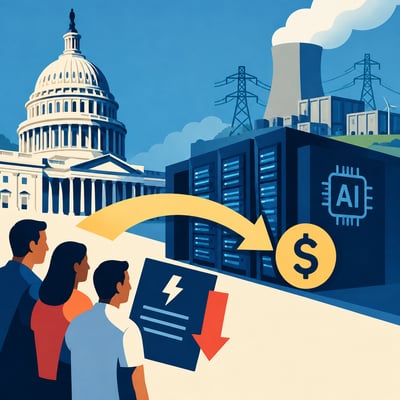
The U.
S. House passed the Ratepayer Protection Act by a 417-3 vote, advancing a framework that would shift generation, transmission, and related infrastructure costs from ratepayers to large data center operators, particularly AI facilities using at least 100 megawatts. The bill still requires Senate action, presidential approval, and potentially state adoption and regulatory implementation. The proposal has increased attention on dedicated nuclear, modular, and other power sources while producing mixed short-term reactions in related stocks.
If you read one thing
It provides the broadest overview of the House bill, its implications for data-center power costs, and the uncertain timeline for dedicated generation.
The evidence
It clearly documents the 417–3 House vote and explains how the proposal could shift grid and power costs toward large data centers.
Best explainer
It adds the market-response angle, showing how nuclear and other dedicated-power stocks reacted to the policy’s potential demand effects.
12 GW
master power agreement capacity with Switch
“Its signed pipeline includes a 12 GW master power agreement with Switch and a 500 MW letter of intent with Equinix that included a $25 million prepayment.”
$25 million USD
Equinix prepayment
“Its signed pipeline includes a 12 GW master power agreement with Switch and a 500 MW letter of intent with Equinix that included a $25 million prepayment.”
500 MW
letter-of-intent capacity with Equinix
“Its signed pipeline includes a 12 GW master power agreement with Switch and a 500 MW letter of intent with Equinix that included a $25 million prepayment.”
100 megawatts or more
Data center electricity demand threshold
“The legislation would establish a regulatory framework that states could choose to adopt. It would require large data center operators, particularly AI data centers with demand of 100 megawatts or more, to cover the costs of new power sources, transmission lines, and other infrastructure needed to serve them. The goal is to prevent those costs from being spread across the broader ratepayer base.”
417 to 3 votes
U.S. House vote on the bill
“The U.S. House of Representatives voted 417 to 3 on Sept. 16 to pass the Ratepayer Protection Act. The bill still needs to pass the Senate and be signed by the president.”
No new member articles were supplied, so there is no evidence of a material change in the topic since the prior state.
Previously
The U.S. House passed the Ratepayer Protection Act by a 417-3 vote, advancing a framework that would shift generation, transmission, and related infrastructure costs from ratepayers to large data center operators, particularly AI facilities using at least 100 megawatts. The bill still requires Senate action, presidential approval, and potentially state adoption and regulatory implementation. The proposal has increased attention on dedicated nuclear, modular, and other power sources while producing mixed short-term reactions in related stocks.