
 AI Governance
 Data Centers
 Drones
 Climate
 Privacy
 2026 Maine Senate
 Bob Dylan
Data Center Moratoriums Reshape Local Siting
Coverage from Live 5 News, Post and Courier, and others
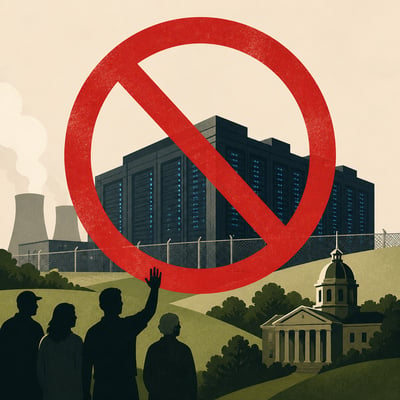
County governments across Georgia and South Carolina are using temporary moratoriums, zoning amendments, and impact studies to slow or condition data-center expansion.
Officials and residents repeatedly focus on electricity demand, grid and utility costs, potable water, cooling, noise, land conversion, and backup generation. Some jurisdictions are considering outright bans, while others are drafting industrial siting limits, buffers, performance standards, and cost-sharing rules. Large proposed campuses are driving the most contested decisions.
If you read one thing
15 South Carolina Counties Consider Data Center MoratoriumsIt provides the clearest statewide overview of the moratorium wave and the fragmented local response to a policy gap.
Latest development
Colleton County Approves Data Center Overlay Despite Resident PushbackIt captures the latest shift from a moratorium toward detailed conditional siting rules while addressing infrastructure concerns.
The counter-case
Beaufort County Weighs Data Center Moratorium or BanIt represents the prohibition-or-freeze side of the central dispute and shows why Beaufort officials are considering a ban or strict rules.
The evidence
DeKalb County Weighs New Data Center Zoning RulesIt supplies concrete examples of proposed campus limits, residential buffers, and infrastructure safeguards.
Moratoriums remain a primary approval mechanism
Moratoriums and approval freezes remain the dominant local response as counties pause projects to assess impacts, consider bans, or draft replacement rules. At least 15 South Carolina counties have proposed or enacted temporary moratoriums, up from at least nine earlier in the summer.
Local policy is shifting toward detailed siting controls
Jurisdictions are increasingly moving from temporary pauses toward selective authorization frameworks with overlay districts, special permits, campus-size limits, residential buffers, noise caps, setbacks, and cooling requirements. Colleton has approved an overlay with operating standards, while DeKalb and Bulloch are advancing comparable restrictions.
Utility capacity is a binding approval constraint
Electricity demand, water availability, cooling, sewer capacity, reliability, and rate impacts remain central constraints on approval. Utility officials and local leaders warn that large facilities could limit municipal growth or shift infrastructure costs onto utilities and ratepayers.
A statewide policy gap is producing fragmented local regulation
With statewide data-center legislation stalled in South Carolina, counties and municipalities are independently setting moratoriums, bans, overlays, and operating standards. The resulting county-by-county framework differs on siting, utility impacts, and whether development should be allowed at all.
120-day days
proposed moratorium duration on data center development
“The planning committee voted to advance a 120-day moratorium on data center development while potential environmental impacts are studied.”
15 counties
counties proposing or having passed temporary data center moratoriums
“At least 15 counties have proposed or passed temporary data center moratoriums, according to an analysis of media reports, council agendas and ordinances. That is an increase from earlier this summer, when The State reported that at least nine counties were considering a moratorium. Mount Pleasant, a municipality in Charleston County, has also begun considering a data center moratorium, making it one of the first towns in South Carolina to do so.”
nine counties
counties considering a moratorium
“At least 15 counties have proposed or passed temporary data center moratoriums, according to an analysis of media reports, council agendas and ordinances. That is an increase from earlier this summer, when The State reported that at least nine counties were considering a moratorium. Mount Pleasant, a municipality in Charleston County, has also begun considering a data center moratorium, making it one of the first towns in South Carolina to do so.”
12-month months
duration of Fairfield County's moratorium
“Fairfield County initially approved a 12-month moratorium in August. During the pause, county officials plan to research data centers through town halls, work sessions with experts and visits to existing facilities.”
2.4 billion gallons
Mount Pleasant Waterworks annual water allotment after reduction
“Nonetheless, after Google began tapping the aquifer, the town utility's annual water allotment was reduced in 2017 from 3.9 billion gallons to 2.4 billion gallons.”
Contested Issue
Should local governments prohibit or indefinitely pause data-center development, or allow it under strict zoning and operating conditions?
The corpus documents materially different local policy approaches. Some jurisdictions are considering bans or extended moratoriums because of anticipated effects on water, electricity, land use, and community infrastructure, while others are moving toward conditional approval frameworks that permit data centers in designated areas subject to enforceable siting, noise, cooling, setback, acreage, and water-use requirements.
Prohibition or extended freeze
Data centers should be banned or blocked through extended moratoriums until their potential effects on water, power, land use, and community infrastructure are resolved.
Conditional regulated approval
Data centers should remain permissible in designated areas if projects meet enforceable standards for noise, setbacks, cooling systems, water use, scale, and infrastructure impacts.
Colleton County replaces part of its moratorium with conditional data-center zoning
Colleton County has moved beyond a temporary pause in parts of its jurisdiction by approving an overlay district that permits data centers in designated areas under strict noise, setback, cooling, and acreage requirements.
Previously
Local governments are pausing or tightening data-center approvals, especially in Georgia and South Carolina, while officials develop zoning and infrastructure safeguards. Reviews repeatedly address electricity and water demand, utility costs, noise, emissions, land conversion, and public infrastructure, with large projects and organized opposition producing a fragmented local response.
The story now centers more sharply on large South Carolina hyperscale proposals, including one potentially expanding to 450 MW. New reporting also highlights the absence of statewide standards, leaving counties and newly involved state and regional agencies to manage impacts inconsistently.
The story now includes a concrete $1 billion Michigan hyperscale proposal facing a rezoning referendum and organized opposition, while Georgia counties are moving from temporary pauses toward decisions between regulated development and outright bans.