
 AI Governance
 Data Centers
 Drones
 Climate
 Privacy
 2026 Maine Senate
 Bob Dylan
Data Center Water Reuse And Cooling
Coverage from RSP Engineers, The Salata Institute, and others
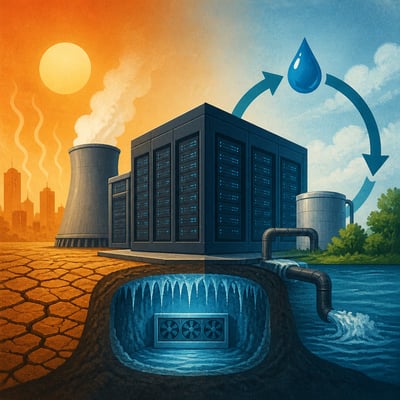
Data center expansion is making cooling water, wastewater reuse, and utility capacity central to U.
S. infrastructure planning. Operators and utilities are testing reclaimed-water networks, closed-loop systems, dry cooling, and thermal storage, while fragmented permits, indirect power-sector water use, infrastructure costs, and local approval remain unresolved.
The story has shifted from evaluating cooling technologies to emphasizing data center growth as a system-level planning challenge for municipal water, wastewater, and utility capacity. New Columbus usage data and Chicago-area reuse proposals sharpen the scale of infrastructure needs and local approval constraints.
The story now places greater emphasis on wastewater reuse as the leading cooling response, with a more concrete Columbus proposal and EPA guidance shaping how projects may proceed. It also adds a clearer set of operational, environmental, and public-health constraints around reuse.
The story has shifted from a broad discussion of cooling tradeoffs to a more concrete infrastructure and governance issue, with utilities and regulators now actively planning for data center water and wastewater needs. Columbus’s disclosed water use and the move toward reclaimed-water partnerships make the capacity and permitting implications much more immediate.
- Utilities in Ohio, Illinois, and the Great Lakes are planning treatment capacity and disclosure rules.
- Columbus disclosed approximately 1.26 billion gallons of annual data center water use.
- Columbus is evaluating recycled-water service for nearby facilities.
- Lifecycle studies show electricity generation can account for most data center water impact.
- Thermal storage and waste-heat recovery are still largely modeled or early-stage.
Data center operators, utilities, and researchers are evaluating cooling systems that can reduce freshwater withdrawals and maintain performance as heat and humidity rise. Treated wastewater reuse, closed-loop and dry cooling, improved airflow management, and underground cold storage offer potential benefits, but each introduces tradeoffs involving electricity demand, water quality, public health, permitting, cost, or site conditions. The direction of travel is toward more location-specific cooling designs and closer coordination between developers, utilities, regulators, and communities.