
 AI Governance
 Data Centers
 Drones
 Climate
 Privacy
 2026 Maine Senate
 Bob Dylan
AWS Cooling Failure Outage
Coverage from CNBC, CRN, and others
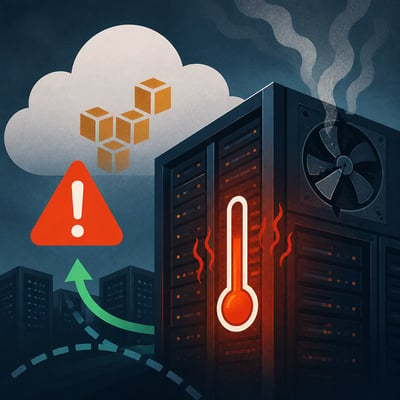
AWS experienced a Northern Virginia outage tied to overheating and cooling failure in us-east-1, briefly impairing EC2 and related services in one Availability Zone while recovery work brought more cooling capacity online.
The update mainly tightens the framing of the AWS incident: it remains a localized Northern Virginia outage, but the current version more explicitly ties the disruption to cooling-system failure and notes recovery work bringing additional cooling capacity online. The broader interpretation is unchanged, though the operational emphasis on facility-level heat rejection is clearer.
The update sharpens the outage mechanism by adding explicit power loss alongside overheating and identifies the affected zone more precisely. It also reframes the impact as broader service degradation within one availability zone, with downstream customer disruption remaining part of the story.
The story is largely unchanged, but the new version sharpens the framing by explicitly adding cooling failure and power restoration as part of AWS’s recovery path. It also slightly broadens the description of affected downstream services, while remaining focused on the same single-zone incident.
The update mostly narrows and stabilizes the story rather than changing it: AWS still attributes the incident to overheating and cooling constraints in a single us-east-1 Availability Zone. The current version drops the customer-impact details and broadens the list of affected AWS services, but no fundamentally new event is introduced.
AWS reported a thermal event and power loss at a Northern Virginia data center that impaired EC2 instances and degraded EBS volumes in one US-EAST-1 Availability Zone. The outage affected services used by Coinbase and FanDuel, with AWS saying recovery would take several hours while it brought additional cooling capacity online. The incident highlights how a localized infrastructure failure in a major cloud region can ripple into customer-facing services well beyond AWS itself.