
 AI Governance
 Data Centers
 Drones
 Climate
 Privacy
 2026 Maine Senate
 Bob Dylan

Local Governments Pause Data Centers
Coverage from Washington Post, WUSF, and others
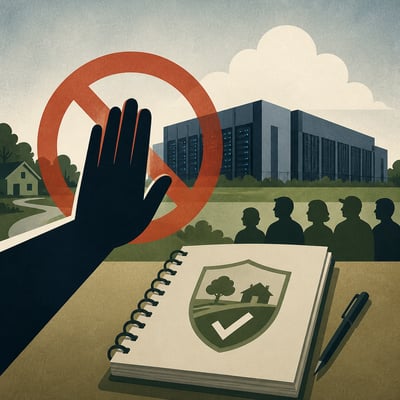
Local governments in Florida, Arkansas, California, Michigan, and South Carolina are delaying or restricting data center projects while they assess water use, electricity demand, noise, environmental effects, and the adequacy of existing rules.
Several jurisdictions adopted temporary moratoriums, while Pulaski County exempted a planned AVAIO Digital facility and Spartanburg County extended review of a major power plant expansion tied to Project MOC-1. The pattern shows that project timelines increasingly depend on local studies, public disclosure, permitting decisions, and negotiated protections, not only on developer interest.
The story now centers more explicitly on active procedural changes: Pulaski County’s exemption for AVAIO and Spartanburg County’s extended review of Project MOC-1. It also adds a clearer link to state-level energy and water policy changes affecting local control and project economics.
The story has broadened beyond a few Michigan and Rhode Island moratoriums into a wider multi-state crackdown, with Florida, Arkansas, California, and South Carolina now in view. The biggest new wrinkle is that some local pauses are being shaped by project-specific exemptions and confidential negotiations, not just generic zoning reviews.
- Florida and Arkansas have joined the moratorium wave.
- Pulaski County exempted AVAIO Digital’s facility from its countywide pause.
- Spartanburg opposition intensified over confidential project talks.
- The Spartanburg power-plant proposal was expanded to about 450 MW.
- Some pauses can now extend up to one or two years.
The story has narrowed from a broad multi-state pattern of data center delays to a more specific set of local moratorium and zoning actions in Michigan, Florida, and Rhode Island. The new version also adds a developer-facing argument in Jackson that frames data centers as a tax and utility-capacity opportunity, which slightly shifts the tone from pure opposition to a more contested local debate.
The story has broadened from a general wave of local moratoriums into a more concrete pattern of project-level disruption, with specific major proposals now being withdrawn, delayed, or carved out from bans. It also adds new jurisdictions and officials, showing the regulatory response is spreading and becoming more tailored.
- Prologis withdrew its Michigan rezoning application.
- AVAIO’s Arkansas project was exempted from a county moratorium.
- Seattle approved a one-year moratorium on large data centers.
- The story now includes Rhode Island and Seattle.
- Officials are weighing takings and litigation risk for broad moratoriums.
The story has broadened from general moratoriums and zoning reviews into a more detailed regulatory crackdown, with localities adding specific controls like setbacks, noise rules, water-use reporting, and licensing requirements. It also now shows more concrete permitting outcomes, including withdrawals, delays, and exemptions for projects already in process.
- New tools include setbacks, height limits, screening, and water-use reporting.
- Licensing ordinances and development agreements are now part of the policy response.
- Several proposals have been withdrawn or delayed pending clearer local rules.
- Officials are explicitly navigating state-law limits on zoning and permit bans.
- Some jurisdictions are exempting projects already in the approval pipeline.
The story now emphasizes that local governments are not just pausing data center approvals, but also actively reviewing zoning rules and infrastructure impacts while some projects are delayed, withdrawn, or carved out with exemptions. It also broadens slightly with new jurisdictions and developers entering the pattern.
The story has expanded from a general pattern of local pauses into a clearer, broader regulatory wave that now includes a major city and more explicit rulemaking activity. The most important new detail is that some jurisdictions are not just freezing approvals, but actively drafting or revising siting standards, with exemptions for advanced projects and tighter treatment of new proposals.
- Seattle City Council adopted a one-year moratorium on large data center creation and expansion.
- Pulaski County exempted AVAIO Digital's advanced project from its moratorium.
- Greenwood County Council advanced a multi-reading moratorium and ordinance process.
- Montgomery County paused new data center permit processing until final rules are completed.
- The current framing emphasizes zoning and siting rule revisions, not just temporary pauses.
The story has become more concrete and broader in its regulatory detail: several jurisdictions are now explicitly pausing new data center permitting or rewriting rules, with Montgomery County, Maryland and Porter Township, Michigan joining the list of active responses. The framing also shifts from generic moratoriums to a clearer emphasis on legal-safe zoning tools and on specific project outcomes like withdrawal and exemption.
The story shifts from a general pattern of local data center slowdowns to a more concrete wave of formal pause actions paired with active rulemaking. It also adds clearer evidence that legal limits and exemption carveouts are shaping how far these moratoriums can go.
The story has broadened from a few Michigan and Arkansas moratorium cases into a wider pattern of local governments across more jurisdictions using zoning pauses, project-specific conditions, and legal carve-outs to manage data center growth. The new emphasis is less on isolated approvals and more on a structural push to build durable siting frameworks amid recurring utility and legal concerns.
- Seattle City Council approved a one-year moratorium on large data centers.
- Porter Township, Michigan approved a one-year pause while updating zoning rules.
- Penn Township, Michigan extended a general-law moratorium and planned zoning amendments.
- Muncy Township, Pennsylvania imposed a planning pause while considering a proposal.
- Some jurisdictions are carving out exemptions for projects already underway.
The story now shows broader and more concrete regulatory management of data center siting, including conditional approvals and exemptions alongside moratoriums. It also adds new jurisdictions and a clearer emphasis on state-law constraints shaping what local governments can do.
The story now includes more concrete implementation: several specific jurisdictions have moved from general zoning concern to formal moratoriums, hearings, and ordinance rewrites, and one major project was withdrawn in the process. The framing is slightly narrower and more actionable, emphasizing active local approval pauses rather than just broad resistance.
The story has broadened from a cluster of temporary pauses and bans into a more explicit regional pattern of local governments actively rewriting data center rules, with Wisconsin newly appearing in the geography. The framing also shifts toward a slower, more structured regulatory adjustment rather than mainly ad hoc opposition.
The story has broadened from one Michigan township dispute into a wider regional pattern of local governments slowing or blocking data center development. The key new development is that moratoriums, bans, and zoning rewrites are now appearing across multiple states, with water, power, noise, and legal-coverage concerns driving the response.
- Moratoriums and bans are spreading across multiple states.
- Some towns are adopting permanent data center zoning bans.
- Jurisdictions are trying to exempt projects already in the approval pipeline.
- State-law limits on local authority are becoming a visible issue.
- Related power plant and solar applications are now part of the story.
Prologis has withdrawn its rezoning request for a proposed data center campus in Washington Township while the township reviews its zoning rules for data centers. Residents have pressed for a temporary moratorium, and township officials are considering safeguards before any future application moves ahead. The property remains in play for industrial development, but timing now depends on local ordinance changes.