
 AI Governance
 Data Centers
 Drones
 Climate
 Privacy
 2026 Maine Senate
 Bob Dylan

Data Center Water Use And Regulation
Coverage from WIRED, Democratic Underground, and others
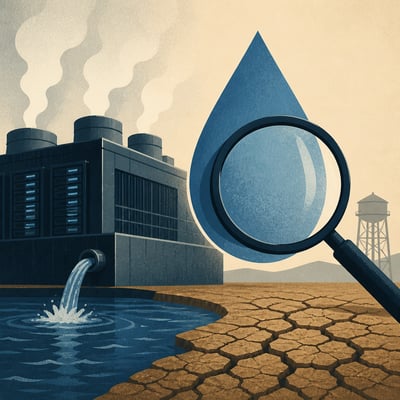
Recent coverage shows data centers under sharper scrutiny for water use, especially where metering, billing, and construction withdrawals intersect with drought.
A Fayette County, Georgia dispute over a QTS campus triggered retroactive charges, local outrage, zoning restrictions, and wider regulatory debate in California, Idaho, Arizona, and Washington.
The story widened from a Georgia water-billing controversy into a broader regulatory push around data-center water use. New coverage adds state-level action and new actors, including California's governor and Meta, while framing the issue around reporting rules, siting limits, and construction-phase withdrawals.
- Gavin Newsom is now part of the story.
- Meta is cited in water-rights and siting debates.
- California is linked to water-reporting regulation.
- New government responses include moratoriums and zoning bans.
- Construction-water demand is separately disputed from cooling use.
The story has broadened from one Georgia billing-and-metering dispute into a wider policy and enforcement pattern affecting multiple drought-stressed jurisdictions. New coverage adds Tucson and Imperial Valley, strengthening the view that data center water conflicts are becoming a broader siting and governance issue.
- Tucson examined construction-water transport for a separate project.
- Imperial Valley raised water-allocation and permit questions for a proposed campus.
- Smart-meter upgrades and retroactive billing are emerging responses.
- The story now includes environmental justice framing.
- Utilities and officials are pushing for stricter oversight.
The story has broadened from a mainly Georgia-centered enforcement dispute into a split narrative: existing sites facing billing and meter violations, and new hyperscale projects trying to pre-arrange water rights and recycling plans. The New Mexico buildout is the key new thread, showing proactive water planning rather than just retroactive conflict.
- Project Jupiter in New Mexico has become a major focus.
- Developers are pursuing water-rights purchases for the project.
- Closed-loop cooling is being used to reduce water exposure.
- Oracle and OpenAI are now named as project tenants.
- Doña Ana County is actively involved in approval and water concerns.
The story has broadened from a Georgia billing-and-metering dispute into a wider policy and infrastructure issue, with Tucson and Washington now showing similar local resistance to data-center growth. The emphasis has also shifted toward formal regulatory responses, including moratoriums, zoning bans, and scrutiny of power planning.
- Resident water-pressure drops are now part of the Georgia dispute.
- Fayetteville imposed a citywide ban on new data centers.
- Washington counties adopted moratoriums on data-center expansion.
- Tucson construction water was used outside the intended service area.
- Power-system planning and ratepayer concerns are now more prominent.
The story has broadened from mainly Georgia and Arizona water disputes into a wider infrastructure problem, with new reporting showing hyperscalers changing cooling and water-disclosure practices while power constraints also loom. The Georgia case remains the dominant example, but it is now framed less as an isolated billing fight and more as part of a structural permitting and utility-limits issue.
- Georgia case now centers on nearly 30 million gallons of untracked or unbilled water.
- Fayetteville adopted a ban on new data centers in all zoning districts.
- Hyperscalers are adjusting cooling choices and water-disclosure practices.
- Arizona grid planning and interconnection delays are now part of the story.
- Project Excalibur is identified as the Fayetteville QTS campus.
The story has broadened from mostly local water-dispute cases into a more clearly regulatory one, with Tucson enforcement and California bill activity adding stronger signs of formal oversight. The biggest new development is that governments are now acting not just reacting, with disclosure, zoning, and approval rules moving closer to implementation.
- Tucson shut off a construction water meter for Project Blue.
- California bills now target water disclosure and approval rules.
- Steve Padilla and Diane Papan are newly identified legislative actors.
- Regulatory focus now includes tariff design and ratepayer cost shifting.
The story has shifted from a water-disclosure dispute centered on the Georgia QTS campus to a more concrete policy-response narrative. Fayetteville has now moved from backlash to action by banning new data centers citywide, while California’s thread has expanded into active legislative efforts on disclosure, review, and cost allocation.
- Fayetteville banned new data centers in all zoning districts.
- California lawmakers advanced bills on disclosure, review, and cost recovery.
- Tucson officials became a separate enforcement example.
- State energy proposals add water and clean-energy conditions for approval.
- The issue now includes enforcement consistency, not just consumption volume.
The story has sharpened from a broad water-use dispute into a more specific and better-documented controversy around a Fayette County QTS campus, with nearly 30 million gallons now tied to metering and billing failures. At the same time, California’s side of the story has become more policy-driven, with stronger pressure for disclosure, zoning limits, and reuse solutions.
- Nearly 30 million gallons were tied to the Fayette County QTS campus.
- Missing or incomplete metering is now central to the Georgia dispute.
- California lawmakers face stronger pressure for disclosure and approval restrictions.
- Planning discussions now include treated wastewater reuse.
- Zoning restrictions and moratorium proposals are newly foregrounded.
The story now centers more explicitly on water governance and disclosure, not just disputed consumption at individual campuses. California has become a clearer policy front, while Georgia remains the main incident-driven flashpoint with retroactive billing and tighter local controls.
The story has broadened from a single Fayetteville dispute into a wider multi-state pattern of scrutiny over data center water use, metering, and permitting. The new emphasis is less on one unresolved controversy and more on emerging regulatory and disclosure responses across several jurisdictions.
- The story now includes separate data center water disputes in Augusta, Tucson, and Cheyenne.
- Augusta Utilities is evaluating water demand and wastewater reuse for a planned campus.
- Tucson officials intervened in a separate construction-water misuse case.
- Researchers are calling for better metering and water-sourcing disclosure.
- Developers are emphasizing closed-loop cooling and construction-phase water use.
Residents and local officials in Fayetteville, Georgia are reacting to reports that a QTS data center campus used nearly 30 million gallons of water through connections that were not properly authorized or billed. The dispute has centered on weak water pressure, retroactive charges, and the decision not to fine the company. It has also accelerated local policy changes, including a ban on new data centers in every zoning district, and fed wider concerns about how data centers affect scarce water supplies in drought-prone areas.