
 AI Governance
 Data Centers
 Drones
 Climate
 Privacy
 2026 Maine Senate
 Bob Dylan

Texas Reconsiders Data Center Growth
Coverage from Fort Worth Report, El Paso Matters, and others
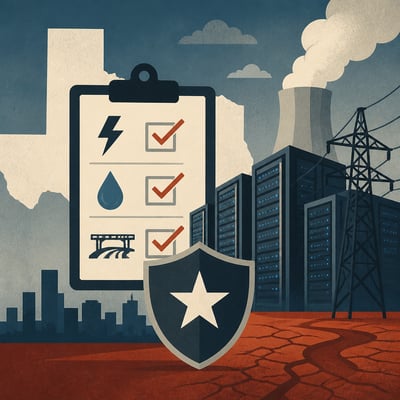
Texas officials are moving from broadly encouraging data center growth toward tighter oversight of projects connecting to the state grid.
Governor Greg Abbott, the Public Utility Commission of Texas, and ERCOT are advancing requirements for data centers to fund associated electric infrastructure, reduce demand during emergencies, improve water efficiency, and disclose resource use, while lawmakers consider additional rules and changes to incentives. The shift reflects concerns that rapid development could raise residential power costs, strain grid reliability and water supplies, and face growing community resistance.
The story has shifted from proposed safeguards to a more concrete oversight phase, with grid requirements advancing alongside measurable public opposition and a project withdrawal. Specific local disputes now demonstrate potential consequences for incentives, water use, emissions, and project viability.
The story broadens modestly beyond Texas as data-center opposition is now identified as a political issue in Pennsylvania, while Texas’s near-term regulatory timeline is specified more precisely.
The story has moved from broad policy consideration toward specific regulatory instructions and a clearer implementation timetable, while ERCOT’s supply outlook adds urgency. National opposition now also explicitly involves Vice President JD Vance.
The story is largely confirmed, with modestly sharper detail that Texas may roll back tax incentives and that major operators are prepared to comply with emerging safeguards.
Texas data-center policy has moved from proposed safeguards toward active restrictions, project audits, and tighter grid-access decisions. The story has also broadened beyond Texas as New York, Pennsylvania, and national political leaders become part of the response.
- Texas has paused or restricted some new data-center approvals and grid connections.
- Agencies are conducting broader project audits covering readiness, ownership, incentives, water, and community effects.
- ERCOT-related reporting cites roughly 474 gigawatts of large-load connection requests, about 90% from data centers.
- New York and Pennsylvania have joined Texas in tightening data-center oversight.
- Dedicated generation and behind-the-meter power are emerging responses to grid constraints.
The current version largely confirms the previous account rather than introducing a new development. It adds specificity about possible closed-loop cooling and emphasizes higher projected large-load demand, but the measures remain proposals and regulatory directives.
The story now frames Abbott’s initiative more explicitly as a response to grid strain and community opposition, not just a cost-shifting proposal. It also adds that most measures are still prospective, with implementation remaining unsettled.
Governor Abbott has now formally pushed Texas regulators to curb the residential cost burden of data-center growth, turning the issue from broad policy debate into a more directed state-level effort. The update also adds a sharper focus on contested incentive agreements, especially the El Paso case, showing how siting and tax-support disputes are becoming harder to unwind.
- Greg Abbott directed regulators to protect residential ratepayers from data-center infrastructure costs.
- Closed-loop cooling is being considered as a water-efficient option.
- Gas generation capacity in ERCOT's interconnection queue exceeds wind capacity.
- Meta's El Paso project is now a named local dispute.
- Litigation over county moratoria shows incentive agreements may be difficult to reverse.
Texas policy has shifted from broad planning and debate to more concrete regulatory tightening around large data-center loads. The new emphasis is on assigning costs, enforcing reliability controls, and scrutinizing tax and local-impact rules as expansion continues.
- PUCT and ERCOT are adopting new load-screening and curtailment measures.
- Texas lawmakers are reviewing $3.3 billion in projected sales-tax losses for 2028-29.
- Annual electricity and water reporting is now being discussed.
- Some local responses now include bans and moratoriums.
- A contested El Paso incentive agreement is now part of the story.
The story has sharpened from general Texas scrutiny of data centers into a more concrete policy push around who pays for grid upgrades, along with tighter rules on incentives and permitting. The updated version also gives greater prominence to formal state and local action, especially cost-allocation guidance and city-level restrictions.
The story has broadened from a general state-level crackdown on data centers to a more concrete policy and utility-planning phase. The biggest change is that Texas officials and utilities are now explicitly grappling with how to allocate grid, water, and infrastructure costs as large developers line up new power needs.
Texas officials are moving to tighten oversight of data centers as rapid expansion strains electricity supply, grid reliability, water systems, and local infrastructure. ERCOT is revising interconnection and performance rules after reliability test failures, while Gov. Abbott and several cities are proposing new limits on incentives, permitting, and resource impacts. The debate centers on whether data center growth can continue without shifting costs and environmental burdens onto residents and utilities.