
 AI Governance
 Data Centers
 Drones
 Climate
 Privacy
 2026 Maine Senate
 Bob Dylan

Utah Stratos Data Center Fight
Coverage from The New York Times, Reuters, and others
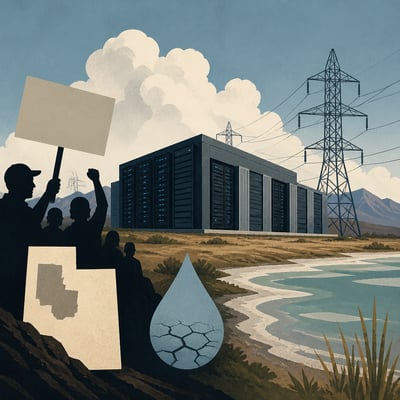
The topic centers on the proposed Stratos data center campus in Box Elder County, Utah, and the political, environmental, and permitting dispute around it.
The project has drawn scrutiny over its scale, water use, power needs, and possible emissions, prompting state and local officials to narrow early approvals to a phased buildout. It matters because the case has become a test of how Utah will handle very large data center projects amid concerns about local impacts and public trust.
The story has shifted from a general permitting battle to a more specific political and procedural fight over how Utah should scale back and stage the Stratos campus. The current version also adds a broader statewide dimension, with the project now framed as a test of transparency, governance, and voter attitudes toward data centers.
The story has shifted from a broad Utah data-center permitting conflict to a more specific account of the Stratos AI campus advancing under tighter state oversight. The new emphasis is on a broader policy response: Utah is now actively shaping rules for future data-center development, not just reacting to this project.
The story has broadened from a single Box Elder County permitting fight into a wider Utah regulatory response to hyperscale data centers, with new local zoning rules and other jurisdictions moving preemptively. The latest reporting also shows stronger, more structured opposition and tighter scrutiny around water-rights changes and cooling methods.
- Water-rights filings, withdrawals, and refilings are now part of the dispute.
- Utah officials are adding phased approvals and reporting requirements.
- Zoning changes now target cooling, noise, and siting standards.
- Voter-led referendum activity has emerged around the project.
- Other Utah jurisdictions are preemptively drafting data-center rules.
The story has narrowed from a broader Utah data-center backlash to a more focused account of the Stratos proposal as the central Box Elder County permitting fight. The main change is a clearer emphasis that the project is still advancing, but now under tighter state scrutiny and broader statewide political opposition.
The story has broadened from a single contested Box Elder County project into a wider Utah pattern of power-dense AI campuses moving through approvals. The main new twist is that oversight is now being described as more layered and ongoing, with phase caps, hearings, and a separate developer model entering the frame.
Box Elder County has now approved the Stratos project, shifting the story from a proposal under review to an approved project facing immediate protests, referendum pressure, and tighter state oversight. The focus has also sharpened around phase-by-phase permitting and unresolved design choices that drive widely different water and emissions estimates.
- Box Elder County approved the Stratos project.
- Protests and referendum efforts followed immediately.
- State officials added air-quality and water-protection review conditions.
- The project may proceed in phases, requiring phased approvals.
- Supporters now emphasize jobs, tax revenue, national security, and grid stability.
The story is now framed more specifically around the Stratos Project’s massive scale and active revisions, especially its 40,000-acre footprint and 9-gigawatt power demand. The latest version also adds clearer political pressure from Utah leaders and organized opposition focused on cooling, water rights, and environmental review.
The story has shifted from a general approvals dispute into a more concrete state-level policy fight, with Utah adding tighter permitting, water-reporting, and phase-limit requirements around the project. The latest version also sharpens the resource picture by emphasizing likely natural-gas power and continuing changes to the project’s design and water assumptions.
The story has shifted from a dispute over one project’s approval to a broader Utah regulatory response, with state leadership now tightening permitting standards for future data centers. The water-rights fight also appears more active and procedural, with filings being withdrawn and expected to be refiled.
- Utah is tightening review standards for future data center permits.
- Permit scrutiny now explicitly covers electricity, emissions, and public input.
- Water-rights filings tied to agricultural-to-industrial conversion were withdrawn and may be refiled.
- The project is being framed as a precedent for Utah data center regulation.
The story has sharpened from a broad approval-and-opposition dispute into a more explicit state-level permitting fight centered on water-right review, air permits, and phased approvals. The latest version also makes the public-transparency and legal pushback more prominent while keeping the same core project and stakeholders.
The story has shifted from a proposed project facing scrutiny to one that has already cleared county approval and is now advancing under tighter state oversight. The new emphasis is on how the phased buildout, water-rights handling, and cooling/emissions design will be constrained going forward.
- Box Elder County approved the Stratos Project.
- A water-rights filing was withdrawn and may be refiled.
- State oversight now includes phase-by-phase approval requirements.
- Cooling design is now a central point of dispute.
- Utah Clean Energy has entered the debate.
The story has tightened from a broad approval fight into a more specific regulatory contest: state agencies are now visibly imposing water-rights, air-permit, and phased-approval scrutiny on the Stratos project. The updated framing also places the project more clearly as a proposed hyperscale AI campus with a major power-and-water footprint rather than just a local county decision.
The story has tightened from a broad approval-and-opposition dispute into a more specific, higher-stakes fight over a massive AI campus’s power, water, and environmental footprint. The current version also adds clearer identification of state actors and the project’s development vehicle, while emphasizing that the regulatory path is still unsettled.
The dispute has broadened beyond water and power into a more politically charged, state-level fight, with tighter oversight and new criticism around transparency, land use, and seismic risk. The latest reporting also shows the project becoming more prominent in state politics, not just county permitting.
- Phased approvals and added air-quality and water-protection conditions are now explicit.
- Criticism has expanded to transparency, land use, and seismic questions.
- State lawmakers and the governor are now directly engaged in the debate.
- Kevin O'Leary is now highlighted as a prominent public defender.
- Formal challenge efforts include a referendum and independent review demands.
The story has sharpened from a broad land-use and water-rights fight into a more detailed regulatory conflict centered on water conversion, air permits, and phased state oversight. The current version also adds a clearer set of actors and opposition channels, including the Box Elder Accountability Referendum and Utah Clean Energy.
The story has sharpened from a broad opposition-and-oversight dispute into a more specific, ongoing infrastructure fight centered on land use, water rights, and power sourcing. The current version also introduces new state and developer actors and highlights threats and political escalation after approval.
Box Elder County, Utah, has approved the first stage of a huge AI data center project backed by Kevin O'Leary, triggering organized local resistance and a referendum effort. The proposal has become a test case for how communities, state officials, and developers balance economic promises against water, air, and land-use concerns near the Great Salt Lake. Utah leaders have since narrowed the initial phase and added oversight conditions, but the project still faces major permitting and public-review hurdles.