
 AI Governance
 Data Centers
 Drones
 Climate
 Privacy
 2026 Maine Senate
 Bob Dylan

Data Centers Face Cooling and Permit Pressure
Coverage from Nature, WIRED, and others
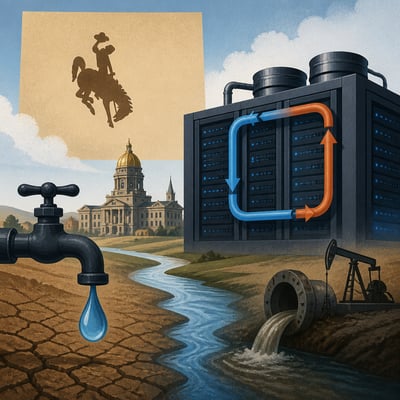
Data center projects are facing growing scrutiny over cooling reliability, water consumption, onsite emissions, and public participation in permitting.
Research indicates that warming and humidity are reducing the operating window for free-air cooling, while operators are testing liquid cooling and other designs that balance water use against electricity demand. In Texas and at the federal level, disputes over minor permits for generator fleets show how air pollution and limited public review can affect project timelines, community acceptance, and operating costs.
The story now places more emphasis on permitting and community-process disputes, not just technical cooling and emissions concerns. It also adds a new Texas stakeholder and highlights local opposition drivers beyond pollution alone.
The story sharpens from a broad discussion of data center constraints into a more specific Texas permitting controversy, adding concrete evidence that onsite power systems are proliferating under minor permits. It also introduces a clearer policy dispute over EPA changes that could further narrow public review.
- At least 38 Texas data centers received minor permits for onsite power sources since 2024.
- Those permits cover more than 2,100 backup generators statewide.
- Texas data centers are increasingly using onsite gas turbines.
- EPA changes could reduce public notice and comment for some minor pollution sources.
- Adaptive, hybrid, liquid, and economizer-based cooling designs are becoming more important.
The story has broadened from a regional water-scarcity dispute around Wyoming and Texas data centers into a wider account of how climate-sensitive cooling, onsite power generation, and air-permitting rules constrain data center expansion. The new version places much more emphasis on emissions, transparency, and public review, especially in Texas.
- Higher heat and humidity are reducing free-air cooling hours in several regions.
- Texas data centers are using large gas turbine and diesel generator fleets.
- Proposed EPA changes could limit public participation on some minor-source permits.
- Amazon reports lower water use in Northern Virginia and progress toward its 2030 goal.
- Cooling tool DC E-WISE compares configurations across energy, water, and reliability.
The story has narrowed into a more specific Wyoming-Texas groundwater conflict centered on the Ogallala Aquifer, with several named projects now tied to incomplete disclosure on cooling and water sourcing. It also adds a clearer policy and fiscal angle as local officials and lawmakers weigh metering, reporting, and tax arrangements.
- Ogallala Aquifer constraints now frame the water dispute.
- Fermi, Related Digital, and Beacon are newly named projects.
- Several projects still lack final cooling or water sourcing disclosures.
- Wyoming officials are weighing data-center metering and reporting requirements.
- Tax and utility cost-sharing has become a live local issue.
The story has broadened from a general water-and-permitting constraint narrative into a more explicit policy and infrastructure planning issue, with Wyoming now the clearest live venue and Texas/Ogallala groundwater concerns adding a new pressure point. The framing also shifts toward comparing competing cooling and reuse strategies against electricity demand, wastewater controls, and public-health risk.
The story has broadened from general water-use scrutiny into a more specific permitting and utility-planning fight, with EPA guidance and regional water governance now playing a bigger role. The newest wrinkle is that air permitting for diesel backup generation has emerged as a parallel constraint, showing buildout limits extend beyond water alone.
The story has broadened from a Wyoming-centered water and cooling controversy into a clearer policy response, with North Carolina now joining as a second major flashpoint. Utility planning is also more prominent, suggesting the debate is moving from local opposition toward system-level infrastructure and cost questions.
The story has broadened from a general data-center water debate into a more explicitly policy-and-utility-driven issue, with EPA guidance and reclaimed-water reuse now foregrounded alongside permitting and discharge questions. Wisconsin also emerges as a more active flashpoint, and the commercial benefits to utilities and equipment suppliers are more visible.
- EPA guidance now explicitly frames water reuse and discharge pathways.
- Wisconsin is now identified as a major active flashpoint.
- Utilities and manufacturers are benefiting from cooling and backup-power contracts.
- Wyoming debate now includes replenishment intervals and produced-water limits.
- Amazon is newly cited for reclaimed-water expansion and efficiency claims.
The story has broadened from a Wyoming-and-EPA water/permitting issue into a wider regional planning and health-risk discussion. New emphasis falls on concrete utility preparation in Ohio and the Great Lakes, plus water-quality concerns around reused-water cooling systems.
- Ohio and Great Lakes stakeholders now feature prominently in the story.
- Utility tariffs, rate changes, and capacity planning are newly emphasized.
- Water-quality and health risks such as Legionella and PFAS are now explicit.
- Cheyenne debate now includes Project Jade and Microsoft water-use estimates.
The story has sharpened from a broad regional water-and-permitting issue into a more specific regulatory and operational debate centered on Wyoming, with EPA guidance and utility planning now taking a larger role. It also adds new stakeholder detail around Columbus Water and Power and a more explicit focus on reuse contracts and discharge rules.
The story has sharpened from general scrutiny of data center water and cooling impacts into a more geographically specific planning and permitting conflict, especially in Wyoming and the Great Lakes region. The new version also elevates regulatory and zoning timelines as central constraints on whether projects can proceed.
The story has broadened from general concern over data center water use into a more active policy-and-implementation phase, with operators and researchers testing concrete reuse, cooling, and heat-recovery approaches. The center of gravity has also shifted geographically, with Illinois and European heat-reuse examples joining Wyoming as major flashpoints.
- Wastewater reuse is moving into policy and engineering practice.
- Federal tax incentives are now part of the reuse discussion.
- Oversight is fragmented across county, state, tribal, and federal processes.
- Heat reuse is emerging as a notable strategy in Europe.
- Illinois has joined Wyoming as a major local flashpoint.
The story has shifted from a general concern about data center water and cooling toward a more specific policy and regulatory debate centered on reuse, permitting, and local water-rights constraints. EPA guidance and state-level pressure in Wyoming and Colorado now play a more explicit role in shaping how facilities can expand.
The story broadens from a general water-and-permitting issue into a more explicit framing around total water burden, including power-generation water demand and wider wastewater/discharge risks. It also adds more specific cooling approaches and regulatory stakeholders, making the operational and permitting picture more detailed.
The story has broadened from a mostly water-use and cooling debate into a clearer regulatory-and-permitting issue, with EPA guidance now more explicitly tying data center water choices to discharge routes, reuse, and permit triggers. The current version also adds new state and technical actors, including Colorado leadership and Vertiv, sharpening the sense that climate limits and local review can constrain low-water cooling adoption.
The story has broadened from a Wyoming-centered debate into a wider regulatory and operational issue spanning multiple regions, with the EPA and utility planning now central to how data center water use is handled. The framing has shifted from local water stress alone to a structural permitting-and-infrastructure problem tied to cooling, wastewater reuse, and electricity generation.
- EPA guidance now shapes water-use and wastewater decisions.
- Wisconsin is now a parallel battleground.
- Wastewater reuse is gaining practical attention.
- Climate limits now affect cooling technology feasibility.
- Permitting complexity extends across jurisdictions.
Wyoming officials, lawmakers, utilities, and data center operators are debating how to accommodate rapid data center growth while limiting pressure on water supplies and local infrastructure. Cheyenne is the main focal point, with most discussion centered on cooling systems, permitting thresholds, and whether closed-loop designs meaningfully reduce water demand or shift it elsewhere through added power use. The topic also includes questions about property rights, municipal revenue, and whether produced water or other alternative supplies could play a role.