
 AI Governance
 Data Centers
 Drones
 Climate
 Privacy
 2026 Maine Senate
 Bob Dylan
Yara Builds Europe’s Cross-Border CCS Link
Coverage from Euronext Markets, PR Newswire, and others
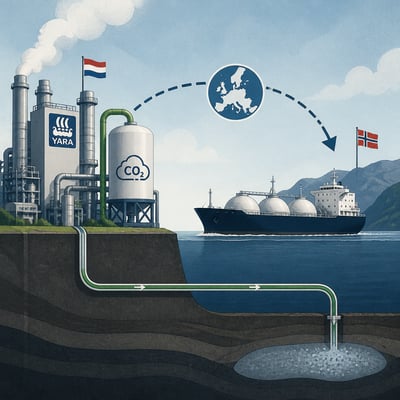
Yara has inaugurated a carbon capture and storage facility at its ammonia and fertilizer complex in Sluiskil, the Netherlands.
The project is designed to capture and liquefy up to 800,000 metric tons of CO2 annually, ship it through Northern Lights to Norway, and store it beneath the seabed, with an estimated 12 million tons captured over 15 years. It is a significant cross-border test of industrial CCS for hard-to-abate emissions, while questions remain about its commercial viability, environmental performance, and wider role in European decarbonization.
If you read one thing
Reuters provides the strongest overall introduction, combining the facility’s scale with the project’s unresolved commercial and policy implications.
Best explainer
This article adds the cross-border perspective by explaining how Dutch capture is linked to Norwegian offshore storage.
Industrial CCS has reached deployment scale
Yara has inaugurated a major CCS installation at its Sluiskil ammonia and fertilizer complex, designed to capture and liquefy up to 800,000 metric tons of CO2 annually from industrial emissions. The project is a concrete test of CCS for hard-to-abate manufacturing.
Cross-border CO2 transport and storage is being demonstrated
The project connects capture in the Netherlands with liquefied-CO2 shipping and offshore storage about 2.6 kilometers beneath Norway's seabed. This creates a cross-border carbon-management model that could be replicated by other energy-intensive European industries.
Commercial and environmental legitimacy remains contested
The inauguration demonstrates technical deployment but does not resolve questions about CCS's commercial viability, storage permanence, environmental effects, or its potential to prolong fossil-fuel dependence. These concerns continue to constrain the technology's broader decarbonization significance.
2.6 km
storage depth beneath the seabed
“From 2026, Yara Sluiskil will capture and liquefy up to 800,000 metric tons of CO2 a year. The carbon will be transported and stored 2.6 km beneath the seabed on the Norwegian continental shelf by transport and storage operator Northern Lights.”
12 million tons of CO2
cumulative CO2 removed from the site
“Over 15 years, Yara expects to remove about 12 million tons of CO2 from the site.”
800,000 metric tons of CO2 a year
annual CO2 captured and liquefied
“From 2026, Yara Sluiskil will capture and liquefy up to 800,000 metric tons of CO2 a year. The carbon will be transported and stored 2.6 km beneath the seabed on the Norwegian continental shelf by transport and storage operator Northern Lights.”
2050
EU net-zero emissions target year
“The European Union plans to use carbon capture technology to help meet its 2050 net-zero emissions target, particularly for industrial processes such as chemical manufacturing, where low-carbon alternatives are not yet available.”
No material change: no new topic members were supplied, so the underlying development remains the inaugurated cross-border CCS facility and its stated capacity, transport and storage model.
Previously
Yara has inaugurated a carbon capture and storage facility at its ammonia and fertilizer complex in Sluiskil, the Netherlands. The project is designed to capture and liquefy up to 800,000 metric tons of CO2 annually, ship it through Northern Lights to Norway, and store it beneath the seabed, with an estimated 12 million tons captured over 15 years. It is a significant cross-border test of industrial CCS for hard-to-abate emissions, while questions remain about its commercial viability, environmental performance, and wider role in European decarbonization.