
 AI Governance
 Data Centers
 Drones
 Climate
 Privacy
 2026 Maine Senate
 Bob Dylan
UK River Whiplash Risk
Coverage from Tyndall Centre for Climate Change Research, Columbia Gorge News, and others
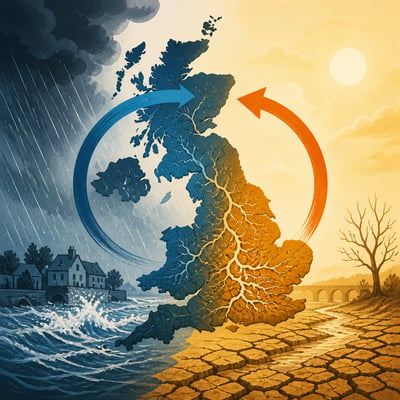
Recent research projects that warming will intensify UK river extremes in opposite directions by region: more flooding in western and northern catchments and longer dry spells in southern and eastern England.
The common pattern is hydroclimatic whiplash, where rivers swing more often between unusually wet and unusually dry conditions. The signal is coherent and strongly current, with little historical spillover. The main uncertainty is not whether the pattern exists in the studies, but how different catchments will translate it into local flood, drought, water-quality, and planning impacts.
The story appears unchanged: the current version repeats the same UK river-whiplash projections, regional split, and adaptation implications without adding new developments or reversing the prior framing.
No material change is evident between the previous and current versions; the core research finding and framing are unchanged.
No material change is evident between the two versions; the story’s core claims, framing, and implications remain the same.
The story is materially unchanged. The current version largely repeats the earlier projections about regional UK river whiplash, with no new event, claim, or actor that alters the interpretation.
No material change is visible between the two versions; the story’s substance, framing, and implications remain the same.
No material change is evident between the previous and current versions. The story, claims, and framing are unchanged, with the new entity list mainly adding supporting references rather than altering the narrative.
No material change is visible between the two versions; the story, claims, and framing remain unchanged.
No material change is evident between the previous and current versions. The core finding, regional split in river extremes, and adaptation implications all remain unchanged.
The update reframes the story from a general flood-drought extremes finding to a more specific hazard-chain story: the key risk is now the transition between wet and dry states, with downstream effects on water quality, soil erosion, and preparedness. It also sharpens the geographic split and narrows the uncertainty to local impact translation rather than the existence of the pattern itself.
Recent research projects stronger flood-drought swings in UK river catchments under 2 C and 4 C warming, with wetter western and northern regions facing more flood risk and southern and eastern England facing longer dry spells. The signal is consistent, model-driven, and adaptation-focused.