
 AI Governance
 Data Centers
 Drones
 Climate
 Privacy
 2026 Maine Senate
 Bob Dylan
U.S. Heat Waves Break Climate Records
Coverage from The Honest Broker, Climate Central, and others
Record-breaking heat affected the U.
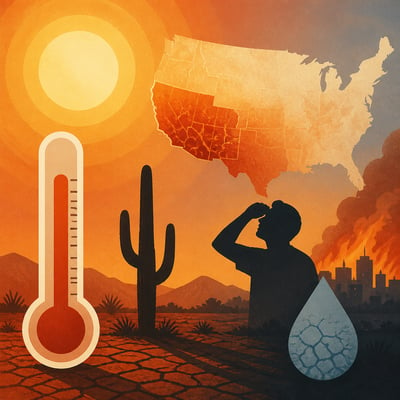
S. Southwest in March 2026 and much of the country in July, with temperatures exceeding seasonal records and forecasts pointing to dangerous heat across a wide area. Attribution analyses concluded that the March event was virtually impossible without human-caused warming, while Climate Central estimated that climate change made the July heat at least five times more likely. The developments highlight growing risks for public health, drought and wildfire conditions, emergency planning, and assessments of how extreme-weather trends are changing.
The main update is a sharper attribution and risk framing: the March heat is now described as virtually impossible without human-caused warming, while the July episode is quantified as at least five times more likely because of climate change. The story also adds a new U.S. dashboard tracking 32 extreme-weather variables, reinforcing the broader trend-monitoring angle.
The story broadens from a March-and-July heat attribution narrative into a more geographically expansive assessment that now explicitly includes the southern Great Plains, northwest Mexico, and a broader swath of U.S. regions affected by the July episode. The framing also shifts from general evidence of warming-driven heat risk to a stronger claim that these episodes are part of intensifying U.S. heat extremes with practical planning consequences.
- March heat records now extend to the southern Great Plains and northwest Mexico.
- WWA says the March event was virtually impossible without human-caused warming.
- The July heat episode could affect more than 101 million people.
- The July forecast spans the Gulf Coast, Southeast, and Midwest.
- Broader U.S. heat extremes are now framed as intensifying.
The main update is a sharper, broader framing: the heat story now centers on late-July U.S. forecasting and explicitly distinguishes observed warming trends from causal attribution. It also expands the risk discussion to more clearly include infrastructure design and insurer exposure.
The story has broadened from a set of record Southwest heat events to a larger, more systemic heat-risk narrative that now includes nationwide summer forecasting, a long-term urban warming analysis, and a methodological critique of how heat risk is measured. This shifts the emphasis from isolated attribution of a March event to ongoing management of widespread and increasingly persistent heat exposure.
- A Climate Central analysis found warming in 97% of 243 major U.S. cities from 1970 to 2025.
- A July forecast projected Climate Shift Index 5 heat for more than 100 million people.
- The Honest Broker dashboard separates extreme-weather trend detection from causal attribution.
- Hazard-specific data limitations are now explicitly documented.
- Insurance risk is newly highlighted alongside planning concerns.
Record-breaking heat in the U.S. Southwest and related attribution studies dominate the cluster, with repeated links to human-caused warming, health risk, wildfire conditions, and water stress. Climate Central's humid-heat work extends the signal into summer by quantifying dangerous wet-bulb conditions and added risk days.