
 AI Governance
 Data Centers
 Drones
 Climate
 Privacy
 2026 Maine Senate
 Bob Dylan
Space Solar’s Promise Meets Cost Reality
Coverage from The Washington Post, OilPrice.com, and others
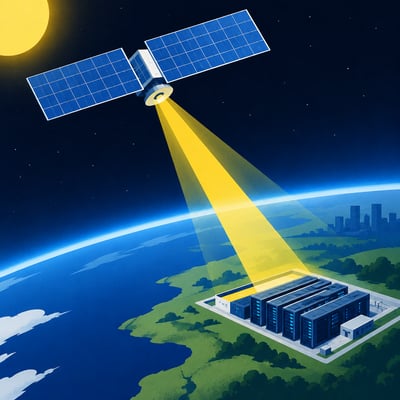
Space-based solar developers are seeking to collect sunlight in orbit and beam electricity to Earth, with Virginia-based Overview Energy planning a demonstration in January 2028 and an agreement covering potential supply to Meta data centers.
The technology could provide power after sunset and reduce land requirements, but orbital construction, launches, transmission systems, safety, and cost competitiveness remain unproven. Growing electricity demand from AI data centers is attracting investment and renewed research in the United States and China, while established alternatives such as terrestrial renewables, batteries, nuclear, and geothermal power remain important benchmarks.
If you read one thing
It provides the clearest overview of the technology's potential, commercial interest, and unresolved infrastructure and cost barriers.
The evidence
It adds validated reporting on data-center demand, strategic competition, and the practical obstacles facing space-based solar.
Commercial and infrastructure viability remain unresolved
Space-based solar still depends on unproven large-scale orbital construction, launches, transmission systems, and operating costs. Its ability to compete with terrestrial renewables, storage, nuclear, and geothermal power has not been established beyond laboratory feasibility and planned demonstrations.
Data-center demand and strategic competition are creating early market pull
AI data-center electricity demand and the prospect of uninterrupted solar power are generating commercial interest, including Meta's agreement covering up to a first gigawatt of potential Overview Energy capacity. U.S. funding and concern about China's expanding research add strategic momentum, although they do not resolve the technology's economics.
$12 million dollars
government funding for universities and space-solar companies
“The Trump administration recently announced $12 million for universities and space-solar companies, while the Department of Energy described space-based solar as a source of “near constant power” that could support its space-superiority agenda.”
first gigawatt
generation capacity contracted by Meta
“Meta has signed a contract to secure the first gigawatt of capacity Overview helps generate for its data centers.”
No new member articles were supplied, so there is no evidence of a material change in the topic.
Previously
Space-based solar developers are seeking to collect sunlight in orbit and beam electricity to Earth, with Virginia-based Overview Energy planning a demonstration in January 2028 and an agreement covering potential supply to Meta data centers. The technology could provide power after sunset and reduce land requirements, but orbital construction, launches, transmission systems, safety, and cost competitiveness remain unproven. Growing electricity demand from AI data centers is attracting investment and renewed research in the United States and China, while established alternatives such as terrestrial renewables, batteries, nuclear, and geothermal power remain important benchmarks.