
 AI Governance
 Data Centers
 Drones
 Climate
 Privacy
 2026 Maine Senate
 Bob Dylan
Seven Earth Boundaries Exceed Safe Limits
Coverage from Earth.com, Canada's National Observer, and others
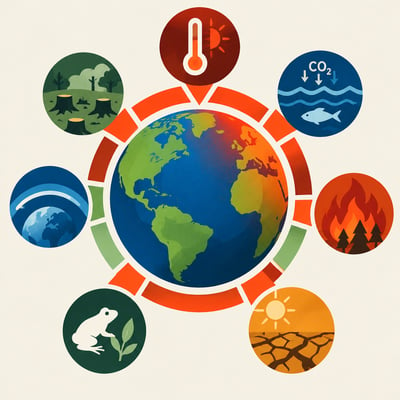
The 2026 Planetary Health Check, prepared by an international team of more than 60 scientists, finds that seven of nine planetary boundaries are beyond safe limits.
It highlights climate change, ecosystem pressures, and newly transgressed ocean acidification, while reporting that heat, drought, fire, and ecosystem degradation may weaken land carbon sinks. The assessment is intended to inform decisions affecting Earth-system stability; it also notes that ozone depletion and atmospheric aerosol loading have improved.
If you read one thing
It gives a clear, broad introduction to the assessment’s central finding that seven planetary boundaries have been breached.
The evidence
It adds specific evidence on flat land carbon uptake and newly breached ocean acidification, with validated figures.
The evidence
Its primary-research-based reporting adds evidence on coral heat stress and how extremes may weaken land carbon sinks.
Multiple planetary boundaries exceed safe limits
The 2026 assessment finds seven of nine planetary boundaries beyond safe limits, with reporting also describing risks of persistent or irreversible Earth-system change. The corpus establishes the scale of current transgression, but does not support a clear year-over-year direction.
about 2000
approximate start of the period when land carbon uptake remained flat
“Excluding direct clearing, land’s carbon uptake has been flat since about 2000, according to the Global Carbon Budget.”
2025
year ocean acidification crossed its boundary
“Ocean acidification was the latest to cross its boundary, in 2025.”
all seven boundaries
transgressed boundaries at their highest recorded levels
“The Planetary Health Check 2026 reports that seven of the nine planetary boundaries are transgressed, with all seven at their highest recorded levels of transgression.”
seven of the nine boundaries
planetary boundaries transgressed
“The Planetary Health Check 2026 reports that seven of the nine planetary boundaries are transgressed, with all seven at their highest recorded levels of transgression.”
close to 30%
human carbon dioxide emissions absorbed by the sea
“The sea has absorbed close to 30% of human carbon dioxide emissions over the past decade, Caesar said, leaving less carbonate for corals, oysters, mussels and plankton to build shells.”
No new-member articles were supplied, so there is no evidence of a material real-world change since the prior state.
Previously
The 2026 Planetary Health Check, prepared by an international team of more than 60 scientists, finds that seven of nine planetary boundaries are beyond safe limits. It highlights climate change, ecosystem pressures, and newly transgressed ocean acidification, while reporting that heat, drought, fire, and ecosystem degradation may weaken land carbon sinks. The assessment is intended to inform decisions affecting Earth-system stability; it also notes that ozone depletion and atmospheric aerosol loading have improved.