
 AI Governance
 Data Centers
 Drones
 Climate
 Privacy
 2026 Maine Senate
 Bob Dylan
Russia's Northern Sea Route Faces Risks
Coverage from Deutsche Welle, Nature, and others
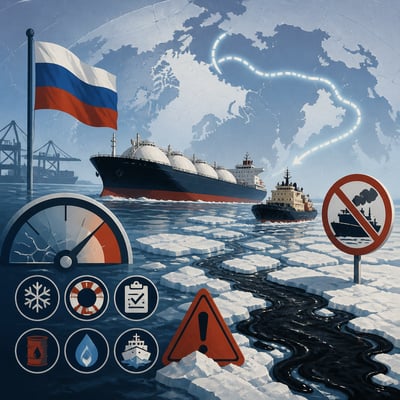
Russia is promoting the Northern Sea Route as a shorter maritime link between Europe and Asia, but seasonal ice, icebreaker dependence, limited rescue capacity, environmental hazards, and political restrictions continue to constrain its use.
Cargo volumes remain dominated by Russian oil and gas rather than broad container trade, while sanctions and Russia's control of access have reduced international interest. The route's longer-term viability depends on Arctic conditions, infrastructure, and whether participating states can sustain predictable and cooperative governance.
The story is more quantified and more explicitly geopolitical: the Northern Sea Route is now framed as a Russia-controlled corridor whose commercial potential is still limited by sanctions, permits, and infrastructure bottlenecks despite shorter distances. The current version also sharpens the economic reality that cargo remains overwhelmingly tied to Russian oil and LNG rather than broad international trade.
The story is largely reinforced rather than rewritten: the Northern Sea Route remains a climate-enabled but still constrained shipping corridor. The main update is a sharper emphasis on unresolved regulatory and geopolitical uncertainty alongside the existing icebreaker, infrastructure, and sanctions limits.