
 AI Governance
 Data Centers
 Drones
 Climate
 Privacy
 2026 Maine Senate
 Bob Dylan
Renewable Grid Frequency Control Advances
Coverage from Nature, SpringerLink, and others
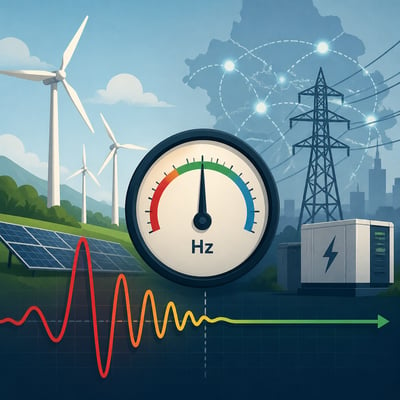
Research is focused on advanced controllers that stabilize power-system frequency as wind and solar penetration increases and conventional system inertia declines.
The studies combine fractional-order, two-degree-of-freedom, digital deadbeat, and optimization-based methods with energy-storage or real-time testing to reduce deviations, overshoot, oscillations, and settling times. The results indicate promising improvements in modeled or laboratory-tested systems, but broader operational validation remains limited.
The story now adds a specific digital deadbeat control line and clearer experimental breadth, showing the research is not limited to fractional-order storage-based controllers. It also more explicitly tempers the optimism by stressing that validation is still mostly model-based and tuning-sensitive.
The framing has tightened around renewable-heavy grids as a frequency-stability problem, with solar and wind explicitly identified as the source of inertia loss and larger swings. The story also shifts toward practical validation, highlighting real-time testing alongside simulation.