Plug-In Solar Challenges Rooftop RulesCoverage from Southern Alliance for Clean Energy, The Conversation, and others
00/00/0000
DailyWeekly
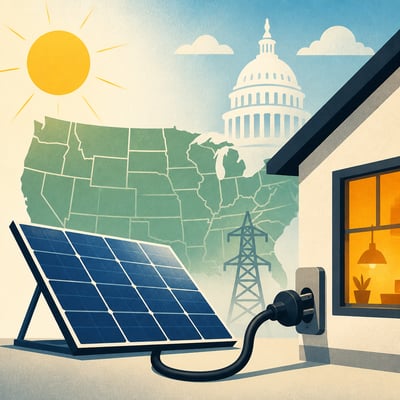
Plug-in or balcony solar systems use small photovoltaic panels connected to household outlets, offering a lower-barrier option for renters, apartment residents, and homes that cannot install conventional rooftop systems.
U.S. states are beginning to remove permitting, utility-approval, and property restrictions for systems typically capped at 1,200 watts, while UL Solutions has introduced a safety certification standard. Adoption remains shaped by state and local rules, landlord policies, equipment requirements, electricity prices, and the need for certified outage protection.
It adds a distinct California case showing how broader solar access can raise unresolved safety and utility cost-allocation concerns.
Yahoo News / Ian James
58
Key Issues
01
U.S. state policy is opening access
State reforms are creating legal pathways for qualifying plug-in solar, with nine states reportedly adopting protections and additional states considering similar measures. The rules remain fragmented, generally centered on systems up to 1,200 watts and retaining some utility, landlord, or placement restrictions.
Stable
Drawn from 4 articles
02
Certification is advancing, but grid rules remain contested
UL 3700 provides a clearer safety pathway for outlet-connected systems by addressing automatic shutdown, outage behavior, overload, backfeed, weather, and ground-fault protection. Interconnection approvals and the appropriate level of utility oversight remain unresolved constraints, with evidence in the corpus arguing that existing rules may be disproportionate to the safety risks.
Stable
Drawn from 3 articles
03
Renter and non-rooftop access is the central adoption case
Plug-in solar’s strongest access proposition is extending household generation to renters, apartment and condominium residents, and properties without suitable rooftops. New Jersey and California measures support that pathway, but certification, landlord controls, implementation conditions, and potential cost shifting to nonparticipants could limit uptake or equity gains.
Stable
Drawn from 3 articles
Key Numbers
before 2030
deadline for legislative reauthorization
if signed
“If signed, the Legislature would need to reauthorize the measure before 2030.”
Yahoo News
14 days
advance landlord notification period
“Landlords must be notified 14 days ahead and may still restrict placement and size.”
The Next Web
40% percent
New Jersey residents who rent or live in apartments
according to advocacy group Permit Power
“About 40% of New Jersey residents rent or live in apartments, according to advocacy group Permit Power. Such residents have generally lacked a way to generate their own electricity.”
The Next Web
1,200 watts
maximum capacity of plug-in solar systems covered by the exemption
New Jersey law
“New Jersey's Garden State Balcony Solar Act exempts plug-in solar systems of up to 1,200 watts from utility fees, approvals, equipment mandates, and other requirements. It also prevents landlords, HOAs, and similar entities from broadly prohibiting the devices, and bars municipalities from prohibiting them or requiring permits.”
CleanTechnica
Nine states
states that have adopted balcony-solar legislation
“Nine states have now adopted balcony-solar legislation, with New Jersey the latest.”
CleanTechnica
Looking Back
242 Day Timeline
Articles published over time. Hover any bar for the period and its article count.
Jan 8
Feb 19
Mar 26
May 7
Jun 18
Jul 23
Sep 3
The Story So Far
No material change
The supplied new-member articles repeat existing information about New Jersey’s plug-in solar law, adoption constraints, and Germany’s cooling market, without establishing a material new development.
Previously
Plug-in balcony solar is gaining a clearer path into the U.S. market as states reconsider permitting rules and UL Solutions establishes a safety certification framework. Small photovoltaic systems connected to household outlets could broaden solar access for renters, condominium residents, and homes without suitable roofs, but adoption remains shaped by property restrictions, utility concerns, local electricity prices, and unresolved regulatory differences. Germany provides an established comparison, while U.S. policy activity is spreading from early state measures to broader legislation in places such as California and New Jersey.
History
09/07/2026
The story now includes concrete commercial activity and a more specific regulatory path, with Colorado joining states easing plug-in solar rules and New Jersey limiting local and landlord barriers. However, market rollout is complicated by unresolved federal communications compliance, including Bluetti reportedly pausing a launch.
09/03/2026
The story now presents plug-in balcony solar as spreading beyond a small group of pioneering states, with similar measures reportedly reaching nine states. The change is mainly a clearer indication of broader regulatory momentum, rather than a fundamentally new policy outcome.
SACE recommends a risk-tiered interconnection framework after citing backfeed deaths from generators and low shock risk from UL 1741 solar inverters in the United States.
6/18/2026 • Policy, Politics & Governance • General
Raymond Ward advanced Utah HB 340 enabling outlet-based balcony solar while Underwriters Laboratories developed certification for plug-in safety after broad U.S. adoption interest.
NFPA published NEC 2026 on August 20, 2025, adding qualified-person installation requirements for hardwired EV chargers as states start adopting the code in 2026.
Utah and other U.S. states modify permitting rules for low-watt plug-in balcony solar systems as UL Solutions releases a related safety standard in 2026.
Utah lawmakers in 2025 enacted permitting reforms for under-1,200-watt plug-in solar systems, while UL Solutions issued a related U.S. safety standard in early 2026.
Solar.com publishes a 2026 guide explaining how UL 3700 safety standards and new state laws enable renter use of balcony plug-in solar across the United States.
Experts warn that solar expansion and heat pump deployment in the United States must be paired with just transition policies to protect fossil fuel workers.
A Los Angeles Times report on February 2, 2026, explains how Utah, California, and other states are developing legislation and safety rules for DIY plug in balcony solar systems, while omitting heat pump topics.
New Jersey Governor Mikie Sherrill signed a law this week allowing renters and apartment residents statewide to install plug-in balcony solar systems up to 1,200 watts.
9/3/2026 • Policy, Politics & Governance • General
Utah led US legalization of plug-in balcony solar kits, and additional states are considering similar laws to broaden access to small distributed solar power.
Senator Scott Wiener and EWG-backed SB 868 would remove utility interconnection rules for plug-in balcony solar in California, expanding renter access and reducing AC-related grid demand.
The UK government plans to legalise plug-in solar kits within months, aiming to expand distributed solar while managing residual-current and islanding safety risks.
California lawmakers passed two solar-access bills in 2024 in Sacramento, proposing stronger community solar and certified plug-in solar programs for residents without rooftop systems.
8/31/2026 • Policy, Politics & Governance • General
The California Legislature passed community and balcony solar bills in Sacramento in 2023, sending measures to Governor Gavin Newsom amid utility concerns about safety and customer cost shifts.
8/31/2026 • Policy, Politics & Governance • General
New Jersey Governor Mikie Sherrill signed legislation in Trenton allowing residents and tenants statewide to install qualifying plug-in solar systems without extensive municipal approvals.
9/3/2026 • Policy, Politics & Governance • General
New Jersey Governor Mikie Sherrill signed a 2026 law in New Jersey allowing qualifying balcony solar systems while limiting utility, landlord, homeowner association, and municipal restrictions.
9/2/2026 • Policy, Politics & Governance • General
New Jersey Gov. Mikie Sherrill signed the Balcony Solar Act on September 1 in New Jersey, allowing qualifying residents to use plug-in solar systems without utility interconnection approvals.
9/2/2026 • Policy, Politics & Governance • General
New Jersey Governor Mikie Sherrill signed a law Tuesday in Trenton permitting residents statewide to use small plug-in solar units despite landlord and municipal restrictions.
9/1/2026 • Policy, Politics & Governance • General
New Jersey Governor Mikie Sherrill signed the Garden State Balcony Solar Act in Trenton, removing regulatory barriers for qualifying plug-in solar devices statewide.
9/1/2026 • Policy, Politics & Governance • General
New Jersey Governor Mikie Sherrill signed the Garden State Balcony Solar Act in New Jersey, exempting qualifying plug-in solar devices from key utility and permitting requirements.
9/1/2026 • Policy, Politics & Governance • General
New Jersey Gov. Mikie Sherrill signed the Garden State Balcony Solar Act in New Jersey, easing rules for plug-in solar systems and expanding access for renters and homeowners.
9/1/2026 • Policy, Politics & Governance • General
New Jersey Governor Mikie Sherrill signed the Garden State Balcony Solar Act in New Jersey, allowing residents to install plug-in solar systems up to 1,200 watts without prior utility approval.
9/2/2026 • Policy, Politics & Governance • General
Connecticut Gov. Ned Lamont signed a solar law creating a new community solar program and automated permitting while utility and local opposition raise deployment uncertainty in 2020s Connecticut.
6/30/2026 • Policy, Politics & Governance • General
Utah lawmakers adopted House Bill 340 in a rollout of UL safety-certified plug-in solar systems connected to household outlets, with similar proposals spreading nationwide.
6/19/2026 • Policy, Politics & Governance • General
State legislators and advocacy groups in early 2026 advanced bills in multiple U.S. states to legalize outlet-connected plug-in solar up to 1,200 watts, led by efforts in California and Utah.
1/30/2026 • Policy, Politics & Governance • General
New Jersey Gov. Mikie Sherrill signed a law Tuesday allowing qualifying plug-in solar systems up to 1,200 watts statewide without standard utility interconnection requirements.
New Jersey Gov. Mikie Sherrill signed the Garden State Balcony Solar Act in Trenton, allowing renters and other residents to install qualifying plug-in solar panels with fewer approvals.
9/1/2026 • Clean Energy & Emissions • General
UPR Utah Public Radio / Leia Larsen, Bethany Baker52
Utah passed House Bill 340 to permit plug-in balcony solar via residential outlets, with Underwriters Laboratories safety certification requirements and expanding interest across multiple states.
Advocates urge New York Governor Kathy Hochul to sign the SUNNY Act after legislative passage to legalize balcony solar plug-in panels with interconnection and net-metering exemptions.
Utah led state reforms in 2025 to reduce permitting and installation barriers for plug-in balcony solar systems below 1,200 watts, with more state action and a 2026 UL Solutions standard.
Utah House Bill 340 (2025) legalizes balcony solar by allowing plug-in panels tied to residential outlets while requiring UL Solutions safety certification and shifting utility liability protections.
Illinois lawmakers consider balcony solar rules and UL 3700 certification for plug-in residential photovoltaic systems, following broader growth in Germany and initial adoption in Ukraine.
At IFA Berlin in 2026, Bluetti, Jackery and EcoFlow showcased battery-backed balcony solar systems for apartments and rental homes, while U.S. regulatory uncertainty complicated deployment.
At IFA Berlin 2026, Bluetti, Jackery, and EcoFlow presented balcony solar systems, while New Jersey's legalization and United States regulatory uncertainty shaped adoption prospects.
The UK government advances plug-in balcony solar over the next months, but safety standards, G98 notification, and planning constraints must be resolved.
Connecticut lawmakers advance House Bill 5340 to allow plug-in balcony solar without utility approval, while Eversource and regulators raise meter and safety concerns.
New Jersey Governor Mikie Sherrill signed the Garden State Balcony Solar Act in New Jersey, exempting qualifying plug-in solar devices from utility interconnection requirements and restricting local and property-based bans.
9/1/2026 • Policy, Politics & Governance • General
New Jersey Governor Mikie Sherrill signed the Garden State Balcony Solar Act in New Jersey, removing interconnection and property restrictions on qualifying plug-in solar systems.
9/1/2026 • Policy, Politics & Governance • General
Pennsylvania lawmakers consider legislation for 1.2-kilowatt plug-in solar systems to help households offset electricity use, amid utility safety concerns about outage disconnects.
6/12/2026 • Policy, Politics & Governance • General
New Jersey Governor Mikie Sherrill signed legislation in New Jersey exempting qualifying plug-in balcony solar systems from utility requirements and limiting local and private restrictions.
9/1/2026 • Policy, Politics & Governance • General
In 2025, global grid battery storage additions reached 112 GW, with Australia and smart-meter demand shifting highlighted alongside plug-in solar safety and climate impact examples.
Virginia and Maine lawmakers advanced plug-in solar deregulation bills in 2026 while Germany installations and United Kingdom regulatory updates support broader distributed solar access.
Connecticut lawmakers weigh House Bill 5340 to allow plug-in balcony solar without utility approval up to 1,200 watts, while addressing safety and metering concerns.
Plug-in solar adoption varies by jurisdiction, with Utah allowing up to 1.2 kW without utility approval while payback depends on local sun and daytime electricity use.
Maine authorized plug in solar in 2024 while Vermont and neighboring New England states consider similar bills to expand access amid wiring safety and outage backfeed concerns.
Illinois Senate SB3104, introduced by Rachel Ventura and supported by Vote Solar, would allow outlet-connected plug-in solar for renters and non-rooftop households pending final Senate action.
The UK government will roll out plug-in solar panels and tighten the Future Homes Standard, pairing distributed generation with new rules for windy-day electricity discounts in Scotland and the East of England.
New Jersey lawmakers enacted renter-focused protections for plug-in balcony solar in 2025, aiming to bypass utility permitting and reduce electrical affordability barriers.
Utah Representative Raymond Ward said plug-in solar adoption depends on state legal changes and a finalized Underwriters Laboratories safety standard, while Arizona’s similar bill stalled.
Calgary and Alberta stakeholders discuss plug-in balcony solar adoption as Canada’s electrical-code and safety certification process delays deployments.
Utah, Maine, and other U.S. states adjust rules for plug-in balcony solar systems below 1,200 watts as UL Solutions publishes a new U.S. safety standard.
Colorado Governor Jared Polis signed HB26-1007 in 2026, expanding balcony plug-in solar access for multiunit housing with anti-islanding and utility adapter requirements.
Bentham Paulos says US regulatory reforms are needed to expand plug-in balcony solar that connects to a 120-volt outlet, addressing safety and compensation issues.
Utah, Virginia, and Maine are adopting laws for plug-in balcony solar that connect to household outlets and cut electricity bills while addressing safety and utility red tape.
US states including New Jersey and New Hampshire are advancing plug-in balcony solar legislation to reduce permitting and housing barriers while introducing UL 3700-based safety evaluation.
7/4/2026 • Policy, Politics & Governance • General
PURA described Connecticut renewable energy incentive transitions in 2021-2022, replacing RSIP, virtual net metering, and LREC/ZREC with Residential and Non-Residential Renewable Energy Solutions programs.
7/8/2026 • Policy, Politics & Governance • General
Illinois lawmakers delayed a plug-in solar access bill in April, targeting a fall veto session after negotiating safety and backfeeding prevention language.
6/26/2026 • Policy, Politics & Governance • General
Utah legalized plug-in balcony solar systems, and other US states are considering similar rules as utilities address backfeeding, circuit capacity, and safety requirements.
5/30/2026 • Policy, Politics & Governance • General
Utah HB 340 legalized plug-in solar systems up to 1,200W connected to standard outlets, and other US states are drafting similar rules as regulators raise safety and grid concerns.
5/22/2026 • Policy, Politics & Governance • General
Illinois Senate Bill 3104 would expand plug-in solar panels by exempting them from utility interconnection rules, while Quincy fire officials request safety and certification clarity.
4/2/2026 • Policy, Politics & Governance • General
New York legislators passed the SUNNY Act to legalize plug-in balcony solar, and Governor Kathy Hochul has until year end to decide whether to sign it.
6/16/2026 • Policy, Politics & Governance • General
Colorado lawmakers considered legislation to legalize UL-certified plug-in balcony solar without utility approval, including outage shutdown requirements, to expand access for renters and multifamily residents.
In the United Kingdom, a DIY solar-plus-battery setup using micro inverter anti-islanding and distribution-board protection was tested for reverse power flow safety.
Illinois Senate moved a plug-in solar bill through committee on March 12, creating streamlined rules for outlet-connected small solar for renters and other residents lacking rooftops.
3/28/2026 • Policy, Politics & Governance • General
Illinois Senate bill on March 12 advanced to allow plug-in solar for renters by exempting small systems from rooftop-oriented rules and requiring simplified utility notifications.
3/27/2026 • Policy, Politics & Governance • General
Connecticut lawmakers consider House Bill 5340 in 2026 to allow plug-in balcony solar up to 1,200 watts without local utility approval, under safety and building-code testing requirements.
3/25/2026 • Policy, Politics & Governance • General
Late-March legislative momentum in Virginia and Maine and UK regulatory updates are highlighted as mechanisms to expand plug-in solar deployment and retail availability.
Minnesota lawmakers consider 2025-era plug-in solar regulations for outlet-based devices with UL-based safety standards and outage disconnect requirements.
3/23/2026 • Policy, Politics & Governance • General
Virginia balcony solar legislation passed, enabling renter and apartment plug-in solar paths that could convert low-cost used panels into practical distributed generation.

 AI Governance
 Data Centers
 Drones
 Climate
 Privacy
 2026 Maine Senate
 Bob Dylan