
 AI Governance
 Data Centers
 Drones
 Climate
 Privacy
 2026 Maine Senate
 Bob Dylan
Clean Energy Relief Faces Grid Strain
Coverage from Inside Climate News, WESA, and others
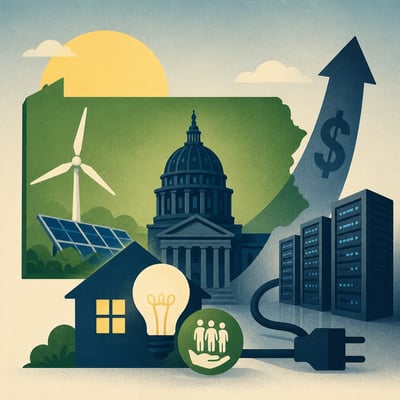
Lawmakers and advocates are pursuing clean energy incentives, grid upgrades, and consumer protections as electricity bills rise and large data centers increase pressure on power systems.
House Democrats have proposed restoring federal tax credits and assistance programs, while Pennsylvania legislators are considering rules for data centers, utility profits, transmission technology, and battery storage. The measures face political and industry disagreements, and several remain proposals or await Senate action.
The story now sharpens around federal tax credit restoration, with House Democrats tying relief to the Trump administration's phaseout and emphasizing the political difficulty of passage. Pennsylvania's side is also more clearly framed as pending Senate action on a broader package of data center, utility, storage, and assistance measures.
The story now centers more explicitly on concrete legislative action in both Washington and Pennsylvania, including federal Democrats’ proposal to restore clean-energy and household-energy incentives and new state efforts aimed at large data centers. It also adds a clearer policy split: supporters frame the measures as affordability fixes, while some developers question whether renewed wind and solar tax credits are still necessary.
- House Democrats proposed restoring renewable, home energy, and efficiency incentives.
- Pennsylvania lawmakers are considering data center disclosure and power-sourcing rules.
- Pennsylvania electricity rates and service terminations have risen.
- Proposed battery storage target reaches 3,000 megawatts by 2033.
- Some developers say wind and solar no longer need repeated tax-credit extensions.
The story has broadened from a Pennsylvania-led clean energy and household relief push into a more explicit electricity-affordability and grid-capacity agenda centered on storage, transmission, and large-load management. The current version also adds more named political and utility actors, but the core direction remains the same.
Pennsylvania lawmakers and allied House Democrats are advancing measures that tie household electricity relief to broader clean energy policy changes. The central approach is to restore or expand clean energy incentives, boost low-income assistance, and reduce the cost burden of rising electricity demand on ratepayers. A major related thread is new scrutiny of data center growth and how large load customers affect grid costs, infrastructure needs, and consumer bills.