
 AI Governance
 Data Centers
 Drones
 Climate
 Privacy
 2026 Maine Senate
 Bob Dylan
New York’s Climate Liability Blocked
Coverage from Heatmap, Climate Change Dispatch, and others
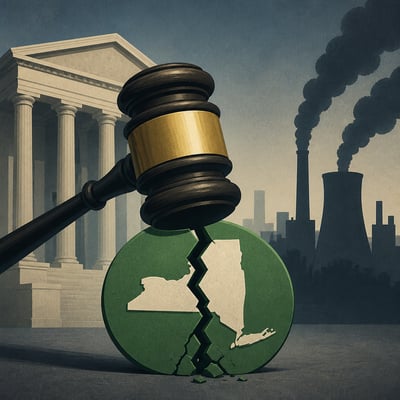
A federal judge blocked New York’s Climate Change Superfund Act, which sought about $75 billion from fossil fuel companies to fund climate adaptation projects.
The court held that the state scheme was preempted by the federal Clean Air Act and raised concerns about regulating emissions originating outside New York, including from foreign producers. The ruling puts similar state climate liability laws under pressure while New York considers an appeal and related cases proceed elsewhere.
If you read one thing
It provides the clearest broad overview of the ruling, the proposed $75 billion adaptation fund, and its implications for state climate-liability laws.
Best explainer
It most directly explains the court’s preemption, interstate-emissions, and foreign-affairs reasoning behind the decision.
The evidence
It adds concrete detail on the law’s intended $75 billion climate-resilience funding mechanism and its consequences for adaptation projects.
The evidence
It situates New York’s ruling within the broader legal uncertainty facing Vermont and other state climate-superfund measures.
Federal limits on state climate liability
New York’s law remains invalidated after the court found that it effectively regulated interstate and global greenhouse-gas emissions in an area preempted by the Clean Air Act. Federalism and foreign-affairs concerns further constrain state efforts to impose broad climate-damage liability on global fossil-fuel producers.
Adaptation funding mechanism blocked
New York’s proposed $75 billion mechanism—approximately $3 billion annually over 25 years—cannot currently finance flood protection, drainage, transportation, coastal restoration, and other resilience work through fossil-fuel payments. That cost-recovery route is unavailable unless the judgment is overturned or replaced by another funding mechanism.
Comparable state programs face legal uncertainty
The New York ruling reinforces preemption-based challenges to climate-superfund and climate-damages measures elsewhere. Vermont’s law remains under federal-court challenge, while the Supreme Court’s Boulder County case and any New York appeal could determine how far states may go in assigning climate-related costs to fossil-fuel companies.
25 years
duration of the planned fossil-fuel-company charge
“On Monday, Chief Judge Brenda Sannes of the U.S. District Court for the Northern District of New York ruled that New York could not enforce its 2024 Climate Change Superfund Act. The law would have charged fossil fuel companies $75 billion over 25 years for climate damages associated with cumulative greenhouse gas emissions.”
2000 and 2024
greenhouse gas emissions period used to determine alleged company shares
“The Climate Change Superfund Act requires major fossil fuel companies to collectively pay $75 billion over 25 years based on their alleged share of greenhouse gas emissions between 2000 and 2024.”
25 years
duration of the required payments
“The Climate Change Superfund Act requires major fossil fuel companies to collectively pay $75 billion over 25 years based on their alleged share of greenhouse gas emissions between 2000 and 2024.”
$75 billion USD
collective liability imposed on major fossil fuel companies
“The Climate Change Superfund Act requires major fossil fuel companies to collectively pay $75 billion over 25 years based on their alleged share of greenhouse gas emissions between 2000 and 2024.”
25 years
duration of the authorized cost-recovery program
“On August 31, 2026, the U.S. District Court for the Northern District of New York struck down New York’s Climate Change Superfund Act. The Act established a Climate Change Adaptation Cost Recovery Program authorizing New York to recover $75 billion over 25 years from fossil fuel companies for their alleged contributions to greenhouse gas emissions. Chief U.S. District Court Judge Brenda K. Sannes granted summary judgment for the challengers, holding that the Act is preempted by federal law and cannot be enforced.”
The new reporting reiterates that New York’s Climate Change Superfund Act was invalidated on federal-preemption grounds, without materially changing the topic’s current state.
Previously
A federal district court struck down New York’s Climate Change Superfund Act, which would have required major fossil fuel producers and refiners to contribute roughly $75 billion over 25 years for flood protection, infrastructure repairs, and other climate adaptation projects. Judge Brenda Sannes held that the state measure was preempted by the federal Clean Air Act and raised additional federalism and foreign-affairs concerns because it addressed emissions originating beyond New York. New York may appeal, while similar laws and climate damages claims in Vermont and Colorado remain subject to litigation or Supreme Court review.
The current version largely confirms the prior account, adding only that the law was revised in 2025 and based liability on companies’ historical emissions.
The update mainly confirms the prior ruling and legal rationale, while specifically identifying Boulder County as another related climate-liability case.