
 AI Governance
 Data Centers
 Drones
 Climate
 Privacy
 2026 Maine Senate
 Bob Dylan
AI Data Centers Strain Climate Commitments
Coverage from Let's Data Science, The Crucial Years, and others
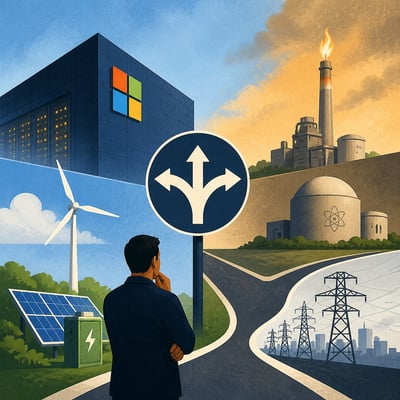
Rapid AI data-center construction is increasing electricity, water, and emissions pressures across Big Tech, while grid constraints are encouraging gas-fired power and intensifying local opposition.
Microsoft’s FY2025 emissions rose about 25%, and reports that it may weaken its 2030 hourly clean-energy target have made the tradeoff between growth, reliability, and decarbonization especially visible.
The story broadens from Microsoft’s emissions and clean-energy dilemma to the wider infrastructure consequences of AI expansion, including utility capacity, local water availability, and community scrutiny. Carbon-removal commitments also emerge as an additional climate target under pressure.
The main update is a more specific explanation for Microsoft’s reported emissions increase: electricity-related emissions rose sharply in reported share partly because accounting shifted away from unbundled renewable-energy certificates. The broader trajectory—rapid AI expansion increasing emissions and keeping the 2030 hourly clean-energy goal under review—is otherwise confirmed.
The current version largely confirms the existing story, with only a modest reframing toward the practical credibility of Microsoft’s 2030 commitment and decisions expected in 2026.
The update largely confirms the existing trajectory rather than changing it: Microsoft adds emphasis on water-use efficiency and newly identifies Chevron and Google in the broader comparison, but reports no decision on its 2030 clean-energy goal.
The story now adds an explanation for part of Microsoft’s emissions increase—ending non-additional renewable certificates—and highlights Virginia’s potential fossil-generation consequences, while the 2030 clean-energy target appears more vulnerable.
The story shifts from primarily measuring Microsoft’s emissions and clean-energy-target strain to emphasizing growing local opposition and corporate influence around AI infrastructure. Water efficiency improvements and comparisons with other technology companies add context, but do not materially alter the core climate-risk assessment.
The update quantifies the scale of Microsoft’s emissions shift more sharply, showing electricity-related emissions rising from 2% to 13% of its footprint. It also strengthens concern over the 2030 clean-energy goal by introducing possible abandonment, rather than merely a review.
The update makes Microsoft’s fossil-power response more concrete: some facilities are now using natural gas, while the company reviews parts of its 2030 strategy. It also adds Chevron and Virginia policy context.
The update adds methodological context for Microsoft’s emissions increase and clarifies that water replenishment exceeded withdrawals for the first time. The central tension over AI-driven growth and the 2030 hourly clean-energy goal remains unchanged.
The story now presents Microsoft’s 2030 hourly clean-energy target as potentially subject to delay or abandonment, rather than merely possible modification. It also broadens the pattern beyond Microsoft by citing Google’s emissions increases during AI infrastructure expansion.
The story is modestly broadened from Microsoft’s facility-level power constraints to wider utility and energy-partner pressure, particularly in Virginia. Chevron appears as a new energy partner, while potential nuclear power is added to the range of options under consideration.
The update adds an absolute emissions estimate and clarifies that accounting changes, alongside AI infrastructure growth, contributed to the increase. It also sharpens concern over Microsoft potentially delaying or abandoning its 2030 hourly clean-energy goal, though no decision has been made.
The story broadens from Microsoft’s corporate emissions and clean-energy dilemma to growing community, utility, and state-policy pressures associated with AI data-center expansion.
The update mainly confirms the prior account, while adding a clearer measure of electricity-related emissions and identifying Chevron’s reported involvement in Texas natural-gas discussions.
The story broadens beyond Microsoft’s disclosures to include utility and policy implications, especially potential natural-gas capacity in Virginia. The core finding remains unchanged, while Microsoft’s first reported year of replenishing more water than it withdrew adds a limited positive development.
The update mainly quantifies Microsoft’s existing emissions problem more precisely, including an absolute fiscal 2025 footprint and a sharp increase in electricity-related emissions. It also emphasizes annual renewable-energy matching while retaining uncertainty over continuous clean-power coverage.
The update adds an accounting caveat to Microsoft’s emissions trend and introduces new policy and industry-comparator context, while otherwise confirming the existing story.
Microsoft’s 2030 hourly clean-energy target is now framed as potentially delayed or abandoned, intensifying concern that AI growth may outpace its climate commitments.
The update largely confirms the previous account rather than introducing a new event. It sharpens the framing by linking AI-driven demand to state decarbonization timelines, particularly in Virginia and Texas, and by specifying renewable-certificate accounting as part of the emissions increase.
The update makes Microsoft’s natural-gas fallback more concrete by identifying facilities already using it, while adding accounting caveats that complicate emissions comparisons. Chevron also newly appears as a potential partner supporting gas capacity for Texas data centers.
The story broadens beyond Microsoft as Google’s rising AI-related emissions provide a comparison point, while community opposition and concerns over electricity costs and fossil-fuel demand sharpen the local consequences.
The story becomes more specific about Microsoft potentially delaying or abandoning its 2030 hourly clean-energy target, while clarifying that annual renewable matching does not resolve the hourly commitment. Chevron and Virginia’s clean-energy policy framework are newly identified stakeholders in the fossil-power and decarbonization tension.
The story broadens from Microsoft’s emissions and clean-energy commitments to the wider community and utility consequences of AI-driven data-center demand. Microsoft’s first-time water-replenishment milestone provides a limited counterpoint, but the central climate and infrastructure tensions remain.
The story moves from planned or contemplated fossil-fuel support toward reported natural-gas use at at least two data centers, while adding improved data-center water efficiency as a mitigation measure.
The story now presents Microsoft’s 2030 hourly clean-energy target as potentially being delayed or abandoned, a more serious retreat than previously reported. It also adds new industry and energy-sector comparators, including Google and Chevron, while documenting broader renewable-energy contracting.
The story gains important accounting and operational nuance: Microsoft attributes part of its emissions increase to changing renewable-energy accounting, while natural-gas use is tied to reliability and grid-connection constraints. Water progress is also framed as a first-time achievement, but the core trajectory remains unchanged.
The current version largely confirms the existing story but sharpens the emissions picture: electricity-related emissions rose from about 2% to 13% of Microsoft’s reported footprint. It also more explicitly links Virginia data-center demand to debate over additional fossil-fuel generation.
The story has become more concrete and consequential for Microsoft: emissions and electricity use are now quantified, and the company may delay or abandon its hourly clean-power goal. Reported reliance on natural gas at specific facilities and growing local opposition sharpen the implementation and community impacts.
The story has broadened from Microsoft reconsidering a clean-electricity target to a wider industry pattern of AI-driven emissions growth and pressure on procurement methods. It now places more emphasis on accounting rules, around-the-clock power needs, and Virginia grid stress as the practical bottlenecks.
- Microsoft reported a sharp year-over-year emissions increase in its latest sustainability filing.
- Google and Amazon are now explicitly included as peers facing similar emissions pressure.
- Unbundled certificates and hourly matching are now central procurement concerns.
- Virginia has become a focal point for data center load and utility planning.
- Microsoft reported improved global water efficiency and net replenishment.
The story is now framed more explicitly as a question of whether Microsoft will delay, soften, or drop its 2030 hourly clean electricity target, not just whether it will adjust procurement methods. The feasibility challenge has also broadened beyond supply mix to include grid, transmission, and interconnection constraints.
Microsoft is reportedly weighing changes to its 2030 hourly clean-energy matching goal as AI-driven data center growth increases electricity demand and complicates around-the-clock carbon-free power procurement. Reporting points to competing supply options, including gas, nuclear, renewables with storage, and grid upgrades, while Microsoft says no final decision has been announced. The issue has drawn criticism from climate groups and community advocates who say the company risks weakening an ambitious pre-AI-era commitment.