
 AI Governance
 Data Centers
 Drones
 Climate
 Privacy
 2026 Maine Senate
 Bob Dylan
Maine Blueberries Face Climate Extremes
Coverage from WBUR, Inside Climate News, and others
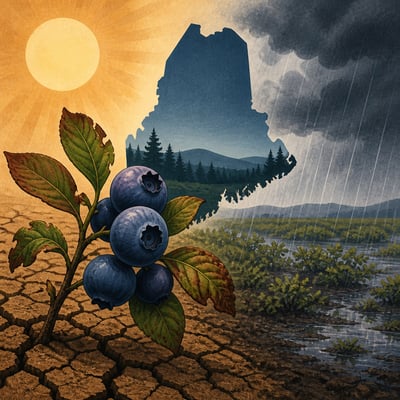
Maine’s wild blueberry industry is facing hotter conditions, drought, intense rainfall, frost risk, and increasingly variable seasons that are shifting ripening earlier and reducing harvest reliability.
Severe weather has contributed to major recent crop losses, while irrigation, mulching, improved plant management, and research may reduce some impacts but remain costly and difficult for smaller farms. The combination of climate exposure, weak prices, rising input costs, and limited adaptation infrastructure is increasing pressure on growers and could create longer-term supply constraints.
The story now emphasizes a sharper near-term harvest loss and a broader set of climate stresses, with a specific example showing just how severe 2025 losses were. It also reframes adaptation as constrained not just by cost, but by limited water, infrastructure, and financing for smaller farms.
The story now emphasizes that 2025 was especially damaging and that adaptation is becoming more technically developed, with researchers and industry groups testing resilience strategies and climate scenarios. It also newly frames the issue as potentially affecting processors, consumers, and prices because Maine’s output is so dominant nationally.