
 AI Governance
 Data Centers
 Drones
 Climate
 Privacy
 2026 Maine Senate
 Bob Dylan
Kelp Losses Outpace Carbon Removal
Coverage from New Scientist, PLOS Biology, and others
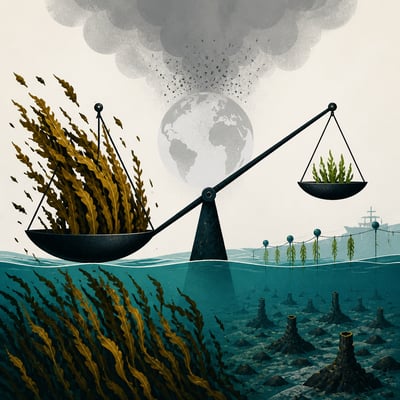
A global analysis finds that climate-driven kelp forest losses are occurring far faster than restoration, afforestation, or seaweed farming can generate carbon-removal gains.
With roughly 60% of kelp forests declining, the losses could substantially reduce natural carbon sequestration and increase cumulative emissions by 2050. The findings favor protecting existing kelp habitat, improving carbon accounting, and reducing greenhouse-gas emissions over relying on kelp restoration or seaweed-based offsets.
If you read one thing
It offers the clearest broad overview of kelp losses, the limits of restoration and cultivation, and the case for protecting existing forests.
The evidence
It adds specific projections on cumulative carbon-abatement losses and the scale gap between restoration and projected kelp decline.
Kelp losses outpace replacement
Climate-driven kelp forest decline is eroding carbon sequestration far faster than restoration, afforestation, or cultivation can replace it. Reporting describes roughly 60% of kelp forests as declining, with losses potentially reaching millions of hectares and substantially reducing future carbon abatement.
Protection is higher-value than restoration
The evidence favors preventing further kelp loss over relying on restoration to recreate lost carbon sinks: preserving kelp is reported to cost at least eight times less per hectare than restoring it. Yet only about 2% of kelp forests are in protected areas, leaving the lower-cost intervention substantially underused.
Seaweed-based carbon removal is unreliable
Seaweed cultivation and restoration provide biodiversity and coastal benefits but do not currently offer a dependable substitute for protecting natural kelp sinks or cutting emissions. In one assessment, emissions from operations offset or exceeded carbon burial in nine of 11 farms, while restoration gains remained far below losses from declining kelp forests.
nine of 11 farms
seaweed farms with emissions exceeding sequestration
“After emissions from farming operations such as boat fuel and plastic lines are included, nine of 11 seaweed farms in a study published earlier this year emitted more CO2 than they sequestered.”
50,000 tonnes tonnes of CO2 per year
CO2 removal from the northern Norway restoration
“The restoration benefited biodiversity but removes only about 50,000 tonnes of CO2 per year. By contrast, global kelp loss is estimated to emit 14 million tonnes of CO2 annually.”
2 per cent percent
kelp forests in protected areas
“The study says preserving kelp ecosystems is at least eight times cheaper per hectare than restoring them, while only 2 per cent of kelp forests are in protected areas.”
at least eight times
relative cost advantage of preserving versus restoring kelp per hectare
“The study says preserving kelp ecosystems is at least eight times cheaper per hectare than restoring them, while only 2 per cent of kelp forests are in protected areas.”
60 per cent percent
kelp forests in decline
“Karen Filbee-Dexter at the University of Western Australia and her colleagues concluded that, with about 60 per cent of kelp forests in decline, these ecosystems could eventually begin emitting more CO2 than they absorb.”
No new member articles were supplied, so there is no evidence of a material change in the topic.
Previously
A global analysis finds that climate-driven kelp forest losses are occurring far faster than restoration, afforestation, or seaweed farming can generate carbon-removal gains. With roughly 60% of kelp forests declining, the losses could substantially reduce natural carbon sequestration and increase cumulative emissions by 2050. The findings favor protecting existing kelp habitat, improving carbon accounting, and reducing greenhouse-gas emissions over relying on kelp restoration or seaweed-based offsets.