
 AI Governance
 Data Centers
 Drones
 Climate
 Privacy
 2026 Maine Senate
 Bob Dylan
Iowa’s Rising Demand Revives Coal Debate
Coverage from Inside Climate News, Iowa Capital Dispatch, and others
Going On
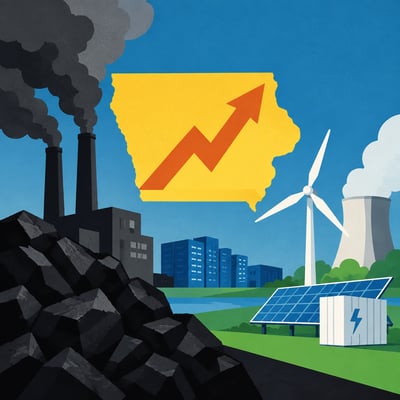
Iowa electricity generation increased from 70.
5 million megawatt-hours in 2024 to more than 74 million in 2025.
A few articles that between them cover the whole topic, picked by the role each one plays.
If you read one thing
Rising Demand Pushes Iowa Utilities Back Toward CoalIt provides the clearest evidence-based overview of rising demand, coal’s rebound and the competing pathways shaping Iowa’s power system.
The evidence
Iowa Scientists Urge Renewables as Electricity Demand RisesIt adds quantified demand projections and the perspective of more than 180 scientists advocating renewable deployment and storage.
The forces this coverage keeps returning to, and which way each has moved.
Electricity demand is accelerating
Iowa’s electricity generation rose from 70.5 million megawatt-hours in 2024 to just over 74 million in 2025. Data centers, AI, manufacturing, electric vehicles, and building electrification are expected to drive further growth, with MISO forecasting peak demand 38% higher in 2044 than in 2024.
Coal use and associated pollution have rebounded
Utilities increased coal’s share of their resource mixes in 2025 as overall generation grew, including increases at MidAmerican Energy and Alliant Energy’s Interstate Power and Light. The shift was accompanied by reported increases of more than 50% in sulfur dioxide and nitrogen oxide emissions.
Iowa is pursuing competing pathways for new capacity
Scientists and environmental advocates are pressing for faster wind, solar, and battery deployment, while utilities are using an all-of-the-above approach that includes renewables, coal, natural gas, and a restarted nuclear facility. Storage is presented as a way to manage reliability and demand without increasing coal dependence, but renewable expansion faces project, cost, and siting constraints.
Figures the coverage reports, each traced back to the sentence it came from.
12 percent
Interstate Power and Light coal share of resource mix
“The Iowa Environmental Council’s annual report, based on data reported to the Federal Energy Regulatory Commission, found that MidAmerican Energy increased coal’s share of its resource mix from 21 percent in 2024 to 27 percent in 2025. Interstate Power and Light, an Alliant Energy subsidiary, increased coal’s share from 12 percent to 20 percent.”
21 percent
MidAmerican Energy coal share of resource mix
“The Iowa Environmental Council’s annual report, based on data reported to the Federal Energy Regulatory Commission, found that MidAmerican Energy increased coal’s share of its resource mix from 21 percent in 2024 to 27 percent in 2025. Interstate Power and Light, an Alliant Energy subsidiary, increased coal’s share from 12 percent to 20 percent.”
70.5 million megawatt-hours
Iowa total electricity generation
“Iowa’s total electricity generation rose from 70.5 million megawatt-hours in 2024 to just over 74 million in 2025.”
More than 180 scientists and sustainability scholars
signatories or participants in the Iowa climate statement
“More than 180 Iowa scientists and sustainability scholars from universities and other organizations across the state have asked Iowans to advocate for deploying renewable energy systems to meet growing electricity demand.”
more than 50 percent
Increase in sulfur dioxide and nitrogen oxide emissions
“Alliant and MidAmerican reported more than 50 percent increases in sulfur dioxide and nitrogen oxide emissions from 2024 to 2025.”
No new topic members were supplied, so there is no evidence of a material change in Iowa’s rising electricity demand, coal and wind generation mix, or the debate over lower-emission reliability options.
Previously
Iowa is generating more electricity as data centers, manufacturing, electrification, and other industrial activity increase demand, but utilities have also raised coal’s share of generation while wind output declined in 2025. Scientists and environmental groups are urging faster deployment of wind, solar, and battery storage, while utilities are pursuing a broader mix that includes natural gas and a restarted nuclear facility. The debate has implications for air pollution, electricity costs, grid reliability, and Iowa’s longer-term decarbonization goals.
Every article behind this topic, ranked by CI Score.