
 AI Governance
 Data Centers
 Drones
 Climate
 Privacy
 2026 Maine Senate
 Bob Dylan
India’s Solar Boom Meets Its Grid
Coverage from Arkansas Online, WKMG News 6 & ClickOrlando, and others
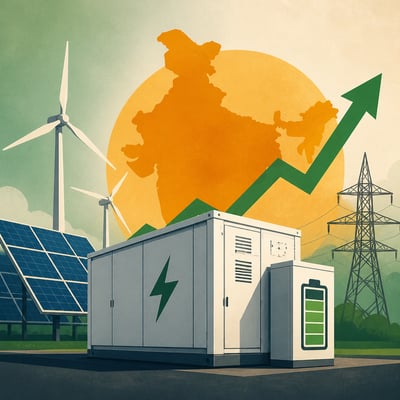
India is expanding renewable capacity rapidly, but transmission congestion, limited storage, and inflexible coal generation are preventing the power system from absorbing all available solar and wind output.
Curtailment is concentrated in major renewable-producing states such as Gujarat and Rajasthan, while rising cooling and agricultural-pumping demand increases the need for electricity after solar production declines. India is responding with expanded transmission, battery and pumped storage, hybrid renewable projects, digital grid management, and proposed storage and grid-forming-inverter requirements for new projects.
The story is more concretely quantified: renewable curtailment reached nearly 11 TWh, while proposed storage rules now specify capacity and duration requirements. The framing also shifts modestly toward the operational challenge of integrating capacity rather than merely adding it.
The story now includes a concrete proposed policy response: certain new government-backed renewable projects would need storage and grid-forming inverters from 2027. Storage requirements are also quantified more precisely, reinforcing a shift from diagnosing grid constraints toward enforcing flexibility measures.
The story is now framed less as a generation-buildout problem and more as an integration problem: transmission, storage, forecasting, and market rules are failing to keep pace. Curtailment is presented as concentrated and increasingly consequential as later-day cooling and agricultural demand rises.
The story now centers more concretely on India’s demand-growth and industrialization pressures, with a sharper emphasis on specific grid-capacity and manufacturing constraints rather than just storage and transmission execution. It also adds a clearer policy-industrial dimension, highlighting domestic clean-energy manufacturing as part of the response.
The story has shifted from a general grid-and-storage bottleneck narrative to a more execution-focused account centered on specific deployment, regulatory, and financing hurdles. It now emphasizes that storage is moving closer to commercialization while policy reforms and DISCOM stress determine whether India can actually absorb more renewables.
- Storage is moving from planning to near-term deployment.
- Policy support now includes storage obligations and viability funding.
- DISCOM financial stress is limiting grid-upgrade investment.
- Coal plant flexibility limits are forcing renewable curtailment.
- Tesla is beginning to look at India's storage market.
The story has shifted from a broad warning about grid constraints into a more specific emphasis on evening demand balancing and the commercial/storage ecosystem needed to solve it. The current version also broadens the set of stakeholders by highlighting industrial users and new corporate players around storage.
The story has shifted from a broad clean-power scaling challenge to a more specific grid-integration problem, with transmission congestion, curtailment, and storage market design now framed as the main limiting factors. The current version also adds stronger emphasis on execution bottlenecks and brings in Avaada as another major developer exposed to these constraints.
- Delayed inter-state transmission schemes are now highlighted as a key constraint.
- Renewable curtailment is described as especially acute in the north and west.
- New procurement structures and policy support are shaping storage deployment.
- Avaada Group is newly named as a prominent developer in the story.
- Policy emphasis is shifting toward grid modernization and dispatchable power.
The story now emphasizes that India’s clean-power challenge is not just grid delivery, but a more explicit execution phase where storage and transmission must scale together under tighter regulation. A new policy angle has emerged around restricting merchant battery grid-charging flexibility, while forecasts for BESS and pumped hydro make storage a central system requirement.
- India has already exceeded its 2030 non-fossil capacity target.
- Regulators are limiting merchant battery grid-charging flexibility.
- Large BESS and pumped-hydro pipelines are forecast through 2033 and 2031-32.
- The transition is framed as an execution phase, not just a capacity buildout.
The story has shifted from a broad warning about renewable oversupply and grid bottlenecks to a more specific delivery challenge: transmission, storage, land access, and procurement design now determine whether new clean power can actually reach users. That reframes the issue as an execution and market-structure problem, not just a buildout problem.
- Land access is now identified as a key constraint on renewable delivery.
- Procurement rules are newly highlighted as shaping how power reaches customers.
- Commercial and industrial users are driving hybrid and round-the-clock renewable demand.
- Large developers may have an execution advantage over smaller players.
- Storage market entrants are becoming more important, but remain secondary to grid buildout.
The story has sharpened from a general storage-growth narrative into a more concrete grid-congestion problem, with measurable curtailment and transmission bottlenecks now driving urgency. It also adds a stronger operational test case in Khavda, where massive renewable buildout is now tied directly to storage and network upgrades.
- Ember estimates about 300 GWh lost in Q1 2026 from transmission constraints.
- Transmission congestion is now identified as a measurable operational bottleneck.
- Khavda is highlighted as a major test case for solar, storage, and network upgrades.
- Policy support now explicitly includes viability-gap funding and ISTS waivers.
India's energy storage market is scaling quickly around grid reliability, renewable integration, and policy support. Large battery projects, new tenders, and forecasts for major capacity growth dominate the signal, while Tesla's planned entry adds a prominent commercial thread.