
 AI Governance
 Data Centers
 Drones
 Climate
 Privacy
 2026 Maine Senate
 Bob Dylan
India Expands Solar Supply Chains
Coverage from pv magazine USA, Deutsche Welle, and others
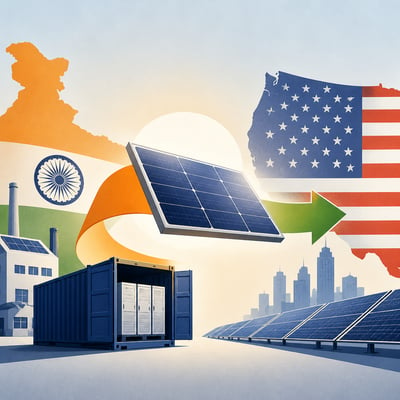
India is expanding solar module and cell manufacturing while positioning itself as an alternative supplier to China for the U.
S. and European markets. A U.S.-India trade agreement that lowers reported tariff exposure on Indian solar exports to 18% could improve demand visibility and support further exports, although U.S. trade investigations remain a risk. India’s upstream supply chain is still incomplete, with heavy reliance on China and other imports for wafers, polysilicon, equipment and specialized clean-energy materials.
The main change is that the tariff story has become more concrete: the U.S. and India reportedly agreed to cut tariff exposure on Indian solar exports to 18%, which could strengthen export prospects. At the same time, the new version adds a fresh downside risk from potential U.S. antidumping and countervailing duties.
The story has broadened slightly from solar modules alone to a wider industrial-policy push that now includes wafers, polysilicon, inverters, and selected hydrogen components. The core thesis remains unchanged: a reported US-India tariff deal could help Indian exporters, but China’s upstream dominance still constrains India’s ability to offer a fully independent alternative.
The story has broadened from a U.S.-India tariff and export issue into a wider supply-chain diversification narrative centered on India’s push to become a partial alternative to China across solar and adjacent clean-energy components. The new version also adds that this diversification is constrained by persistent dependence on Chinese upstream inputs and may take years to fully scale.
- India is targeting upstream solar inputs such as polysilicon, ingots and wafers.
- European buyers are seeking non-Chinese solar equipment.
- China remains dominant in wafers, polysilicon and manufacturing equipment.
- India’s localization plans now include green hydrogen and wind-energy components.
- Diversification will take years and may carry a price premium.
The update sharpens the tariff story by specifying the reduced duty level at 18% and clarifying that US trade enforcement investigations still remain active in the background. It also more explicitly frames the consequence as improved US project economics and stronger Indian export positioning.
The cluster is centered on a US-India trade agreement that materially reduces tariffs on Indian solar modules and related energy storage components. The immediate current signal is tariff relief for solar trade, with secondary attention on Indian manufacturing scale-up, export growth, and possible effects on US project economics and supply-chain diversification. Coverage is tightly aligned around the same policy change, with limited fragmentation.