
 AI Governance
 Data Centers
 Drones
 Climate
 Privacy
 2026 Maine Senate
 Bob Dylan
Heat and Drought Squeeze Europe’s Power
Coverage from POLITICO, CleanTechnica, and others
What's Going On
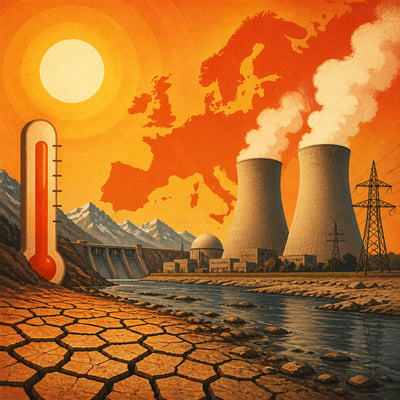
French nuclear plants lost substantial capacity as high river temperatures and environmental limits restricted cooling-water discharges.
Where It Stands
The forces this coverage keeps returning to, and which way each has moved.
Water-dependent generation is an operational constraint
Hot, low rivers are curtailing nuclear output and creating shutdown risks across France and Central and Eastern Europe, while low water has also removed coal capacity in Poland. Cooling requirements and environmental limits are converting heat and drought into direct generation constraints.
Heat is stressing supply and demand simultaneously
Heatwaves increase cooling demand while reducing the output or efficiency of nuclear, gas and wind generation and tightening cross-border supply. Short disruption periods can therefore produce import dependence, demand reductions and sharp price exposure even when annual generation impacts are limited.
Solar provides daytime relief, but flexibility is needed after sunset
Solar is helping meet heat-driven daytime demand as conventional generation faces cooling and water constraints. Its benefit weakens at the evening peak, increasing the importance of batteries, demand response, interconnection and other flexible resources.
Power planning is confronting climate-adjusted reliability limits
The episode is challenging historical assumptions about river cooling, hydropower availability and asset reliability. Responses include climate-adjusted design conditions, cooling upgrades, storage, interconnection and demand flexibility rather than reliance on conventional generation alone.
Start Here
A few articles that between them cover the whole topic, picked by the role each one plays.
If you read one thing
How Heatwaves Affect Nuclear, Gas, Wind, Solar and StorageIt provides the broadest explanation of how heatwaves simultaneously constrain generation, increase demand, and raise the value of flexibility.
The counter-case
France’s Heatwaves Show Nuclear Power’s Manageable LimitsIt presents the qualifying manageable-curtailments case that nuclear output losses can remain limited while firm generation supports resilience.
The evidence
Climate Risks Expose Europe’s Nuclear Power VulnerabilityIt supplies strong quantified evidence that water stress is changing nuclear planning and increasing freshwater reliability exposure.
The evidence
Heatwaves Boost Europe’s Solar Output, But Storage Is NeededIt adds the distinct mitigation perspective that solar can stabilize grids during daytime heat stress while storage remains important after sunset.
What's Contested
The disagreements that actually divide this coverage.
Do heat- and drought-related nuclear curtailments pose a major reliability threat to Europe’s electricity system?
The corpus presents two materially different strategic interpretations. Some sources describe heat-related nuclear reductions as short-duration and manageable through adaptation, firm generation, and system balancing. Others emphasize that heat and drought can remove substantial nuclear and other generation capacity during periods of peak cooling demand, increasing reliability, price, and fossil-fuel-dependence risks.
Manageable curtailments — 3 articles
Heat-related nuclear reductions are generally short-duration and manageable, with firm generation, adaptation, and system balancing helping preserve electricity-system reliability.
Material reliability exposure — 6 articles
Heat and drought can remove substantial nuclear and other generation capacity precisely when cooling demand rises, increasing electricity-system reliability, market-price, and fossil-fuel-dependence risks.
Key Numbers
Figures the coverage reports, each traced back to the sentence it came from.
15 percent
reactors worldwide dependent on freshwater sources under significant warming-related strain
“About 15 percent of reactors worldwide depended on freshwater sources under significant warming-related strain in 2022; the IAEA expects that share to reach 25 percent over the next 20 years.”
more than 70 percent
installed nuclear capacity in operation or under construction concentrated in Eastern North America, Western and Central Europe, and East Asia
“The International Atomic Energy Agency said more than 70 percent of installed nuclear capacity in operation or under construction is concentrated in Eastern North America, Western and Central Europe, and East Asia—regions facing hazards including extreme heat, heavy precipitation, floods and tropical cyclones.”
€4.3 billion euros
planned spending to adapt EDF plants to climate change
“France’s state-owned EDF said it plans to spend €4.3 billion by 2040 adapting its plants to climate change. Hungary’s Prime Minister Péter Magyar is reconsidering expansion plans for a plant whose cooling system he said is unfit for global warming conditions.”
The Story So Far
How the framing has shifted since the last time this topic was analysed.
The supplied articles reinforce that heat and drought constrain water-dependent power generation while solar can support the grid, but they introduce no material change to the Topic’s existing state.
Previously
Exceptional heat and drought across Europe in June-August 2026 disrupted electricity generation and transmission while increasing demand for air conditioning. Nuclear reactors in France, Hungary, Romania and Switzerland faced output restrictions or shutdown risks because rivers were too warm or low for normal cooling, while hydropower reservoirs and wind generation also weakened. Solar generation and batteries provided support in some markets, but the episode highlights the need for improved cooling, storage, interconnection and demand flexibility as climate extremes place simultaneous pressure on power systems.
History
The update mainly confirms the existing account while sharpening the focus on specific Danube constraints and framing water dependence as a persistent vulnerability of Europe’s power system.
The story has broadened from water-related nuclear and hydropower losses into a wider, multi-country power-system stress event affecting transmission and wind as well as generation. Solar and batteries provided partial relief, while reduced French exports and higher prices underscored the market impact and intensified focus on resilience measures.