
 AI Governance
 Data Centers
 Drones
 Climate
 Privacy
 2026 Maine Senate
 Bob Dylan
Global Map Exposes Fungal Carbon Networks
Coverage from Inside Climate News, Grist, and others
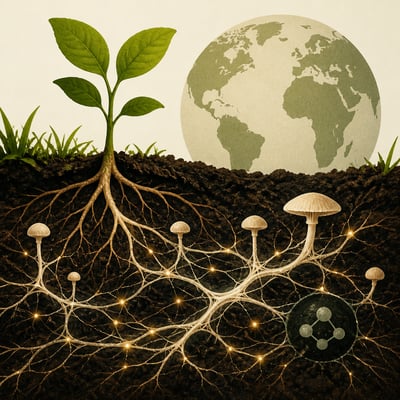
Researchers have produced the first global maps of living arbuscular mycorrhizal fungal networks, combining more than 16,000 soil samples, machine-learning models, and laboratory imaging.
The study estimates that these networks extend across roughly 110 quadrillion kilometers, partner with most plant species, and help move and store carbon in soils. It also identifies major pressures: fungal network density is about half as high in croplands as in wild ecosystems, while grasslands hold a large share of global fungal biomass but receive limited protection. The findings give climate and conservation planners a clearer, though still incomplete, basis for considering underground fungal systems in land and soil decisions.
The story now adds methodological detail and sharper quantification, showing the global fungal map is based on extensive soil sampling and imaging rather than just broad estimates. It also reframes the policy angle around land and climate planning, while stressing that major data gaps and incomplete coverage still limit confidence.
The story now emphasizes a clearer policy and advocacy turn: the global fungal map is not just adding ecological evidence, but being used to argue for stronger climate and conservation protection for fungi. The research framing also tightens around underground carbon storage and ecosystem resilience, while cropland and grassland vulnerability remains the main land-use concern.
The story has become more specific and data-driven, shifting from broad fungal conservation coverage to global-scale measurement of arbuscular mycorrhizal networks and their soil-carbon role. It also adds a sharper land-use angle, with cropland conversion, tillage, and weak protection emerging as the main threats.
- Planetary-scale mapping now quantifies arbuscular mycorrhizal fungal networks.
- Cropland conversion and tillage are identified as major drivers of fungal loss.
- Grasslands are described as holding a large share of predicted fungal biomass.
- Weak protection is reducing fungal density in important ecosystems.
- The evidence base grew to seven articles, concentrated in June 2026.
Recent coverage treats fungi as a climate-relevant ecosystem layer, with emphasis on mycorrhizal networks, soil carbon storage, biodiversity mapping, and growing conservation efforts that seek formal policy recognition and protection.