
 AI Governance
 Data Centers
 Drones
 Climate
 Privacy
 2026 Maine Senate
 Bob Dylan
Glacier Tourism Faces Climate Risks
Coverage from Grist, WAMC, and others
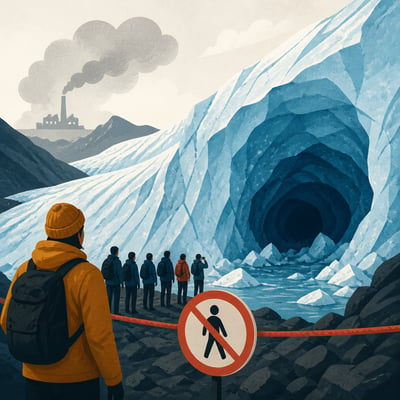
Glacier retreat is increasing interest in glacier destinations, turning them into sites of last-chance tourism, climate awareness and ecological grief.
The resulting visitor growth can add emissions and environmental damage, while unstable ice caves and extended operating seasons create serious safety risks, as illustrated by the 2024 Breiðamerkurjökull collapse in Iceland. The central policy challenge is to manage access and local livelihoods without reinforcing the forces accelerating glacier loss.
The story now places greater emphasis on governance and operational pressure: glacier tourism is not just risky and climate-linked, but is being pushed into longer seasons by commercial demand, prompting calls for stronger science-based regulation. It also broadens the stakes by explicitly tying glacier melt to water security for nearly two billion people.
The story now adds a concrete 2024 fatal ice-cave collapse in Iceland and a named coordination mechanism, making the safety risk more immediate and operational than before. It also sharpens the global tourism frame with a quantified visitor estimate and a stronger emphasis on last-chance tourism.
- The ten most visited glaciers draw more than 14 million visitors annually.
- The 2024 Blue Flame collapse killed one visitor and critically injured another.
- Icelandic stakeholders created GLACIS for cave-status and safety communication.
- The cited research was published in 2026.
- The story now emphasizes last-chance tourism more explicitly.
The story is framed less as a tourism-emissions tension and more as a broader governance problem around glacier loss, with stronger emphasis on water security and the need for tighter operational limits. New institutional references also broaden the cast beyond local stakeholders.
Glacier retreat is driving more "last chance" tourism even as it raises emissions, increases safety risks at unstable ice caves, and adds pressure to communities that depend on glacier meltwater. The strongest current signal is the tension between visitor demand and science-based limits on access, especially in Iceland.