
 AI Governance
 Data Centers
 Drones
 Climate
 Privacy
 2026 Maine Senate
 Bob Dylan
Extreme Heat Adaptation Pressure
Coverage from PBS News, The Guardian, and others
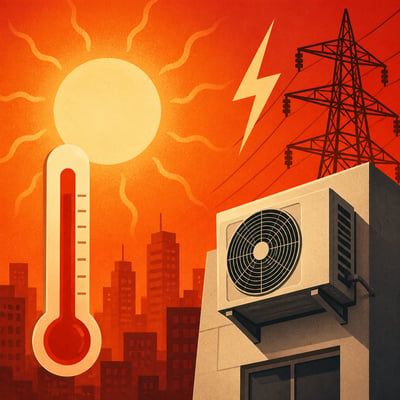
Recent material shows a clear push toward heat adaptation planning as warming intensifies cooling demand, strains electricity systems, and exposes gaps in health, housing, and water infrastructure.
The strongest signal comes from repeated findings on extreme heat exposure and UK adaptation warnings, with climate models and agency assessments converging on the need for faster cooling, resilience, and water management.
The story has shifted from a future-facing research projection to a live, unfolding heat emergency across Europe. What was previously about projected adaptation needs is now about immediate disruptions, health warnings, and record-breaking temperatures already affecting daily life.
- Early-season heat waves are breaking temperature records across Europe.
- Heat alerts are being issued by health agencies and governments.
- Climate Action Week events in London have been canceled.
- Schools, hospitals, transport, and sports events are being disrupted.
- Coverage now emphasizes Europe’s rapid warming and poor heat readiness.
The story has shifted from UK river whiplash to a broader Oxford-led climate adaptation finding: extreme heat exposure is projected to surge globally by 2050, with cooling demand rising fastest in hotter, lower-income regions. The new framing raises the urgency from water-management adaptation to near-term building, energy, and health resilience.
- Extreme heat exposure is projected to nearly double by 2050 under 2C warming.
- Cooling demand is expected to rise rapidly before 1.5C warming is reached.
- A global dataset of heating and cooling degree days accompanies the research.
- Oxford researchers Jesús Lizana and Radhika Khosla are now named.
- Nature Sustainability is identified as the publication.
The story has shifted from an acute heatwave disruption narrative to a longer-term climate adaptation story about how warming will destabilize UK river behavior. The new focus is on projected flood-drought whiplash and the need for region-specific water planning rather than one-size-fits-all responses.
- Research covers 698 UK river catchments.
- Study models 2C and 4C warming scenarios.
- Western UK faces greater flood-risk increases; southern England faces longer dry spells.
- Some catchments may rise from four to seven or nine whiplash events.
- University of East Anglia and Dr Yi He are new story actors.
The story has shifted from projected future heat risk to an active, severe heatwave already affecting Europe, with records, health warnings, and service disruptions now materializing in real time. The new emphasis is on immediate operational and public-health impacts, plus direct attribution of the event to climate change.
- Record or near-record temperatures are affecting the UK and much of Europe.
- Heat alerts now include amber and red warnings from public authorities.
- Suspected heat-related fatalities have been reported in France.
- Climate Action Week events in London were cancelled or disrupted.
- Attribution groups say the heatwave is exceptionally severe for the region and time of year.
The story has shifted to a different climate-risk theme: from UK river flood-drought volatility to Oxford-led research on sharply rising global heat exposure and cooling demand by 2050. This materially broadens the geography, stakeholders, and policy implications toward health, electricity demand, and building adaptation.
- Extreme heat exposure is projected to nearly double by 2050.
- Cooling demand is expected to rise sharply in tropical and equatorial regions.
- Cold-climate countries may still face large increases in hot days.
- Early adaptation in buildings and cooling systems is urged.
- High-resolution global maps of cooling and heating degree days are used.
The story has shifted from heatwave disruption to a new UK-focused climate modeling study about hydroclimatic whiplash. The key new insight is that warming may push river catchments toward faster alternation between flooding and drought, requiring region-specific water management rather than one-size-fits-all planning.
- Modeling spans 698 UK river catchments.
- Study published in Earth's Future in June 2026.
- Projected scenarios compare 2C and 4C warming.
- Western and northern UK face higher flood risk.
- Southern and southeastern England face longer dry spells.
The story has shifted from a forward-looking projection about future extreme heat exposure to a live European heatwave emergency already disrupting daily life. The new version adds concrete impacts, official warnings, and attribution claims tying the severity to climate change.
- Europe is in a series of unusually early heatwaves in May and June 2026.
- Health authorities issued amber and red heat warnings.
- Heat disrupted travel, schools, and public events.
- Reports link the heatwaves to human-caused warming and fossil-fuel pollution.
- Heat has caused localized strain on electricity, transit, and cooling capacity.
The story has shifted completely from UK river hydroclimatic whiplash to a broader Oxford-led study on extreme heat exposure, cooling demand, and adaptation needs by 2050. The new framing expands the geography, stakeholders, and policy implications from water management to buildings, electricity systems, and public health.
The story has narrowed from broad heat-adaptation concerns to a specific new UK hydrology study showing faster alternation between flood and drought conditions. The key shift is a more detailed regional planning message: western and northern catchments face greater flood risk, while southern and eastern areas face deeper water-stress and drought risks.
- Study projects hydroclimatic whiplash across 698 UK river catchments.
- Regional impacts differ sharply between western/northern and southern/eastern England.
- Dry-to-wet swings may increase flash-flood risk and water-quality problems.
- Wet-to-dry swings may undermine drought planning after wetter periods.
- Study was published in June 2026 in Earth's Future.
The story has become more explicitly framed as a practical adaptation-planning issue, not just a warning about heat exposure. The UK now stands out more clearly as the main test case, while new emphasis falls on power-system strain and water-security planning.
The story has become more concrete and operational, shifting from general heat-adaptation pressure to specific warnings about cooling demand, building retrofits, and water-related resilience. It also adds a new institutional and technical focus on UK social housing and vulnerable buildings.
The story has broadened from a general heat-and-cooling adaptation theme into a more explicitly cross-sector planning problem, with stronger emphasis on electricity networks, health systems, and urban inequality. The UK remains central, but the framing now highlights practical operational stress and governance pressure rather than just future adaptation needs.
The story has broadened from a UK-focused adaptation push into a wider climate-risk and infrastructure narrative centered on extreme heat, cooling demand, and power-system stress. The emphasis has shifted from specific policy pressure on vulnerable buildings to a more general operational challenge for buildings, grids, and public services.
- Multiple sources project much larger populations exposed to extreme heat by midcentury.
- Cooling demand is rising faster than heating demand is falling.
- Extreme heat is linked to electricity-system load pressure.
- Adaptation scope now includes India, Nigeria, Bangladesh, Pakistan, and the Philippines.
- Heat pumps face affordability, insulation, and electricity-cost barriers.
The story has sharpened from a broad UK adaptation agenda into a more concrete, current heat-response policy push driven by record May temperatures and official warnings. Cooling in vulnerable public buildings and workplace heat limits now read as the most immediate measures, while water, flood, and grid resilience remain part of the same package.
The story has shifted from a broad climate-heat adaptation discussion to a specifically UK policy and funding agenda. The new emphasis is on concrete measures—cooling in public-facing buildings, workplace heat limits, and large-scale investment—alongside flood, drought, and water-security planning.
- UK Climate Change Committee issued explicit adaptation recommendations.
- Cooling is urged for care homes, hospitals, schools, and vulnerable households.
- Workplace maximum-temperature rules are being proposed.
- Flood, drought, and water-security planning joined heat adaptation priorities.
- CCC estimated adaptation investment at about £11 billion annually.
Recent climate research and commentary point to rapidly rising extreme-heat exposure, higher cooling demand, and growing stress on buildings and power systems. Heat pumps, passive cooling, and building decarbonisation recur as adaptation tools, while inequality and grid capacity remain central constraints.