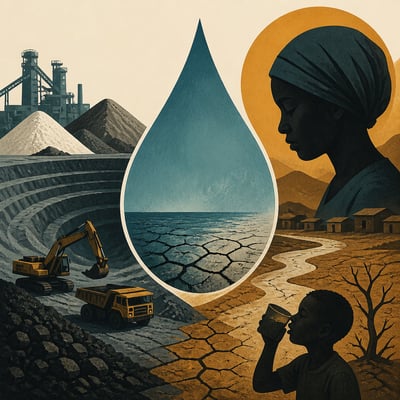
The Water Costs of Critical MineralsThe Water Costs of Critical MineralsCoverage from Northwestern Now, OilPrice.com, and others
00/00/0000
DailyWeekly
Critical-mineral mining is expanding alongside demand for electric vehicles, batteries, renewable-energy equipment, power systems, and digital technologies, but extraction is intensifying concerns over water depletion, pollution, health, and community rights.
Evidence and analysis focus on mining regions including the Democratic Republic of the Congo, the Lithium Triangle, and the western United States, where environmental pressures can compound existing water stress. The central policy tension is how to secure mineral supplies while limiting new extraction through stronger safeguards, recycling, alternative materials, lower material demand, and greater local participation.
Looking Back
128 Day Timeline
Articles published over time. Hover any bar for the period and its article count.
Apr 29
May 20
Jun 10
Jul 4
Jul 25
Aug 15
Sep 5
History
09/07/2026
The story now places less exclusive emphasis on clean-energy demand, highlighting construction, defense, manufacturing, conventional transport, and artificial intelligence as additional mineral-demand drivers. It also gives greater prominence to demand reduction, recycling, material substitution, and reuse as potential alternatives to new extraction, while stressing their limited near-term impact.
07/23/2026
The story now places greater emphasis on concrete execution and near-term policy changes: the EU is actively fast-tracking strategic mines while considering water-permitting changes, and a new U.S. study sharpens the risk outlook for proposed lithium projects. It also broadens the conflict beyond water impacts to include labor and consultation failures, making community-rights concerns more central.
Northwestern University researchers project water shortages for most proposed U.S. lithium mines from 2040 to 2060, especially in the Salton Sea region and Nevada.
The Oakland Institute found in 2024 that clean-energy technologies and electric vehicles represented 26% of six-mineral demand globally, while other industries accounted for most consumption.
9/6/2026 • Economy, Business & Innovation • General
UNU-INWEH led a report in 2024 warning that lithium and cobalt mining for clean energy can intensify water insecurity, health harms, and inequality in mining regions.
In a 2026 commentary, the Oakland Institute argued that critical-mineral mining expansion serves artificial intelligence, military, and other industries as well as clean-energy technologies, with harms concentrated in Global South communities.
In 2026, the IEA reports rapid EV sales growth while debates over cobalt-linked battery supply chains focus on mining harms and shifting battery chemistries.
Energy-transition manufacturers and mining communities face rising mineral demand and environmental risks worldwide as electric vehicles and renewable infrastructure expand during the 2020s.
Report No.305 links critical-mineral supply-chain growth in the Amazon Basin to higher risks of criminalized mining and Indigenous harms across Brazil, Colombia, Peru, and Venezuela.
6/4/2026 • Economy, Business & Innovation • General
Springer Nature Research Communities / Akeem Adeyemi Oladipo53
A climate-energy analysis argues clean transition deployment can increase critical-mineral bottlenecks and environmental risks, and proposes polymer-based energy technologies.
5/31/2026 • Economy, Business & Innovation • General
Researchers at the United Nations University Institute for Water, Environment and Health reported water depletion and health harms from lithium, cobalt, copper, and rare earth mining across multiple countries, urging enforceable governance.
Saeed Mohammed Al Tayer of WGEO urged critical-minerals investment and governance for clean-energy net-zero progress at London Climate Action Week 2026.
6/28/2026 • Economy, Business & Innovation • General
Researchers linked critical minerals mining to water depletion, pollution, and health and food system harm in mining regions without stronger supply-chain monitoring and regulation.
Imperial County proposed Lithium Valley near the Salton Sea in California, but nonprofit lawsuits and water-and-power disputes are slowing plans and fueling local equity concerns.
6/3/2026 • Economy, Business & Innovation • General
Native leaders in South Dakota, Nevada, and Arizona report water and sacred-site impacts as the U.S. accelerates lithium mining for electric vehicle batteries through faster permitting and federal support.
UNU-INWEH describes water and pollution harms from critical-mineral extraction supporting electric vehicles and digital infrastructure, urging stronger standards and reporting.
The US Energy Security Index reports shale-era gains in oil and gas reliability while critical mineral and uranium dependencies increasingly raise energy security risk amid Persian Gulf conflict.
A 2025 Transition Mineral Tracker reported increased allegations of environmental and human rights abuses at mining operations tied to clean energy minerals across South America and Africa.
6/29/2026 • Economy, Business & Innovation • General
Business and Human Rights Centre reported 329 2025 allegations of abuses tied to transition minerals, with the sharpest increases in Africa, especially Zambia and the DRC.
University of Michigan researchers estimate North America has sufficient rare earth deposits to support clean energy supply chains amid rising global demand.
6/16/2026 • Economy, Business & Innovation • General
Amnesty International links increased critical mineral extraction for electric vehicles, renewables, and AI data centers to human rights and environmental abuses across multiple countries.
UNU-INWEH researchers report rising critical-minerals demand increases water depletion, toxic waste, and health risks in major mining regions such as the Democratic Republic of the Congo and South America's Lithium Triangle.
5/17/2026 • Economy, Business & Innovation • General
UNU-INWEH released an investigation in the 2020s linking critical mineral extraction for solar and battery supply chains to freshwater depletion, contamination, and health risks in the Democratic Republic of Congo and other mining regions.
Business and Human Rights Centre reported 148 transition-minerals abuse allegations in 2025 involving Chinese-backed projects, with Indonesia the highest-impact location.
UNU-INWEH in 2024 warned that lithium and cobalt extraction for batteries and microchips is depleting water and contaminating drinking sources in Congo, Bolivia, and Chile.
4/29/2026 • Economy, Business & Innovation • General
European Commission plans a Water Framework Directive revision during fast-tracked permitting for critical raw materials mines, while analyses link many projects to drying and drought-prone regions in Spain, Portugal, and Greece.
Mineral economics research estimates USD 2.1 trillion in 2024-2050 mining investment needs for net-zero minerals, citing sharp graphite and lithium demand growth and ESG-linked financing risks.
6/23/2026 • Economy, Business & Innovation • General

 AI Governance
 Data Centers
 Drones
 Climate
 Privacy
 2026 Maine Senate
 Bob Dylan