
 AI Governance
 Data Centers
 Drones
 Climate
 Privacy
 2026 Maine Senate
 Bob Dylan
Climate Change Raises Rodent Virus Risks
Coverage from ORF Middle East, The Microbiologist, and others
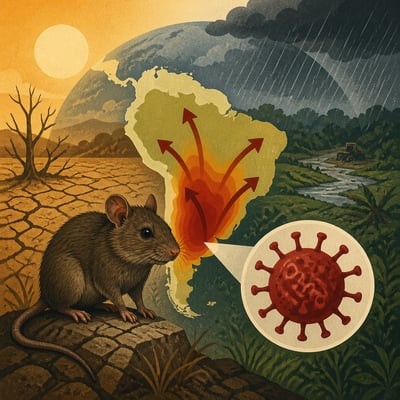
Research and outbreak reporting are linking climate variability, extreme weather, habitat disruption, and human expansion with changing risks from rodent-borne diseases, particularly hantaviruses and New World arenaviruses.
Models project that climate and population changes could make previously non-endemic parts of South America more suitable for arenavirus transmission, while drought, rainfall, flooding, and land-use change may alter rodent abundance and human exposure. The evidence supports stronger climate-informed surveillance and forecasting, but specific outbreaks cannot generally be attributed to climate change without dedicated attribution studies.
The story shifts from broad climate-sensitive infectious diseases to a focused assessment of rodent-borne viruses, adding quantified projections for arenavirus expansion and concrete travel-linked and Argentine outbreak evidence. Attribution remains cautious: climate change is a plausible influence, but not an established cause of specific outbreaks.
The story has broadened from general climate-disease risk to a more specific preparedness frame, with renewed attention to hantavirus in Argentina and Africa and clearer emphasis on cross-sector response needs. It also adds a more explicit call for attribution research, diagnostics, and rapid-response planning before transmission becomes established in new places.