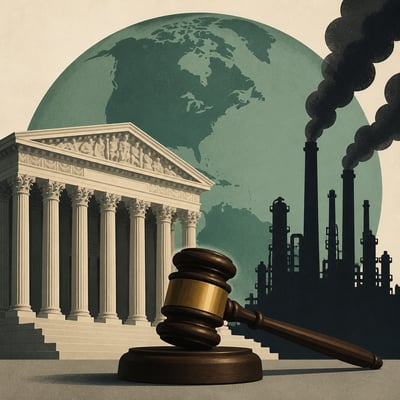
It documents the litigation-driven political scrutiny surrounding National Academies attribution research and its potential financial stakes.
Politico · 06-11-202675
Where It Stands
The forces this coverage keeps returning to, and which way each has moved.
01
Attribution is more actionable but remains hazard-specific
Improved observations, models, ensembles, and methodological standards now support more reliable estimates of how warming changes the likelihood or intensity of heat and large-scale rainfall. Confidence remains materially lower for localized storms, tornadoes, circulation-driven extremes, and data-scarce regions.
Drawn from 5 articles
02
Boulder case is a national litigation gateway
The Supreme Court’s review of Boulder’s claims against ExxonMobil and Suncor is testing whether local governments can pursue climate-adaptation damages under state law. The outcome could affect more than two dozen similar suits and billions of dollars in potential fossil-fuel liability, while questions about causation and damages would remain even if the case proceeds.
Drawn from 4 articles
03
Scientific credibility and liability pathways face organized political pressure
The National Academies’ attribution work is being challenged over funding, peer review, institutional independence, and alleged litigation connections. In parallel, fossil-fuel allies and congressional Republicans are pursuing measures and legal strategies that could restrict or immunize companies from climate-liability claims.
Drawn from 5 articles
Key Numbers
Figures the coverage reports, each traced back to the sentence it came from.
more than two dozen lawsuits
similar climate-liability lawsuits
brought by states, cities, counties and tribes
“The companies’ lawyers said allowing cases like Boulder’s to proceed could expose the fossil-fuel industry to billions of dollars in damages through lawsuits across the country. A ruling for the companies could stop Boulder’s case and affect more than two dozen similar lawsuits brought by states, cities, counties and tribes. A ruling for Boulder would still leave unresolved questions about how courts could calculate each company’s contribution to global emissions and the resulting effects in a particular locality.”
NBC News
billions dollars
potential damages faced by the fossil-fuel industry
if similar lawsuits proceed across the country
“The companies’ lawyers said allowing cases like Boulder’s to proceed could expose the fossil-fuel industry to billions of dollars in damages through lawsuits across the country. A ruling for the companies could stop Boulder’s case and affect more than two dozen similar lawsuits brought by states, cities, counties and tribes. A ruling for Boulder would still leave unresolved questions about how courts could calculate each company’s contribution to global emissions and the resulting effects in a particular locality.”
NBC News
How It Developed
190 Day Timeline
Articles published over time. Hover any bar for the period and its article count.
Feb 23
Mar 30
Apr 27
Jun 1
Jun 29
Aug 3
Aug 31
The Story So Far
No material change
The new articles reinforce the existing focus on the Supreme Court’s jurisdictional review of Boulder’s climate-liability case and its potential effect on similar lawsuits, without establishing a material new development.
Previously
The National Academies’ report finds that extreme-event attribution has advanced substantially, using observations, statistical methods, and climate models to estimate how human-caused warming changes hazards such as heat, heavy rainfall, hurricanes, and drought. The report is also facing political and legal scrutiny from President Donald Trump and congressional Republicans over peer review, funding, and alleged conflicts of interest, while its findings bear on climate-liability cases involving ExxonMobil and Suncor Energy. Attribution confidence varies by event type, with stronger results for heat and large-scale rainfall than for localized storms and tornadoes.
History
09/06/2026
The main update is that the Supreme Court’s review now has a scheduled October 5, 2026 argument date, sharpening the litigation timeline and emphasizing its jurisdictional stakes for similar local lawsuits.
08/24/2026
The story gains a significant judicial dimension as the U.S. Supreme Court reviews the Boulder climate-liability case, potentially affecting many similar lawsuits. Political scrutiny also becomes more concrete through records requests, panel criticism, and reported committee departures.
The National Academies of Sciences, Engineering and Medicine reported that researchers worldwide can increasingly attribute extreme heat and heavy rainfall to human-caused warming, while localized storms remain uncertain.
The National Academies reported in a recent United States assessment that improved attribution methods increasingly identify climate change effects on extreme events while retaining substantial uncertainty.
Deepti Singh helped assess National Academies science on extreme event attribution, concluding improved tools and climate models allow event likelihood and intensity assessments used in planning and litigation.
Deepti Singh and a National Academies committee assess advances in extreme event attribution science and summarize impacts on event likelihood and intensity across heat, storms, wildfires, and droughts.
A National Academies report released in 2024 evaluates extreme weather event attribution to human-caused climate change, with uneven confidence across event types and regions.
National Academies issued a report in support of extreme event attribution methods used to quantify human influence on heat waves, droughts, and wildfires in legal and risk contexts.
National Academies report on extreme event attribution released in 2020s says event-specific links to fossil-fuel warming have strengthened while gaps remain for data-poor regions.
National Academies issued an extreme event attribution report describing scientific advances since 2016 and potential legal relevance for cases cited by Multnomah County, Oregon.
World Weather Attribution links a US eastern heat wave to fossil-fuel greenhouse gases as insurers and policymakers increasingly use attribution despite political credibility disputes.
National Academies released a 252-page report in the USA assessing increased strength in extreme weather attribution research and its potential litigation use.
Republican-backed oil industry allies contest a National Academies attribution study ahead of climate disaster lawsuits, with Supreme Court arguments and Verisk Analytics litigation stakes.
National Academy of Sciences report published in a context of attribution debates links human-caused warming to hurricanes, heat waves, and extreme rainfall using improved methods.
Boulder and Boulder County asked the U.S. Supreme Court to allow their climate damages lawsuit against Exxon Mobil and Suncor Energy to continue in Colorado state court.
8/31/2026 • Policy, Politics & Governance • General
NASEM will publish an updated extreme weather attribution report as U.S. lawmakers and courts contest its use in climate-damage lawsuits, including Oregon cases tied to a 2021 heat dome.
Donald Trump and congressional lawmakers sought federal review of the National Academies after a report linked energy company emissions to extreme weather attribution findings.
Donald Trump and U.S. lawmakers seek federal review after scrutiny of a National Academy report attributing extreme weather to emissions from energy companies.
President Donald Trump and U.S. lawmakers challenged National Academies federal contracts tied to extreme weather attribution methods based on climate model comparisons.
In the USA during 2024 to 2025, President Donald Trump and members of Congress scrutinized the National Academy for Sciences report on extreme weather attribution amid oversight and litigation-linked conflict concerns.
In the United States, President Donald Trump and lawmakers scrutinize a National Academies attribution report after more than $205 million in 2024 federal contracts.
As You Sow highlighted a National Academies report on extreme weather attribution, describing potential insurer pricing and court responsibility impacts in the United States.
National Academy of Sciences released a climate attribution synthesis on extreme event likelihood and event impact harms, amid debates over climate accountability and EPA regulation.
National Academy of Sciences released a July 16, 2026 report on climate attribution showing fossil-fuel emissions increase extreme weather likelihood and severity.
On June 10 and 11, Columbia Climate School and the Sabin Center for Climate Change Law held a conference linking attribution science to climate lawsuits and regulation, while highlighting NCAR disruption risks and legal barriers.
6/25/2026 • Policy, Politics & Governance • General
The United States Supreme Court will hear Boulder County and City of Boulder arguments on October 5, 2026, in Washington, D.C., over climate damages claims against ExxonMobil and Suncor.
9/4/2026 • Policy, Politics & Governance • General
The Supreme Court ruled in 2025-2026 that presidents may remove independent agency commissioners without cause, potentially reshaping FERC and NRC regulation for energy and climate policy in the USA.
6/30/2026 • Policy, Politics & Governance • General
Environmental groups cite Hencely v. Fluor Corp in filings against DOJ efforts to preempt New York and Vermont climate superfund laws for greenhouse gas emissions.
5/6/2026 • Policy, Politics & Governance • General
Colorado wildfire plaintiffs seek climate-damages recovery from fossil fuel companies as the U.S. Supreme Court agrees to hear a Colorado-related preemption and liability case in 2021.
3/26/2026 • Policy, Politics & Governance • General
U.S. Supreme Court will hear appeals affecting whether Colorado and other U.S. localities can pursue fossil fuel climate tort liability amid federal preemption and jurisdiction disputes after EPA endangerment-finding rescission.
London School of Economics researchers report increased protective climate litigation in 2025 after U.S. climate rollbacks, including EPA endangerment finding revocation and state-level challenges.
6/26/2026 • Policy, Politics & Governance • General
London School of Economics researchers report a 2025 surge in U.S. and global protective climate litigation against EPA and policy rollbacks tied to the second Trump term.
6/26/2026 • Policy, Politics & Governance • General
U.S. Supreme Court agreed in February 2026 to hear Suncor Energy Inc. v. Boulder County, focusing on federal preemption and jurisdiction for climate damages claims from Colorado.
6/1/2026 • Policy, Politics & Governance • General
Boulder, Colorado and similar local governments seek Supreme Court review of fossil fuel accountability suits that could affect Clean Air Act-based climate regulation and state superfund laws.
5/1/2026 • Policy, Politics & Governance • General
CO2 Coalition members criticized a National Academies extreme-weather attribution report after a 253-page webinar reviewed model-based damage attribution and counterfactual assumptions.
National Academies scientists released a report in 2026 describing how climate change intensifies extreme weather as the United States, Europe, and Canada face record heat and wildfire smoke.
President Donald Trump and members of Congress scrutinize a National Academies report on extreme weather attribution tied to energy companies as the Supreme Court prepares for Suncor v. Boulder County Commissioners.
U.S. Congress and President Donald Trump scrutinize a National Academy attribution report linking human activity to extreme weather signals ahead of ongoing litigation review.
7/28/2026 • Climate Science & Impacts • General
Sustainable Energy & Environment Coalition (SEEC)61
House SEEC leaders in Washington, D.C., issued a statement after a National Academies report on extreme weather attribution, citing evidence for human-caused climate change and criticizing federal data suppression.
National Academies attribution methods are cited in U.S. climate lawsuits and climate superfund bills as fossil-fuel industry groups oppose accountability legislation amid wildfire impacts.
7/28/2026 • Policy, Politics & Governance • General
National Academies released an attribution report last week, and President Trump ordered federal reviews after criticism tied to climate litigation and liability.
7/23/2026 • Policy, Politics & Governance • General
Spencer Fane / John L. Watson and Amy L. Mitchell59
In April 2026, U.S. Supreme Court and federal decisions limited equitable tolling and preemption, remanding climate and environmental lawsuits to state courts.
6/15/2026 • Policy, Politics & Governance • General
Seven Colorado ranchers filed a Supreme Court brief supporting Boulder’s climate liability lawsuit against Exxon Mobil and Suncor Energy, citing drought and water shortages across Colorado.
Harriet Hageman, Ted Cruz, Cynthia Lummis, and August Pfluger introduced US bills in 2025 that expand fossil fuel immunity and ease Clean Air Act compliance while advancing the FENCES Act for state foreign-emissions attribution claims.
4/30/2026 • Policy, Politics & Governance • General
Vermont defended in federal court a Superfund-modeled 2024 climate-damages law while the U.S. Chamber of Commerce, API, and DOJ challenged constitutionality and federal preemption.
3/29/2026 • Policy, Politics & Governance • General
National Academies extreme weather attribution research faces opposition research and open records requests amid U.S. climate liability lawsuits in the 2020s.
6/12/2026 • Policy, Politics & Governance • General
National Academies extreme weather attribution report faces political and records-request pressure, potentially affecting climate-liability cases in the USA.
6/11/2026 • Policy, Politics & Governance • General
Noah Walker-Crawford reports in Transnational Environmental Law that major fossil fuel companies shift climate-litigation defenses by contesting causation, attribution standards, and expert credibility across Peru, Germany, Italy, the Netherlands, and the United States.
3/25/2026 • Policy, Politics & Governance • General
Phil Weiser and allied state attorneys general urged the U.S. Supreme Court in a filing to let Colorado courts continue hearing Boulder’s climate damages lawsuit against Exxon Mobil and Suncor Energy.
8/8/2026 • Policy, Politics & Governance • General
A King County judge allowed a Washington wrongful-death climate heat case to proceed after oil-company motions to dismiss, amid state immunity laws and DOJ actions against similar litigation.
7/24/2026 • Policy, Politics & Governance • General
Harriet Hageman and Ted Cruz introduced the Stop Climate Shakedowns Act of 2026 to grant oil and gas immunity from climate accountability lawsuits in the U.S.
4/24/2026 • Policy, Politics & Governance • General
U.S. Representative Harriet Hageman introduced a bill in April 2026 to grant fossil fuel companies immunity from climate-damage liability, echoing state actions in Tennessee, Utah, Iowa, Louisiana, and Oklahoma.
4/17/2026 • Policy, Politics & Governance • General
E&E News by POLITICO / Corbin Hiar, Lesley Clark, Chelsea Harvey52
Climate attribution scientists and lawyers met at Columbia University to discuss fossil fuel and political efforts targeting attribution research and climate lawsuit pathways.
6/12/2026 • Policy, Politics & Governance • General
Columbia University hosted a Sabin Center meeting on extreme event attribution and climate law, highlighting litigation stakes and described campaigns challenging attribution credibility.
6/16/2026 • Policy, Politics & Governance • General
Michael Burger and Sher Edling involvement are criticized as NAS prepares a climate attribution science report and July 16 webinar on legal-use design.
7/14/2026 • Policy, Politics & Governance • General
National Academies climate attribution efforts face growing US political scrutiny, with fossil fuel liability concerns and court-evidence stakes tied to attribution science.
6/12/2026 • Policy, Politics & Governance • General
Multnomah County lawyers in Oregon invoked Chevron v. Plaquemines Parish during oral arguments to resist a stay of climate liability litigation against fossil fuel companies.
4/27/2026 • Policy, Politics & Governance • General
Joana Setzer and Catherine Higham report a 2025 surge in U.S. climate protective lawsuits tied to Trump-era rollbacks, alongside similar litigation in Canada and Brazil.
6/26/2026 • Policy, Politics & Governance • General
SCOTUS agreed to hear Boulder v. Exxon and Suncor, a climate accountability case that may determine whether plaintiffs can pursue state-court deception and damages claims.
3/23/2026 • Policy, Politics & Governance • General
NASEM published a report on human attribution to extreme temperatures, rainfall, and compound hot-dry events that plaintiffs may use in state lawsuits against Chevron and ExxonMobil.
7/21/2026 • Policy, Politics & Governance • General

 AI Governance
 Data Centers
 Drones
 Climate
 Privacy
 2026 Maine Senate
 Bob Dylan