
 AI Governance
 Data Centers
 Drones
 Climate
 Privacy
 2026 Maine Senate
 Bob Dylan
Climate Change Speeds Nitrate Pollution
Coverage from ACS Publications, Omaha World-Herald, and others
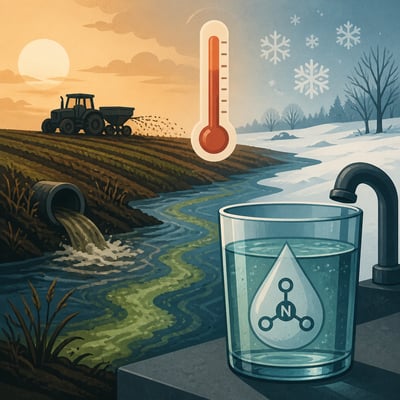
Climate change is making agricultural nitrate pollution harder to manage by increasing runoff during warm winters, drought-related leaching, and the movement of legacy nitrate into groundwater.
In the United States, elevated nitrate levels affected public water systems serving about 18 percent of the population from 2021 to 2023, while Iowa communities face recurring treatment costs during pollution events. Global modeling indicates that climate change could accelerate nitrate arrival in groundwater, particularly across cold and temperate regions and identified hotspots including the North China Plain, South Asia, and Western Europe.
The story now adds a more concrete local-cost example and broadens the climate-model finding to most climate zones, while keeping the core narrative intact. It also slightly shifts from general contamination risk to specific management and regulatory tensions.
The story is sharper and more specific: it now quantifies the U.S. nitrate problem and adds concrete cost and winter-runoff impacts, while elevating the policy fight over conservation and treatment. The climate-risk framing also broadens from general groundwater contamination to faster legacy nitrate movement and winter pulse events.
- EWG found elevated nitrate in 6,114 U.S. public water systems.
- Those systems serve about 18% of the U.S. population.
- Des Moines spends about $16,000 per day on special filtration.
- Warming winters can intensify winter nitrate pulses in Iowa watersheds.
- Conservation funding and water-quality rules are now explicitly contested.
The story now has a clearer U.S. public-water-systems angle, with new review findings showing nitrate exposure is already widespread and tied to agriculture, while climate change is worsening both groundwater and surface-water contamination pathways. It also adds policy relevance by linking nitrate reduction efforts to conservation funding, not just climate-driven hydrology.
- U.S. public water systems show widespread nitrate exposure.
- Environmental Working Group produced a U.S. review of nitrate levels.
- Drought can concentrate nitrate while rainfall can flush it into waterways.
- Legacy nitrate in soils and the vadose zone may reach groundwater sooner.
- Reduced conservation funding could weaken nitrate runoff controls.
The story has broadened from a general winter runoff and drought contamination problem into a more clearly climate-driven nitrate transport mechanism, backed by modeling and framed around recurring hotspot regions. Iowa/Des Moines remain the operational example, but the current version gives the issue a more explicit scientific and geographic scope.
The story broadens from winter-driven nitrate pollution to a more climate-linked water-quality problem that now explicitly includes drought. It also shifts from mainly describing runoff impacts to emphasizing governance conflict and litigation over nutrient controls.
Warming winters are worsening nitrate pollution in drinking water, especially in agricultural states where runoff reaches rivers and groundwater more often. The strongest signal is operational and recurring: higher treatment costs, health exposure, and policy disputes over how to reduce farm-related nutrient pollution.