
 AI Governance
 Data Centers
 Drones
 Climate
 Privacy
 2026 Maine Senate
 Bob Dylan
China’s Electric Shift Cuts Oil Demand
Coverage from Carbon Brief, Rocketnews, and others
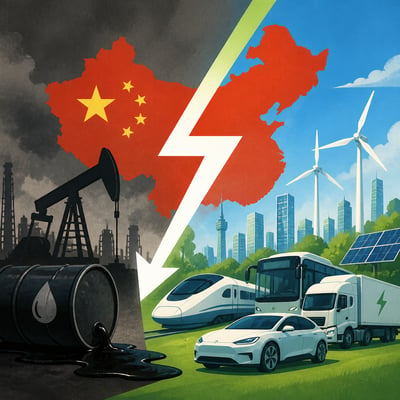
China’s carbon dioxide emissions fell about 1% in the second quarter of 2026 as electric cars, buses, trains and trucks displaced oil use, with transport consumption down 16%.
Oil imports and total oil consumption also declined, although strategic reserve drawdowns and disruptions to Gulf supplies influenced the import figures. The shift is improving China’s exposure to oil-market shocks, but rising coal generation and renewable-energy curtailment show that electrification has not yet produced a uniformly cleaner power system.
If you read one thing
It provides the clearest, best-supported overview of the oil-led emissions decline alongside coal expansion and grid constraints.
Latest development
It captures the latest development that rapid electric-vehicle adoption may be pushing China past peak oil demand.
Transport electrification is displacing oil demand
Electric cars, buses, trains and especially heavy trucks are reducing China’s transport oil use despite continued transport activity. The shift is also reducing exposure to oil-market and supply disruptions, although the reported import decline was partly affected by strategic-reserve drawdowns and Gulf supply conditions.
Emissions are falling through an oil-led shift
China’s CO2 emissions fell about 1% year on year in Q2 2026, driven primarily by a 9% decline in overall oil use and a 16% decline in transport oil use. The reduction is meaningful but uneven because coal consumption and power-sector emissions continued to rise.
Coal expansion and grid constraints limit cleaner power gains
Coal generation and capacity expanded even as wind, solar, hydropower and nuclear output grew. Renewable curtailment, inflexible power-market rules, inadequate transmission and storage, and potentially higher curtailment limits are preventing electrification from translating into uniformly larger emissions reductions.
2.4%
increase in coal use
“Power-sector emissions increased as coal use rose 2.4% and gas-fired generation fell 1.2%. This occurred despite strong growth in wind and solar capacity, a 9% increase in hydropower generation, a 2% increase in nuclear output and slower electricity-demand growth.”
2%
increase in nuclear output
“Power-sector emissions increased as coal use rose 2.4% and gas-fired generation fell 1.2%. This occurred despite strong growth in wind and solar capacity, a 9% increase in hydropower generation, a 2% increase in nuclear output and slower electricity-demand growth.”
9%
increase in hydropower generation
“Power-sector emissions increased as coal use rose 2.4% and gas-fired generation fell 1.2%. This occurred despite strong growth in wind and solar capacity, a 9% increase in hydropower generation, a 2% increase in nuclear output and slower electricity-demand growth.”
77%
year-on-year growth in electric heavy-truck sales
“Electrification was therefore a major factor in reducing oil demand. Electric heavy-truck sales rose about 77% year on year in the second quarter, while electric trucks exceeded 45% of new sales. The number of EVs on the road increased 33%, and charging volumes rose 60%, indicating that existing EVs were being used more intensively.”
16%
decline in transport oil consumption
“China’s carbon dioxide emissions fell by 1% year on year in the second quarter of 2026, despite a continued rebound in coal-fired power generation. Oil consumption fell by 9% overall and by 16% in transport after supply disruptions linked to the Strait of Hormuz crisis.”
China’s EV-driven oil decline reaches globally consequential scale
New analysis puts China’s avoided oil use at roughly 1.5 million barrels per day in the second quarter, a scale that could materially affect global oil prices, production decisions, and drilling investment as electric vehicles—especially heavy trucks—displace petroleum demand.
Previously
China’s carbon dioxide emissions fell about 1% year on year in the second quarter of 2026 as oil consumption and transport fuel use dropped sharply amid expanding electric cars, buses, trains, and trucks. The decline was partly reinforced by oil-market disruptions, while coal generation increased and grid constraints led to wind and solar curtailment. The results point to a changing energy mix in which electrification is reducing oil demand, but the durability of wider emissions cuts depends on coal controls, grid reforms, and better use of renewable power.
The main update qualifies the oil-import decline: strategic-reserve drawdowns and Gulf supply disruptions influenced the figures. The story is also framed more strongly around electrification reducing oil-shock exposure and potentially hastening a broader fossil-fuel demand peak.