
 AI Governance
 Data Centers
 Drones
 Climate
 Privacy
 2026 Maine Senate
 Bob Dylan
Asia's Uneven Shift From Coal
Coverage from Story china building coal plants despite solar wind boom 129805102, The Crucial Years, and others
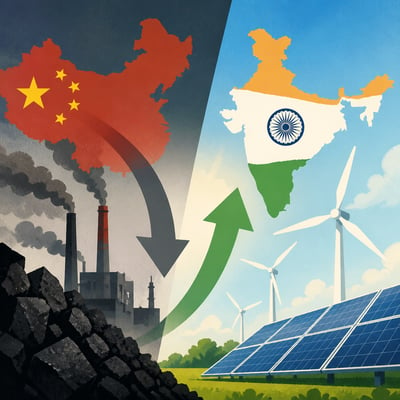
Asia's energy transition is advancing unevenly.
China and India recorded declines in coal-fired generation as rapid solar, wind, hydropower and electric-vehicle growth began meeting rising demand, while Southeast Asia is expected to remain a major source of energy-demand growth with coal, gas and oil still supplying much of the increase. The central tension is whether renewables, electrification, grids and regional cooperation can expand quickly enough to improve energy security without prolonging fossil-fuel dependence or increasing exposure to climate and supply disruptions.
The update sharpens the Asia energy-transition story with a more specific and more security-focused outlook: Southeast Asia is now framed as a large, quantifiable source of future demand growth that fossil fuels will still dominate, while regional cooperation and system flexibility are presented as part of the response. It also strengthens the China-India coal decline as a confirmed milestone rather than just a trend.
The story broadens from a China–Southeast Asia coal-and-grid tension into a wider Asia-wide transition, with India now showing the same coal-decline pattern as China. The framing also shifts toward cleaner power, storage, efficiency, and fuel-supply disruption as the key determinants of whether the transition can hold.
- India recorded a decline in coal-fired generation.
- Solar, wind, hydropower and EV growth are now explicitly linked to lower coal emissions.
- Middle Eastern supply-route disruptions are raising regional energy costs.
- Indonesia and Vietnam are identified as pivotal to Southeast Asia’s coal outlook.
- Climate hazards now include floods and extreme heat risks to power infrastructure.
The story broadens from a China-and-India clean-power versus coal tension into a wider regional frame centered on Southeast Asia’s rising electricity demand, import exposure, and grid constraints. The current version also sharpens the warning that coal remains structurally embedded as backup and security insurance even as renewables accelerate.
- Southeast Asia is now a central focus alongside China.
- IEA forecasts strong electricity demand growth in Southeast Asia.
- Imported-fuel dependence is highlighted as a regional vulnerability.
- Grid, storage, transmission, and flood risks are emphasized as limits.
- China’s emissions may be flattening or falling in some periods.
The framing has shifted from a broad Asia-wide transition story to a more China-centered reliability narrative. The new version emphasizes that coal is not just declining or expanding in parallel with renewables, but functioning as a deliberate backup buffer against grid-balancing and security risks.
Recent reporting tracks a mixed power-sector transition in Asia: coal generation is falling in China and India as solar and wind surge, while coal capacity is still expanding in China and Southeast Asia for energy security and grid stability.