
 AI Governance
 Data Centers
 Drones
 Climate
 Privacy
 Bob Dylan

Ecosystem Carbon-Cycle Feedbacks
Coverage from MIT Technology Review, Winzheng, and others
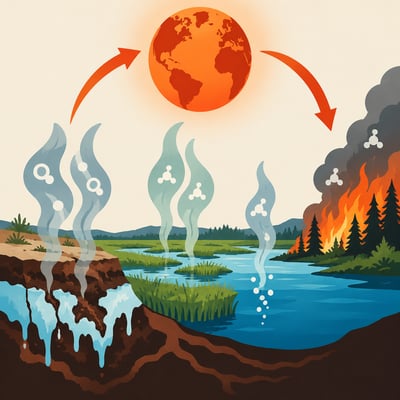
As temperatures rise, thawing permafrost can expose stored carbon, while wetlands and inland waters can release more methane and wildfires can emit carbon from ecosystems.
Together, these processes create reinforcing feedbacks: warming prompts emissions that can contribute to further warming. A study published in Environmental Research Letters estimated that these sources could add 0.2–0.4°C of warming by 2100, with permafrost accounting for about half of the estimated emissions. The research also highlights how omitting or underrepresenting such feedbacks in climate models can affect warming projections, remaining carbon budgets, and assessments of the emissions cuts needed to limit warming.
If you read one thing
It gives the broadest research-based overview of the feedbacks, their projected warming, and their implications for models and carbon budgets.
Latest development
It reports the new effort to test these feedbacks across climate models, materially advancing the story beyond the original warming estimate.
The local angle
Its Canadian reporting grounds the broader feedback in specific permafrost, wildfire, and wetland mechanisms while connecting them to climate-model and carbon-budget risks.
Ecosystem feedbacks could add substantial warming
Emissions from thawing permafrost, wildfires, wetlands and inland waters are estimated to add about 0.2–0.4°C by 2100, or roughly 20–30% more warming this century. Estimates vary by emissions scenario, and one study attributes about half of the anticipated warming-induced emissions to permafrost thaw.
Model omissions may understate warming and carbon-budget pressure
Many models used for major climate projections omit some or all warming-driven ecosystem emissions. The reported gap could cause projections to understate future warming and remaining carbon budgets to appear more permissive than they are.
2.6°C
warming above preindustrial levels expected through 2100
“A study in Environmental Research Letters in September, synthesizing the results of previous papers, found that the additional carbon dioxide and methane released from thawing permafrost, intensifying wildfires, hotter lakes and reservoirs, and wetter, warmer wetlands alone could drive global average temperatures up 0.2 °C to 0.4 °C this century. That would come on top of the 2.6°C of warming above preindustrial levels that modelers are already expecting through 2100.”
40% or more percent
reduction in methane production in laboratory and test locations
“EDF is funding experiments that add minerals to wetlands to reduce methane production to natural levels; laboratory and test locations have shown reductions of 40% or more.”
20 to 30 per cent percent
additional warming this century
“A new study finds that climate feedback loops—including wildfires, permafrost thaw and emissions from wetlands—could add 20 to 30 per cent more warming this century than current estimates account for.”
20–30% percent
amplification of global warming
“Scientists published research estimating that warming-induced greenhouse gas emissions from natural systems could amplify global warming by approximately 20–30% and add 0.2–0.4°C of warming this century on top of anthropogenic warming under different scenarios.”
25% percent
maximum shortening of time before warming thresholds are consistently breached
“A separate analysis published in One Earth in March, which examined what the feedback problem means for our international climate goals, concluded that the world may be much further off track than is widely believed. It found that just three regional sources of warming-driven emissions—thawing permafrost, increasing fires in boreal forests, and warming tropical wetlands—may shorten by as much as 25% the time before the planet consistently breaches the 1.5 °C and 2 °C warming thresholds.”
An international modeling effort targets omitted climate feedbacks
More than 20 international teams are now comparing how climate models represent warming-driven ecosystem emissions, with researchers hoping the results will inform the UN’s 2029 climate assessment. This is a concrete effort to address the modeling gap; the newly reported warming estimates largely reinforce the existing assessment.
Previously
A study estimates that emissions released as the planet warms—including from permafrost, wildfires, wetlands and freshwater systems—could add 20–30% to this century’s warming. The projected addition ranges from about 0.2°C under a lower-emissions scenario to 0.4°C under a higher-emissions scenario, highlighting a potential gap in climate projections and carbon-budget estimates; sparse measurements in high-latitude regions add uncertainty.
The story now adds a response-focused dimension: emissions cuts can limit feedback-driven warming, while proposed monitoring and targeted wetland or peatland interventions carry ecological tradeoffs.