
 AI Governance
 Data Centers
 Drones
 Climate
 Privacy
 2026 Maine Senate
 Bob Dylan
Brazil's Rare-Earth Push Meets Amazon Risks
Coverage from Repórter Brasil, WTOP, and others
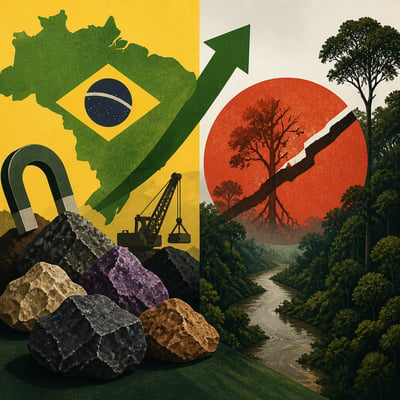
Brazil's Senate has advanced legislation creating a framework for critical and strategic minerals, including a 2 billion-real guarantee fund, 5 billion reais in tax credits for domestic processing, and a council to designate priority projects.
The measure is intended to attract investment, develop Brazil's rare-earth sector, and reduce reliance on China-centered supply chains. Environmental groups warn that expanded extraction, including near Amazon territories, could threaten ecosystems and communities if safeguards remain insufficient.
If you read one thing
It provides the clearest overview of Brazil’s new critical-minerals framework, its financial incentives, and the unresolved safeguard debate.
Latest development
It materially broadens the story with updated evidence on Indigenous territories, governance gaps, and environmental risks linked to implementation.
State-backed push for domestic processing
Brazil has moved from legislative approval toward an enacted critical-minerals policy combining a 2 billion-real guarantee fund, 5 billion reais in five-year tax credits, and a council to prioritize projects. The framework is designed to shift the sector beyond raw extraction toward domestic processing and industrial capacity.
China diversification is attracting foreign capital
Brazil is positioning its rare-earth sector as an alternative to China-dominated supply chains while seeking to capture more value domestically. That strategy is linked to major U.S. investment, including the reported approximately 2.8 billion dollar agreement for Serra Verde’s Goiás mine and processing plant.
Environmental and community safeguards remain contested
The policy’s extraction and industrial objectives remain in tension with unresolved environmental and social protections. Reporting identifies proposed licensing flexibility, exploration applications around hundreds of Indigenous lands, limited civil-society representation, and concerns that mining near Amazon reserves could proceed without adequate safeguards.
2 billion reais
federal contribution to the Mineral Activity Guarantee Fund
“The legislation establishes the Mineral Activity Guarantee Fund, backed by a federal contribution of 2 billion reais, or about $391 million, to guarantee projects and activities related to critical and strategic minerals. It also creates a program to encourage processing and transformation in Brazil, including 5 billion reais, or $978 million, in federal tax credits over five years.”
5 billion reais
federal tax credits
“The legislation establishes the Mineral Activity Guarantee Fund, backed by a federal contribution of 2 billion reais, or about $391 million, to guarantee projects and activities related to critical and strategic minerals. It also creates a program to encourage processing and transformation in Brazil, including 5 billion reais, or $978 million, in federal tax credits over five years.”
approximately $2.8 billion dollars
agreed purchase price for Serra Verde
“In April, USA Rare Earth said it had agreed to pay approximately $2.8 billion for Serra Verde, owner of the Pela Ema rare-earth mine and processing plant in Brazil's Goiás state.”
5 billion reais
federal incentives for mineral processing and transformation
“It also creates a program to encourage mineral processing and transformation in Brazil, with federal incentives totaling 5 billion reais, or $978 million, in tax credits over five years.”
hundreds Indigenous lands
Indigenous lands around which applications for critical-mineral exploration have been identified
“Repórter Brasil’s Energy Transition Observatory cross-references mining, renewable energy and infrastructure data with Indigenous lands, quilombola territories, protected areas and settlements. Its findings show that the energy transition is not occurring in an empty territory. Applications for critical-mineral exploration have been identified around hundreds of Indigenous lands.”
Contested Issue
Should Brazil accelerate critical-mineral mining and domestic processing under the new framework despite unresolved environmental and community-protection concerns?
The evidence presents a policy conflict between using public guarantees, tax incentives, and strategic investment to expand mining and domestic processing, and conditioning or limiting that expansion until stronger climate, environmental, and affected-community safeguards are in place. The disagreement is reinforced by concerns about regulatory flexibility and possible exploration near protected or Indigenous territories.
Industrial expansion
Brazil should use state-backed financing, processing incentives, and strategic investment to expand critical-mineral production, attract capital, and diversify supply chains away from China.
Safeguard-first expansion
Brazil should not accelerate critical-mineral mining under the framework without stronger climate, environmental, and affected-community protections, especially where projects may approach Amazon reserves or other protected territories.
Mining expansion now carries documented territorial and licensing risks
New evidence broadens the issue from general environmental warnings to concrete implementation risks: critical-mineral exploration applications surround hundreds of Indigenous lands, proposed licensing exemptions could weaken oversight, and the policy excludes civil society from permanent voting representation on its governing council.
Previously
Brazil's Senate has advanced legislation creating a framework for critical and strategic minerals, including a 2 billion-real guarantee fund, 5 billion reais in tax credits for domestic processing, and a council to designate priority projects. The measure is intended to attract investment, develop Brazil's rare-earth sector, and reduce reliance on China-centered supply chains. Environmental groups warn that expanded extraction, including near Amazon territories, could threaten ecosystems and communities if safeguards remain insufficient.