
 AI Governance
 Data Centers
 Drones
 Climate
 Privacy
 2026 Maine Senate
 Bob Dylan
Bangladesh Expands Solar Support
Coverage from BSS, The Climate Watch, and others
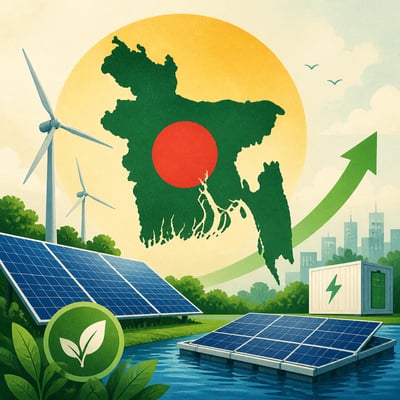
Bangladesh is placing solar power at the center of a renewable-energy expansion, combining targets for 20% renewable electricity by 2030 and 30% by 2040 with proposed tax relief, rooftop-solar incentives, private-sector participation and a 10,000 MW solar goal by 2030.
The strategy is intended to reduce exposure to imported LNG, coal and oil, but delivery depends on faster approvals, grid upgrades, storage, financing and stable policy. Wind power remains comparatively stalled, showing the gap between Bangladesh’s renewable ambitions and the conditions required to turn project pipelines into operating capacity.
The story now more explicitly ties Bangladesh’s renewable push to energy-security concerns, especially reducing reliance on imported LNG, coal and oil. It also adds clearer implementation constraints—faster approvals, storage, and procurement reform—while continuing to show wind as stalled.
Bangladesh’s renewable story has shifted from a general buildout to a more specific, policy-backed solar push anchored in the Renewable Energy Policy 2025 and a 10,000 MW target. The update also adds clearer evidence that implementation bottlenecks are worsening for wind and grid readiness, while EV incentives broaden the clean-energy agenda.
- Renewable Energy Policy 2025 sets 20% renewables by 2030 and 30% by 2040.
- Proposed zero tariffs on solar equipment would run through 2035.
- Bangladesh is targeting 10,000 MW of solar capacity by 2030.
- Wind projects are delayed by approvals, financing, transmission gaps, and coastal risks.
- EV tariff and charging-station incentives were added.
The story has shifted from a general renewable-policy push to a more concrete implementation phase, with new budget incentives and import-duty relief aimed at speeding solar deployment. The updated version also sharpens the gap between ambition and execution by emphasizing that installed capacity is still far below targets and that grid and financing constraints remain binding.
The story now centers more narrowly on implementation: Bangladesh is pairing its renewable push with grid modernization and explicit fossil-fuel backup to manage reliability during the transition. The framing also tightens around solar as the main growth engine, with policy incentives and supply-chain support becoming more prominent than the earlier broad renewable mix.
Bangladesh is advancing Renewable Energy Policy 2025 with targets to supply 20% of electricity demand from renewables by 2030 and 30% by 2040, alongside a long-term 10,000 MW capacity goal. The policy broadens the mix beyond small-scale solar toward utility-scale solar, rooftop and floating solar, wind, storage, and stronger private investment. Public debate centers on whether fiscal incentives, financing tools, and institutional capacity are sufficient to turn the targets into deliverable projects.