
 AI Governance
 Data Centers
 Drones
 Climate
 Privacy
 2026 Maine Senate
 Bob Dylan
Australia’s Solar-Battery Shift Accelerates
Coverage from PV Tech, pv magazine Australia, and others
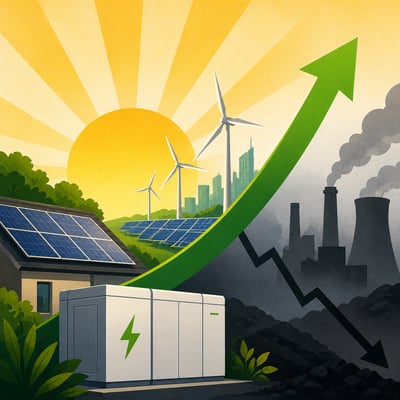
Australia is adding solar generation and battery storage at record levels, with renewable sources supplying 42% to 46.
5% of National Electricity Market generation in the reported 2026 quarters. Large-scale batteries are discharging more often and setting prices in a growing share of trading intervals, while household installations are expanding with federal support. The shift is increasing the role of renewables in the power mix and coincides with lower coal and gas output and a lower average wholesale spot price, although the figures cover different periods and market segments.
If you read one thing
It provides the broadest evidence-backed overview of Australia’s accelerating solar and battery deployment across the Topic’s main dimensions.
Latest development
It materially updates the picture with Q2 records while showing that mid-scale renewables and wind investment still lag.
Best explainer
It explains how rapid solar uptake drives battery charging, evening discharge, lower wholesale prices, and greater renewable penetration.
Renewables and solar deployment are accelerating
Renewables supplied 42% of National Electricity Market generation in the reported quarter, up from 37% a year earlier, while rooftop solar exceeded 1 GW and utility-scale solar reaching final investment decision reached 1.8 GW. Growth is concentrated in solar: mid-scale approvals remain below historical averages and no wind projects reached final investment decision in the June quarter.
Batteries are becoming active grid-market assets
Battery deployment is expanding across household and utility-scale segments, with batteries increasingly shifting solar output into evening supply and participating in National Electricity Market price formation. The supplied evidence supports a larger operational role, but does not establish a new rate of change relative to the prior snapshot.
Policy support is driving distributed battery expansion
Household storage reached record scale, with more than 111,000 batteries approved and 3.6 GWh installed during the quarter, supported by federal incentives and falling costs. Demand remained strong after incentive changes, but revised settings shifted installations toward smaller systems and pulled substantial activity forward.
111,000 installations
battery installations approved
“More than 111,000 battery installations, representing 3.6GWh of storage capacity, were approved under the Cheaper Home Batteries Program during the quarter.”
2.8GWh
battery storage capacity approved in April
“Installation activity was concentrated ahead of the changes: 78,000 systems representing 2.8GWh were approved in April, and average battery size reached 36kWh. After the changes, installation rates moderated and average system size fell to about 23kWh in May and June, although underlying demand remained strong.”
1.8GW
large-scale solar generation capacity reaching final investment decision
“The CER said 1GW of rooftop solar was installed in the June quarter, exceeding the previous quarterly record of 942MW set in Q4 2023. Large-scale solar investment also reached a new high, with 1.8GW of generation capacity reaching final investment decision. No wind projects were approved or reached FID during the quarter.”
1GW
rooftop solar installed
“The CER said 1GW of rooftop solar was installed in the June quarter, exceeding the previous quarterly record of 942MW set in Q4 2023. Large-scale solar investment also reached a new high, with 1.8GW of generation capacity reaching final investment decision. No wind projects were approved or reached FID during the quarter.”
100kW and 1MW
capacity range of mid-scale renewable projects
“However, approvals for mid-scale renewable projects between 100kW and 1MW remained below historical averages in the first half of 2026.”
Household battery growth proves partly front-loaded by incentive changes
Record household battery approvals in Q2 2026 were partly pulled forward ahead of program changes: installations and average system sizes moderated afterward, although underlying demand remained strong.
Previously
Australia is adding solar generation and battery storage at record levels, with renewable sources supplying 42% to 46.5% of National Electricity Market generation in the reported 2026 quarters. Large-scale batteries are discharging more often and setting prices in a growing share of trading intervals, while household installations are expanding with federal support. The shift is increasing the role of renewables in the power mix and coincides with lower coal and gas output and a lower average wholesale spot price, although the figures cover different periods and market segments.