
 AI Governance
 Data Centers
 Drones
 Climate
 Privacy
 2026 Maine Senate
 Bob Dylan
Last Update: 09/22/2026 at 11:33 PM EST
Agrivoltaics Trade Cooling for Crop Light
Coverage from Eos, AutoNotion, and others
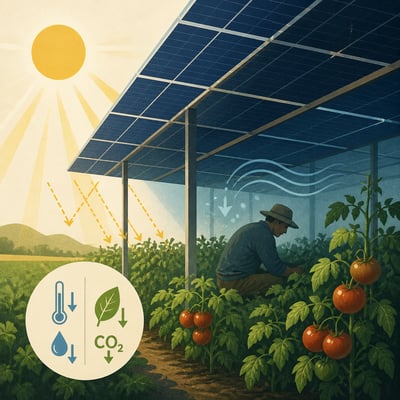
Agrivoltaic systems can cool crops and farmworkers while reducing evapotranspiration, but the shade that provides those benefits also reduces sunlight and carbon uptake.
A Princeton tomato simulation found lower leaf and perceived worker temperatures alongside 22.4% lower evapotranspiration, while carbon uptake fell under substantially reduced light. Field studies in Italy are extending the research to fruit and aromatic crops, but full-season yield data are still limited and shade tolerance appears crop-specific.
Looking Back
15 Day Timeline
Aug 19
Aug 21
Aug 24
Aug 26
Aug 28
Aug 31
Sep 2
All Articles3 articles
Important
Hosseini et al. modeled a Princeton, New Jersey, tomato farm and found agrivoltaic panels reduced crop heat, water loss, and worker heat exposure.
8/19/2026 • Clean Energy & Emissions • General
Giuseppe Ferrara's Italian research group and Princeton researchers are evaluating agrivoltaic systems in Italy and New Jersey, finding reduced heat and water stress alongside potential crop and efficiency tradeoffs.
9/2/2026 • Clean Energy & Emissions • General
Interesting
Researchers modeled agrivoltaic tomato production in Princeton, New Jersey, finding solar panels reduced crop heat, water loss, and worker temperatures while sustaining carbon uptake.
8/31/2026 • Clean Energy & Emissions • General