
 AI Governance
 Data Centers
 Drones
 Climate
 Privacy
 2026 Maine Senate
 Bob Dylan
EV Batteries Expand Grid Storage
Coverage from WebProNews, Energies Media, and others
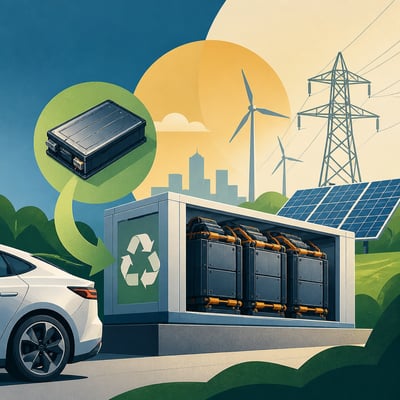
Electric-vehicle batteries are becoming more closely integrated with electricity storage through several routes: sodium-ion cells are entering early EV and stationary applications, retired lithium-ion packs are being reused, and bidirectional charging could allow parked vehicles to support homes and power grids.
Stationary storage is also becoming a more important source of battery demand as utilities, data centers and renewable-energy systems require flexible capacity. The direction is promising but remains dependent on cost, safety certification, charging standards, battery performance and reliable end-of-life management.
The story now places much more weight on bidirectional charging and the broader role of stationary storage, not just repurposed batteries and sodium-ion demos. It also adds more concrete commercial and technical framing, including ISO 15118 timing, usable battery-pool estimates, and the weakening economics of second-life reuse.
The story has broadened materially beyond second-life EV batteries to include sodium-ion batteries as a parallel storage and EV pathway. It also adds new commercialization, standardization, and supply-chain dimensions, making the market look larger and more multi-technology than before.