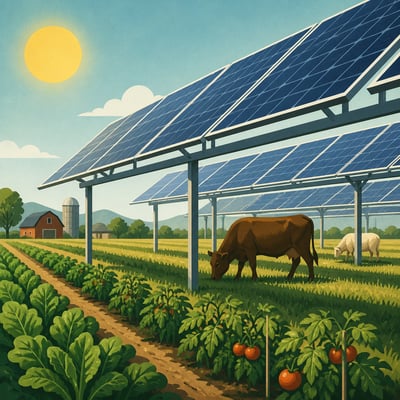
Farming Under Solar PanelsFarming Under Solar PanelsCoverage from Civil Eats, Solar Now, and others
00/00/0000
DailyWeekly
Agrivoltaics combines elevated or specially configured solar arrays with farming, grazing, or related land-management activities.
Research and pilot projects report potential benefits including reduced soil moisture loss, lower heat exposure, supplementary farm income, and continued agricultural production, but results vary by crop, panel design, climate, and operating practices. The approach is also being considered as a way to reduce farmland opposition to solar development, while higher construction costs, permitting disputes, and uncertain long-term farm performance remain significant constraints.
Looking Back
236 Day Timeline
Articles published over time. Hover any bar for the period and its article count.
Jan 24
Mar 7
Apr 11
May 23
Jun 27
Aug 8
Sep 12
History
09/03/2026
The story now extends beyond agricultural production into desert ecosystem restoration and worker/equipment heat exposure, while legislative and permitting considerations become more prominent. New named research and policy actors also broaden the stakeholder landscape.
07/23/2026
The story has broadened from general agrivoltaics experimentation into a more specific, current picture of early commercial deployment and active U.S. research sites. The main emphasis also shifts toward clearer limits: stronger evidence for grazing and specialty crops, but continued uncertainty for large mechanized row-crop systems.
US solar developers are being urged to manage agricultural soils, vegetation, and grazing systems beneath utility-scale photovoltaic arrays across rural America.
In Virginia, legislators in 2025–2026 propose multiple bills to guide agrivoltaic and utility-scale solar siting as counties continue rejecting many projects.
1/31/2026 • Policy, Politics & Governance • General
Farmers and solar developers are expanding agrivoltaic projects in 2025 across U.S. agricultural regions, while USDA funding restrictions and local opposition complicate renewable-energy siting.
Arizona State University researchers report crustivoltaics field results showing increased desert biocrust biomass and cover beneath solar photovoltaic panels.
Our Table Cooperative in south of Portland, Oregon, installs the Lettuce Shine agrivoltaics system to manage crop shade and generate power amid regional warming.
Citicore Renewable Energy Corporation deploys agrivoltaics at nearly 200 MW in Batangas, Philippines, guided by Tarlac trials testing turmeric under solar PV.
Agrivoltaics project designs are evaluated by crop-specific farm performance, cost, and repeat adoption, with grazing under standard PV identified as most scalable.
SALSA continues agrivoltaics research in Arizona after foundation funding replaces USDA and DOE support, linking farmworker heat protection with solar generation.
University of Arizona researchers studying agrivoltaics in Casa Grande, Arizona report shaded solar arrays can lower skin temperatures and water use for crops.
Studies across Italy, Canada, and Brazil assess agrivoltaics productivity, while China and the US expand solar grazing and mapped site inventories in 2024.
Doral and Kibbutz Ma'ale Gilboa harvested 30 tons of grapes under solar panels on Mount Gilboa, Israel, demonstrating agrivoltaics for heat-stressed farming.
Virginia Senate Bill 340 defines agrivoltaics as solar panels enable concurrent farming and drought-related water savings while renewable capacity expands for data center demand.
Agrivoltaics deployment in the United States combines solar PV generation and crop production to improve land use efficiency while providing farm energy and potential yield support.
6/27/2026 • Clean Energy & Emissions • General
University of Wisconsin-Madison Division of Extension53
U.S. solar farms adopting agrivoltaics and irrigation shading in California, Colorado, Minnesota, Arizona, and Texas aim to improve crop conditions and biodiversity outcomes alongside electricity generation.
Byron Kominek's Jack's Solar Garden in Longmont, Colorado, combines crop production and solar electricity generation to improve farm income and resilience under hotter, drier conditions.
Byron Kominek launched Jack's Solar Garden near Longmont, Colorado, in 2016 to combine solar generation with agrovoltaic crops amid hotter, drier growing seasons.
University of Wisconsin-Madison began 2025 agrivoltaics research at Kegonsa to test solar panel spacing effects on crops, grazing, and land-atmosphere measurements in Wisconsin.
Michigan State University Extension hosts a webinar series on agrivoltaics to share research and best practices for farming within solar arrays in Michigan.
University of Bonn researchers surveyed nearly 2,000 adults in Germany and found higher willingness to pay for agrivoltaic solar than for conventional open-land solar parks.
Researchers mapped 25 years of California land use and solar footprints to compare full conversion with partial solar-crop colocation and evaluate financial and water effects.
In central Illinois, Pivot Energy agrivoltaics sites use sheep grazing to manage solar vegetation while landowners seek income diversification and rural acceptance.
Bryant Parker and Jessica Parker in Dunlap, Illinois deploy sheep grazing under a 7.1-megawatt solar farm to support agrivoltaics as Illinois expands community solar.
Agrivoltaics advocates farm-first design and measurable dual-use standards to ensure solar pv co-location preserves agricultural value in China, the United States, Europe, and Japan.
University of Seville and Polytechnic University of Madrid researchers tested agrivoltaic photovoltaic shading with regulated deficit irrigation for tomatoes in Madrid and Seville in spring 2024.
Solar PV paired with farm production is expanding internationally, with U.S. policy changes in Illinois and Virginia and trials in France and studies in Italy and Brazil.
DataM Intelligence published an agrivoltaics market report in 2026, forecasting growth through 2032 while citing U.S.-led pilots and AI-enabled PV-crop optimization across Europe and Asia.

 AI Governance
 Data Centers
 Drones
 Climate
 Privacy
 2026 Maine Senate
 Bob Dylan